
Banner
    Genealogy: Afro-Amerindians, Slavery and the vagaries of "free persons of color".
    By Hontas Farmer | September 26th 2009 03:17 PM | 24 comments | Print | E-mail | Track Comments
    Genealogy is the study of ones family history and background.  I have been doing such a study in my spare time.  What I found was in a word shocking, affirming, and surprising.  I knew from oral history passed down by my elders including a 98 year old Aunt, now passed away, that our family originated in colonial Virginia.  What I did not know was much about what happened between our earliest African ancestors arriving, and my great great grandfather. 

    What I knew was told to me in the form of a oral history.  
    The oral history of the Farmer family as passed down to me in brief.  Our first black ancestor to arrive in America came in about 1619 or 1620, we don't know which for sure.  He was one of the first Africans to come to America.  He was not yet a slave, slavery came latter.  His name was John Richard Hewing because he was an wood worker, a hewer of wood.  My uncle is named after him.  There weren't many women available among the whites and the blacks.  So he took a native american woman as a wife.  With her he had 7 children and so was born the farmer family.    We lived in Virginia, and then Missouri as free farmers, were enslaved for a time, then escaped from slavery in missouri in 1820 or 1830.  As I was told it we were not sure when.  

    That's a nice narrative here are the facts I found out.
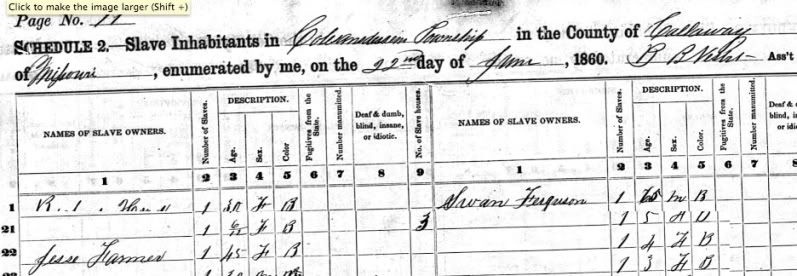


    As I traced my family line back I found incontrovertible evidence that my family once owned slaves.  (The picture above has been altered so that you can see the line my direct ancestor is on, along with the meanings of each column, and the information needed to check if you really wanted to.)

    I don't mean ol massa came into the slave quarters because he was lonely.  I mean they were as written on census records "black", "Mulatto" ( and sometimes the exact same person is recorded as white) triracial "colored" people who owned slaves. That is the case with Jesse Farmer and with others in my family tree as well.  While the records of what race they were considered is ambiguous, which could be a sign of significant Native American admixture, the above is not. Jesse Farmers son and father are reported as black or Mulatto, the census records establish the lineage clearly.  This "black" man my great-great-great grandfather owned other black people in the immoral bonds of slavery. 

     The area of Missouri they lived in was known as "little dixie" , where tobacco was king.  The people from there were migrants from the upper south, Virginia, Kentucky and Tennessee along with nothern North Carolina.  Specifically the Farmers lived for a few generations around Cote Sans Dessein, Callaway county Missouri, and in Chariton Missouri.  In about 1850 my family moved from Missouri to points father west.  In particular to, Council Bluffs, Potawatomi county, Iowa, which at that time likely still had a significant  Potawatomi population. As the history of the prairie band of the  Potawatomi shows their situation was not cut and dried simple either.  My grandfather, after whom I am named was named there in Council Bluffs by his grand mother, in the old matriarchal traditions of the natives, her name was Minerva Fields. She gave him the name Hontas Farmer... no one is really 100% sure what it means, other than a clue on our early ancestry.  Minerva would in her old age move in with relatives in Newport News Virginia  where she died. 

    For earlier generations their are records of owning hundreds of Acres of land in various parts of Virginia, at the same time.  Even straddling two counties. Good tobacco planting land, while no clear records exist of them having slaves, it is likely. 

    From this much research I was abel to tell that my family was very mixed both genetically and culturally on both sides of my family.  

    Working further back 

    I followed a trail of family trees on this, well known and respected website for researching genealogy, which I will not name.  Many family trees  had side branches which overlapped with mine, and at least every other generation had clear official archived records which reinforced those links.  I followed this trail until I reached the great great great grandfather of Jesse Farmer, Thomas Farmer the third and a wife simply named Ann... born 1660  


    This is a point where things become pretty sketchy.  Before I tell you about Ann let's return to the oral history.  

    My first African ancestor,  according to that story came here in 1620 or 1619 and was named John Richard Hewing.  I had already read of the ship carrying the "20 and some odd negars"  (verbatim as John Rolfe wrote it  )to arrive in the new world when I began my research.  To realize the significance say that last quoted word with a southern accent, like the way Jeff Foxworthy or Robert "Sheets" Byrd would say it.  I'm 100% positive Rolfe just had trouble with Spanish or Portugese and for all we know how did the 20 and odd pronounce Negro?   Either way I suppose having ancestors who were among the first to have that word used towards them sorta makes up for their descendants behavior. Recent scholar ship has uncovered where in the world those first 20 came from one of the African neighbors of the Portuguese colony of Angola.  They were likely Christian, knew Portugese and their native language, and had valueable skills amongst them, notably the knowledge of rice agriculture, which is still practiced in Virginia and the east coast.  Those first black people were not slaves but indentured servants, many of whom would eventually earn or escape to freedom one of those according to the oral history was John Richard Hewing. 

    What about Ann?  
    On a hunch for mysterious Ann I inserted the last name Hewing.  Then I hit search for records.  What I found was a interesting and very similar family history for a family named Hughes.  They trace part of their lineage back to a John "Trader" Rice/Reese Hughes.   He only appears on record in 1620 and after. They are not all in agreement about the John, nor about the middle name.  These stories are passed among families which, at least appear  caucasian.  They think he came from either Wales or Scotland.  No hard records, even of his arrival at Jamestown, (keep in mind this is from before the Pilgrims even landed.  Every ancestor I have from Great Britain has a record of their arrival in Virginia.  Not Hughes.)   The timing, and the lack of records were big clues.  A key piece of circumstantial evidence was that Hughes was married to one Nicketti, the sister of Cockacoeske and had a daughter named Elizabeth Hughes born 1650 with her.  Cockacoeske was the Aunt of the last weroansqua of the Pamunkey Indians,  known as "Queen Ann" Who lived from 1660 to about 1720.  Cockacoeske's being Ann's aunt means that Ann was the daughter of Nicketti and her husband Hewing/Hughes would have to have been Ann's father.  Though I suppose it is possible that Huges and Hewing are different men who would have been involved with the same woman.  We may never know for sure.  Different fathers one white, and one black producing daughters who respectively have to gain by being among the natives, VS having something to gain in white society could explain allot about that murky bit of US history. ( In case you are wondering Cockacoeske is supposed to be the daughter of uttamattamakin and Mattachana sister to pocahontas.  Because the female line which would have inherited the wero hood, the "crown" if you will, apparently died out, leaving the relatives of Wahunseneca to carry on.  The daughters of either Ann or Elizabeth Hewing/Hughes would be the rightful matrilineal heirs to that legacy.)

    Conclusions.

    What I can conclude that is of general applicability, is that one should not take oral histories too seriously nor should they be discounted. Their was more than a grain of truth in the oral history passed down to me.  That said it was influenced by the realities of the day.   A history of being slave owners became a story of being slaves.  A history of being related indirectly to Pocahontas, and decent from one of the first Africans to come here.  This has made at least one member of my family angry...a afrocentric young man who perceives Native Americans as being white people.  :smh: He'll have to get over it, as his relations too have much native blood.  Finally I conclude that African americans who think they may be Afro-Amerindians, need to take care, gather data before you start looking, and look at the history of where your "black" or "mulatto" ancestors lived to get a feel for weather or not they were in indian country at the time. 
    Update (July 7th 2010)

    ______________________________________________________________________________________I have since writing this been able to fully flesh out the structure of my family tree.  A life long project of mine will be to learn more about the lives of the people I have found.

     I found the equivalent of 11.95 complete generations of ancestors.  I have complete information going back about six generations. 


    In addition to a direct descent from Pocahontas: 


    I have found direct descent from one Anthony Johnson  who was perhaps one of that first "20 and odd negars" brought to English America from Angola.  His name was first recorded as Antonio a Negro as well as that of his wife Juana who took the name Mary.  In Angola at that time the city people had all converted to Roman Catholicism, had a Portuguese first or middle name, and new Portuguese.    Technically he was the first to own a true "servant for life" or slave.   (I have learned to accept that slave owners of all colors were motivated by $$$$  white supremacy may have been invented latter to keep the non-slave owning populations support as well as to keep black people mentally chained.  This would have been done in response to Bacon's rebellion and other things. )


    Which is interesting because I am related to Johnson by way of  then union and apparent marriage of Margaret Williams, a part black Free person of color, and someone who certainly appears to have been a slave (Though it could just be that all their records were destroyed in the civil war and by the ravages of time) York Williams.  York was certainly at least part black judging by the subsequent recorded races of his descendants as Margaret Williams was.  Margaret Williams mother was Sarah Elizabeth Johnson.. the 5xGreat Granddaughter of Anthony Johnson. 


    The same number of generations back I found quite by accident a relative by the name of William Spencer.   Who according to many sources makes me and my mothers side of our family related to.....  Franklin Delano Roosevelt, Winston Churchill, Calvin Coolidge, George H.W. Bush, George W Bush, George Washington, and Princess Dianna Spencer.  [source][source]  


    ______________________________________________________________________________________
    1-26-2012 Updated to fix broken links to pages on my web family tree.   


    Also I would like to point out a reply of mine ( _http://www.science20.com/comments/96312/reply_blog ) to recent writings by Helen Rountree  ( _http://www.encyclopediavirginia.org/Nicketti_Princess ) . The gist of my reply is that Rountree's assertion that Nicketti would be a mistaken identity for nectowance does not make sense.  Nicketti was a woman..nectowance was a man.  It is more likely she is based on the one known to history as "Queene" Betty and whoever her male consort/ lover/ husband was.  Betty was Ann's direct predecessor and there is question as to weather Ann and Betty were the same person with different names or different people.  The simple occams razor is that they were simply different people one who's NDN name sounded like Betty.  


    I am not the only one who has noticed that Rountree's work while well intended and mostly reliable is not gospel.  Just like myself she has to try to piece together a picture that makes sense from ripped pieces and not even all the ripped peices.   
    _http://urocyon.wordpress.com/2011/03/08/inspired-by-the-latest-discussion-of-the-sick-pocohontas-mythology/ )  In particular her wrongness about he Nottoway tribe of virginia.   Which was recognized as a tribe inspite of her objections.  


    I would also like to point out that when writing this blog I had a thought in the back of my head.  I had also found a DISTANT relationship  to the Spencer ancestors of Princess Dianna and hence Prince William.  I had also found a direct male line back to a English family that owned an estate called Easton Neston.  They spelled the name Fermor.  I thought to myself.... there will be more argument about a possible relationship to Pocahontas and other Powhatan NDN's than to any prominent Brit.   I was right.  Just totally absurd. 


    ___________________
    Update January 7 2009


    The Encyclopedia Virginia has written up something which clarifies just what the scholars think about the whole Nicketti issue.    

    http://blog.encyclopediavirginia.org/2012/02/07/betty-nicketti-and-necotowance/ 


    That’s all I say in the article (I just checked over it): that there are no 17th century documents about such a person, so that only oral history is left. I don’t pooh-pooh oral history. I don’t accuse anyone of lying—that’s Farmer’s perception, with heightened sensitivity showing through
    So said Helen C. Rountree. 

    In short the oral history is not backed up by any written record in this case.  That is not the same as saying a oral history is false.     


    For my part.  The best evidence I have that the oral history I have passed on here is probably based in on a set of facts is that, in the age before the internet, people in essentially unrelated families told essentially the same story about their ancient roots.   Why would my elders, and the elders in other families make up basically the same story.  It is folk history.  Not as concrete as written records, or as tangible as archaeology, but still valuable.  That is not the same as saying it is false.    



    Comments

    rholley
    This is very interesting.  Now that people in Britain are starting to trace their ancestry, one learns that the indigenous people of the Caribbean also have descendants among the wider population.

    Many years ago, I read the story of Inkle and Yarico, in the 1711 Spectator version.  Which of the several versions is true?  Veracity is not a strong point even in today's reportage.
    Robert H. Olley Quondam Physics Department University of Reading England
    Hfarmer
    I'll bet some version of that it 100% true.  It sounds like the kind of shenanigans that went out back then.  It's tough to imagine a world where people are property.  Thats what makes this all sound bizarre to us now.
    Science advances as much by mistakes as by plans.
    Hank
    I like that there is even a 'Afro-Amerindians' phrase - like a 6-bladed razor, there may never be enough hyphens for special interests.

    Still at the top spot in my 'funniest recent politically correct tailspin' terms was during Lewis Hamilton's rookie season in Formula 1, when ESPN referred to him as the African-American driver from England.
    Want more no-nonsense, independent science? Buy Science Left Behind
    Hfarmer
    I don't know how PC it is really.  Being of any small part african descent, and acknowledging any other part of ones racial background is almost taboo.  There are people who would call me self hating for even mentioning it. 
    Science advances as much by mistakes as by plans.
    Hfarmer
    Update: I have been able to find more recent native Association if not ancestry.  My fathers grandmother, husband and child appear on the tribal role of the Prarie Band of the Pottawatomie.  It makes sense.  To look at a picture of that woman she looks very indian.  This band of indians is was constituted from various bands which moved through Missouri at the same time as my ancestors were there.  She lived in the same county as that tribe does today even after marrying a succession of black men.  
    As such my father and uncle are 1/4 descended from tribal a alottee and could claim membership.  But why?  So we could take some more of their limited resources.  On the other hand my father is 68 and they have a right fine retirement home there. hmmm.  

    It's just nice to be able to point to some specific indians and say those are the tribes.  Instead of assuming like so many black people do, that is was cherokee or some such. 
    Science advances as much by mistakes as by plans.
    Rice/Rees Hughes is not Trader Hughes, reason being two: 1. Rice Hughes still living in New Kent County in 1660's.Ref: Charles City County records see below:
    Charles City County, Court Orders, 1661-1664: . . . p. 359. "Bee it known to all whom this may concern that I, Manwairing Ham'ond, of Riccohocke, Esq., out of the confidence and trust I repose in my trusty and well-beloved friends- the Hono'ble Francis Morrison, Esq'r., Mr. Theodorick Bland, Capt. Thomas Stegge, Major Joseph Croshaw, and Mr. Stephen Hamelyn, doe appoint and constitute the same persons, my true and lawful attornies, ov'rsee all the estate, reall and personall, I leave behind me in Virginia and they, or any thereof them, to have hereby power to lett or make sayle of . . . this 2d day of June 1662. Signed M. Hammond. Wit: George Morris, Sam Huckstepp, LANCELOTT WOODWARD, Rees Hughes. Rec. 7 die ffebr. seq. [Charles City County, Court Orders, 1661-1664, p. 359 - Copy of Original Document] & [Fleet III, op. cit., p. 269].

    2. I am a direct descended of Rice Hughes and I live within a mile or two of Rice Hughes Jr's Land grant of 1690's in what was St Paul Parish Hanover County.

    Here is the proof that William and Orlander Hughes are the sons of Rice Hughes Jr:
    Hanover Co., Va Court Records 1733-1735
    Deeds, Wills & Inventories
    pages 187-189 Indent 10 Jan. 1734 Samuel Rather of St. Pauls Par., Hanover Co., to Richard Tyree of St. Peters Par., James City Co. ; Lease and Release; L60 currt. money; 200a. in St . Pauls Par., binding on lands of John Anderson Gent., late Dec'd. and George Thomas late of this Co. now in Possession of Dannet Abney and the Land formerly of Nicholas Meriwether now in Possession of James Pyrant and the land of Orlander and William Hughes; sd. 200a. was given by last Will and Testament of Rees Hughes Late of New Kent Co. to the be heirs of Dr. William Phillips as may appear in the Record of New Kent be heirs to sd. Phillips and William Wadkins proving himself to be heir to the said sd. Phillips as may appear in the Record of New Kent Co. 1720; sd. Wadkins made sale of same to Robert Wade who sold to Samuel Rather; part of 430a. granted to Rees Hughes by patent 23 Dec. 1714.

    Hfarmer
    Ahh so people who have trader Hughes with the middle name Rice or Rees would be wrong in their oral history.    For example this one online family tree typifies many others.   So what you have is evidence that those people have their Hughes confused?   If that's what your saying it backs up my assertion that the "trader Hughes" in those stories and the John  Richard Hewing told of in my families oral history would be one and the same. That he was not any European Welshman or otherwise.  But an African who came in 1619.   The where and when certainly match up.


    I already know at least one ancestor, my direct male ancestor was Thomas Farmer an ancient planter of Virginia.  So called for having survived the 1622 "massacre".  This places someone I am definitely related to and his descendants in the right places at the right times for my families oral history to make sense. 


    Science advances as much by mistakes as by plans.
    Very interesting article. I ran across this searching for information on Rees Hughes. A Rees Hughes received property 1705 for transport of 12 person from Great Briton,one of those transported I believe may have been my 4th Great grandfather. I am also researching my 2nd Great Grandmother Susanna Hughes of Louisa County VA. and possible connections to Rees. I am also a descendant of Thomas Farmer.

    Hfarmer
    Well great to meet you cousin!  Isn't the internet wonderful that it can do such a thing as reunite family tree branches that split in the 17 or 16 hundreds.
    Science advances as much by mistakes as by plans.
    Is it possible for you to do a DNA test. Family Tree has the Family Finder test which will give you percentages of your heritage. For instance, my maternal line is Hughes. My Hughes were in Henrico, Charles City Counties and associated with Rees Hughes, Sr. For years, I thought my ancestor, Edward Hughes, was a son of Rees. I can't find any proof of this and my ancestor was living in Henrico on Tuckahoe Creek. My Hughes migrated up the James River over a few generations and then settled for a while in Albemarle County. In the mid-1800s, my direct line went on to Nelson County, a few miles away from their home in Scottsville. I have done the 23andMe atDNA and I am 99 percent European, and 1 percent Asian (Native American). We have always heard we had Indian ancestors. I think one of my Hughes may have married someone with a good bit of Indian heritage. I have also used the y-DNA tests at Family Tree for several of my lines, and it really helps. We have lost so many records, so DNA may be the only way to "prove" your line. As some have said here, there are so many mistakes in the family trees on the internet. There are just as many mistakes in published records. There are mistakes in the census records - bad spelling errors. Sometimes children are left off - perhaps they are married or working. I know this for a fact, because I know some of my family for certain and there are errors in almost everything I look at.

    Virginia Phillips-Smith
    Hughes and Phillips Researcher
    Hughes and Phillips Volunteer Co-Administrator
    Family Tree DNA Project

    Hfarmer
    I could do a DNA test.  However when it comes to DNA test that purport to say what race a person is there are reasons to not trust those.  Genealogical detective work, records and to a lesser extent oral history are a much better guide.

    Here is the pertinent branch of my family tree which includes Hughes/Hewing.  The details on there were deduced by detective work. Taking into account the Oral history of the Farmers, and of the Hughes plus what is known from records to have been going on in Virginia at the time. 

    http://freepages.genealogy.rootsweb.ancestry.com/~hfarmer2/ppl/2/9/ba09fde7fa15bc98fd1cfd71792.html

    The man that I have Identified as John Richard Hewing, Who I'm pretty sure is your Hughes if I am right did marry a native American woman "Nicketti" as your oral history sounds like and I belive was known to the English at the time as "Queen Betty".  She was the second to last Weroansqua or hereditary female chief of the Pamunkey Indians.  
    The Oral history of the Hughes and the oral history of the Farmers agree on many details except the name, and the African Origin of the man in question.  Who according to our oral history came to America on the very first slave ship to come here.  Who was held in Henrico county, where Thomas Farmer is recorded as being in residence.   

    A word on those DNA test.  May I ask what was the margin of error on those test?  Their is always a statistical margin of error in any scientific measurement.  Plus there is a deal of uncertainty.  


    I would also point out that going back ten generations one would have 2^10 ancestors. That's 1024 ancestors.  Assuming you are 10 generations or more from Hewing/Hughes then you  would have 0.0977% of your DNA from him. If your just two more generations from him thatst 2^12 or 4096 ancestors  which means you would get  0.024% of your DNA from him.   

    Given the small amount of DNA passed on from so long ago such a test cannot reliably tell you the race of all your ancestors going back 20 or 30 generations.   Plus Asian DNA results can be found in people who are 100% European.  Europe and Asia are after all connected.    
    Science advances as much by mistakes as by plans.
    I think i understand what you are saying. I'm not an expert on DNA, and perhaps I can get someone to answer some of these questions who knows more than I do. I do know what has happened in my family research at courthouses, libraries, and the internet compared to DNA tests results.

    I ordered a y-DNA 37 marker test for my first cousin who is a Hughes. I searched and found a descendant of a brother to my 4x great grandfather. Both lines claimed not to be kin, but they both "went back" to the same ancestor, and I couldn't find any other possibility. I had a 3x great grandfather whose name was spelled wrong in the census records, he was left out of an index at the county courthouse, he was left off a history of the county that told about his family - all those things made it impossible for me to "connect" to my 4x great grandfather. The DNA of descendants of these brothers matched 35/37, which is about right for people born in 1743 and 1745. The y-DNA follows the surname father to son so it is very helpful for our research (we do have non-parental events, so often you need 2-3 tests of the same line to be sure you have the right DNA!).

    Also, in my atDNA test, I have certain segments of chromosomes matching many of the surnames associated with my maternal line. We are close to finding connections with several lines including surnames of question. I am unsure of the surname of my 4x greatfather's wife. It is believed to be Ball, and I'm matching several people who have this surname in their ancestry in my area. I haven't had time to figure some of this out, but with the y-DNA and atDNA results, I can place my ancestors in certain areas or counties of Virginia with some certainity. The percentages you list are interesting, and if you used one relative with your surname, I don't think you would prove that much. If, however, you find descendants of your earliest known ancestor from two separate branches and they match, it seems to me that would be almost indisputable to get your ancestry proved to that point.

    In the 23andMe or Family Finder tests, they can tell your ancestry, with some certainty. They are able to determine your maternal and paternal haplotypes. They can give you percentages of your ancestry, such as Asian, European, African, etc. If you would like further information, let me know. I don't know enough to really convince someone who is as intelligent as you seem to be. You have good questions and you want themanswered. When I heard the explanation of the y-DNA test, it convinced me.

    Take care. I enjoy the conversation and your story. I'm not saying we can prove the trader Hughes story, but with y-DNA results, we can prove your ancestry to certain points.

    Virginia Phillips-Smith
    Family Tree DNA Hughes and Phillips Projects
    Volunteer Co-Administrator

    Hfarmer
    I know about the test that give percentages.   What you need to look at are the margins of error on those.  Every test like that has a margin of error.  They don't run just one test.  They run the same test several times.  Then they report the mean, and the standard deviation.  If a DNA test of the type you describe says 99% European... with a standard error of +/- 2%, and 1% Asian with the same standard deviation, then as someone who is knowledgeable of statistics I have to inform you that such a test has basically said you are 100% European.
    To see more check out this article from science magazine.  _
    The Science and Business of Genetic Ancestry Testing _Deborah A. Bolnick et. al.

     http://dirkschweitzer.net/E3b-papers/Science-0710-Bolnick-1.pdf
    However, both scientists and consumers should approach genetic ancestry testing with caution because 
    (i) the tests can have a profound impact on individuals and communities,
    (ii) the assumptions and limitations of these tests make them less informative than many realize, and 
    (iii) commercialization has led to misleading practices that reinforce misconceptions.


    In short in addition to the purely mathematical points I made earlier there are real reasons to be leery of such a test as a definitive measure of ancestry. 

    As for the name Hughes...  Their are a number of things to consider.  

    Finding two men with the same Y Chromosome they could have a common male ancestor from hundreds or even thousands of years ago.   

    It is a rather common name and given the above that two men with that name have the same YDNA proves they are related on some level but at what degree?  When did their family lines diverge?  Etc Etc.  DNA cannot really tell us things needed to prove that JR Hughes was here or there at such and such a time and so on.  Only records can do that.  

    Don't get to carried away with DNA test on anything other than the Y Chromosome and the MT DNA.  
    Science advances as much by mistakes as by plans.
    23andme will detect Asian admixture within 5 generations, anything beyond that may not be detectable. This is the Ancestry Painting Feature. I will say that if Native Ancestry (Markers) are detected, you should see an Asian percentage. Even 1% can be real but under 2% is below average.

    Hfarmer
    This posting is based on reconstructing my family tree with records not ancestry by DNA.  DNA can only tell us racial backgrounds and percentages.  Records can tell us names, where people lived, and just who ancestors were.  :)
    Science advances as much by mistakes as by plans.
    Hfarmer

    This is in reply to a blog posting 

    I'm related to a princess.

    Which airs the recent claims by the historian Helen Rountree that one known as Nicketti could not have existed.  Further Rountree speculates that it s a misprononciation of nectowance.  Here I respond to that. 

    The long and the short of what I am going to say is this, one has to use oral history with caution. Like a detective getting different eye witness accounts. Keeping the details that match while discarding the ones that don’t. In particular unrelated witnesses saying the same thing has extra weight. Through such detective work it looks likely someone real isat the heart of the Nicketti story and I have identified her in written records from the period.

    The Powhatan / Pamunkey had aweroansqua known to written history as “Queen Betty”.(http://www.nps.gov/history/history/online_books/jame1/moretti-langholtz/...) This Betty is the most likely candidate for being the historical basis for Nicketti. The oral histories relating Trader Hughes, oras my family called him in our variation John Richard Hewing, andNicketti all point to this person. In particular her relationship to the Powhatan "royal" family. Certainly not a mistaken identity of Nectowance , as Rountree writes, who history knows was a man.

    My case hinges on the recently published oral history of the Mattaponi tribe in the form of a book"The True Story of Pocahontas: The Other Side of History" by Linwood Custalow and Angela Daniel. It contradicts "facts" reported in books by the likes of the illustrious Rountree. For example it alleges that Thomas Rolfe was the child of rape by colonial gov Thomas Dale. That John Rolfe and others conspired to poison her on the trip home etc. Check it out.

    The salient facts for a discussion of Nicketti are that in the book it says that:

    Uttamattamakin and Mattachanna were married.

    Mattachanna was the eldest full sisterof Pocahontas.

    In the book they take time to explain the names people had. The syllable ‘mat’ or ‘matt’ appears in the names of those associated with the Mattaponi tribe. Names such as Matoka, or Mattachanna or Uttamattamakin. In that sense Nicke-tt-i is consistent with other Mattaponi names.  Nicketti is probably a mispronunciation of a name...but not Nectowance. After all we knowthat Nectowance was a man! (lol)

    If Nicketti was Pocahontas's niece then she would likely be the daughter of her only sister of any consequence. From that we have a good idea of who her parents were.

    Furthermore we have one more curious fact. Powhatan’s successors include a woman called by the English in written period records as "Queen Betty". (http://www.nps.gov/history/history/online_books/jame1/moretti-langholtz/...) Betty was the sister or niece of her predecessor Cockacoeske thewife of chief Totopotamoi (who's name is on the 1677 treaty of middle plantation.) How easy would it be to call a Indian woman named Nicketti by the name Betty? Very easy indeed.

    It is much more likely that Nicketti is a more faithful pronunciation of the Powhatan successor known to history as “Queen Betty” than Nectowance. At least then their genders match up.

    As for Trader Hughes / John Richard Hewing.

    Someone on Ancetry.com, their own "hint" system, and records searches,  alerted me to the similarity between the stories of Trader Hughes and my families John Richard Hewing.

    Hewing had names like "traders"supposed names John and Richard/Rice.

    He had an Indian wife who was related to Powhatan, specifically she was Pocahontas's niece.

    The big difference between the stories was our man was black and one of his children married into the farmer family.

    A far as I know no ancestor of mine was aware of either the Nicketti or Hughes stories. The Hughes story having only been written on the Internet by a Huges Davis descendant in the late 90’s. I was told the John Richard Hewing story by my father in the late 1980’s. At that time it wasn’t even widely known that African indentured servants had been brought to Virginia‘by about 1620’. I asked myself "What are the odds that two non interacting groups of people would make up the Trader Hughes/ John Ricahrd Hewing story?"

    After about 1723 the black branch ofthe Farmer family was chased out of Virginia,as were most all free colored people and into North Carolina and west Virginia. This I know from various court records, wills, land titles etc dating to the very early colonial period. They had lots of land in Virginia, more than simply inheriting from an Ancient Planter would explain. From then on the rapidly hardening color lines would have cut communication. It stands to reason this story goes back at least that far and probably farther to real actual people.

    As you noticed in doing ancestry workoral history plays a role. It can guide ones search for documents toa point. It can also fill in blanks where written records simplydon’t exist. It can start the search as the first step to buildinga family tree is asking your parents or grandparents who theirparents and grandparents were and where they lived.

    As I noted on my blog one cannot rely on those for anything approaching incontrovertible facts about the deep past. I found much was wrong with the oral history I was told by my own elders. The facts had been shaded to paint our family in a more acceptable light. Each variation on Trader Hughes / John Richard Hewing and Nicketti / Betty does this in some way. However they match up in details that would not make sense at all if they were made up. Someone with a name that kinda sounded like Betty existed, was a weroansqa of the Pamunkey and therefore had to be related to Powhatan , Pocahontas and all the rest of them in someway.

    Science advances as much by mistakes as by plans.
    I am involved with the Kingdom of Callaway Historical Society and the Tebbetts Community Historical Society (Cote Sans Dessein). I have heard of Jessie Farmer and we have had Farmers living in our area. I just found a death certificate for Patsy Farmer whose parents were listed as slaves. We would be very interested in any information that you might have pertaining to Jesse Farmer in our area. We have just recently been contacted by a man connected to the Farmers, I am wondering if there might be a connection.

    Hfarmer
    There sure could be.  It sounds like your historical society could clear up allot of things for me.  
    All I really know about him is pretty much here.   I know his ancestry went back to an "ancient planter" of Virginia who arrived very early in colonial history.  His name was Thomas Farmer.  Though that connection he was related to some prominent colonial families.  I also know that he was not a totally white man by ancestry due to race mixing in times before racial lines had hardened.  

    I know he owned several parcels of land in Missouri.  On Ancestry I have even found the scanned images of the deeds to the land.  

    I know he owned slaves, as shown here.  There are plenty of census records to back that up.  

    One way or the other one of his descendants, Jackson Farmer who is listed in several sources as "colored" owned the very same land Jesse did after his death.  This is a snipped from a US geological survey doccument from 1919 which mentions that. 
    http://d2.o.mfcreative.com/f1/file12/objects/c/c/7/ccc7f951-f36f-4e38-9d76-270a57d410e7-0.jpg 

    Bulletin - United States Geological Survey, Issue 567 page 197
    I notice they did not go out of their way to mention the race of anyone else. 

     This map shows various parcels of land owned by the Farmer family.  
    http://d2.o.mfcreative.com/f1/file06/objects/5/f/6/65f62544-f488-4c58-8941-5a4c032f0a0d-0.jpg 


    I have thought long and hard about coming out that way to see whatever there is to see.  To at least get a feel for the lay of the land that, one way and/or the other, my ancestors worked.   Odds are you all could tell me much more about these people. 
    Science advances as much by mistakes as by plans.
    I don't know how much we can help. Out Tebbetts historical Society is just a group of interested locals but the Kingdom of Callaway Historical Society is more. My finding your blog came about when someone contacted the KCHSoc tracing geneology. There is a Farmer connection. We have some probabte records but I am not sure whose. Let me do some more checking and see what I can find out as far are resources. I will not be back to the KCHSoc until next week.
    We had a small community called "The Ridge", located just outside our villiage of Tebbetts. Oakley Chapel A.M.E. is about 132 years old and is now on the Historic Register. There is a lady whose grandparents resided on The Ridge. She is doing research and is currently gathering information from the Kansas City Call newspaper which covered Afro-
    American news from all over the state. Mrs. Handy is a very sharp lady in her 80s. If you do come to this area, you may want to speak to her.

    Hfarmer
    Well I will certainly try to do that over this summer if I can get out that way. :)  
    Thanks for the info. 
    Science advances as much by mistakes as by plans.
    I was just looking at Trader Hughes and Ancestry records yesterday for clues about him. I happened on a History TV lecture by Helen Roundtree and wondered what her ideas might be. Timing was perfect for me to find your blog.
    I have found this all interesting and our family histories are whatever they are, but I wonder how the children of Trader Hughes or Hewing could have intermarried with white familes if he was black. Indian blood would have justified some dark pigmentation, but darker children would surely have shown up, Also, if Hughes was known to be black by any of the families, would they have objected to the marriages of the children?

    As for DNA, my reading has pointed to direct line male DNA being pretty accurate,

    Hfarmer
    Helen Rountree has already looked into this and found  that there are no written records of the hughes story as told (i.e. that he was welsh).  The version of the story passed along in my family does have the fact correct that Africans were brought to america in about 1620.    Rountree finds no records of a Nicketti instead thinking the people telling the story are talking about Nectowance... but we all know he was a man.    I have found, records of a "queene Betty"  (The English always called chief women Queen in those days) who was a rather obscure person.  
    The Encyclopedia Virginia has a blog posting about this very issue

    As for interracial marriage.

    There are a few things to remember.  

    First, racial lines had not yet hardened as they latter would.  A contemporary of Hewing... a man known to history as Antonio/Anthony Johnson* was also one of the very first imports from Africa.  He would end up having both white and black indentured servants and arguably one of the first true black slaves for life.   His descendants did marry white people, and were free people of color in Maryland.     

    Second, Hewing/Hughes according to the story married (or perhaps simply consorted with) a prominent woman among the Powhatan.  If "Nicketti" was the one the English called "Betty" then it is likely the would have inherited her influence, wealth and power.  Remember that American Indians in that region were a matrilineal society.  If your mother was an Indian you were one of them.  Hewing's children and grandchildren by her would have had much land.  The same as the children of Anthony Johnson.  

    In short, between the fact that white people had not yet decided to relegate blacks to second class status, taken with the Indians not yet discriminating against blacks, means  that a black person and his/her immediate descendants had a real chance of becoming rich in early colonial Virginia.  They could be come rich enough that whatever prejudice there was against them could be mitigated or overcome. 


    As for direct male DNA. Do you have a oral tradition that makes you (or your father) his direct male descendant?  The only attested probable children of Nicketti/Betty are daughters.   Elizabeth  who married a white man and Ann who did not (but she did pretty well either way.
    Science advances as much by mistakes as by plans.
    I do not have a male connection. My relationship to Trader Hughes goes back 10 or 11 generations. It moves down a few generations through the Davis family, then Burks, then Parks. I don't even have a direct female line.

    I have been looking at the records for Rice and Rees Hughes, as well as a family named Hoos. There are several Hughes families in records which would have to be sorted through. The whole John Rice thing could just be what someone latched onto. And I think Rice was supposed to be Welch, so that may be the source of that idea.

    It would be interesting to get tested and see if our DNA thinks we're cousins!

    Hfarmer
    Well regardless of the truth of this story thats very well possible. My family has old colonial roots as does yours.  In all of Virginia there may have been at most 30,000 people in total probably far less .    If we go back 12 generations that gives about 4000 ancestors.  That would make the odds of us being relatives at least 1/8.
    Those ancestry DNA test I think can only positively tell if people are related if they share matrilineal mitochodrial, or patrilineal Y chromosomal lines....and they cost a bundle.  If your willing to pay I'm willing to try. :)  


    Science advances as much by mistakes as by plans.

