There are many hypotheses about genetic advantages of sexual reproduction but none have been proven in humans.

The researchers of a new study say they have done so, showing how humanity’s predispositions to disease gradually decrease the more we mix our genetic material together. That's right, sex leads to less disease, at least for a species. Obviously sleeping around individually is going to get you sent to a clinic. 

Scientists at Rigshopitalet, Herlev Hospital and the University of Copenhagen identify a new biomarker that can predict the risk of developing dementia by way of a simple blood test. In the long term, this could mean better prevention and thus at least postponement of the illness and at best evading the development all together. The study was recently published in an internationally acclaimed journal, the Annals of Neurology.

Scholars have long debated what successful aging is, how to measure it, and how to promote it. But the latest issue of The Gerontologist lays the groundwork for building consensus on the topic -- while pointing out that the answer may differ among academics and the general public, as well as across populations and demographic groups.

Medical care of transgender patients, including surgical and hormonal treatment, has largely been met with resistance by physicians in favor of psychiatric treatment, owing to misconceptions that gender identity can be changed. According to a review article in Endocrine Practice, there is increasing evidence of a biological basis for gender identity that may change physicians' perspective on transgender medicine and improve health care for these patients.

The article was led by researchers at Boston University School of Medicine (BUSM.

Having trouble getting those fruits and vegetables in your backyard to grow? Don't blame the bees, they are doing their jobs, according to a new study.

Native bees are able to provide adequate pollination service in San Francisco, despite the urban setting, and in what appears to be good news for farmers in space-starved cities, the amount of pollination a plant received was driven not by how large the garden was, but how densely it was populated with flowers.

Scientists at The Scripps Research Institute (TSRI) have found diverse genomic changes in single neurons from the brains of Alzheimer's patients, pointing to an unexpected factor that may underpin the most common form of the disease.

A new study, published February 4, 2015 in the online journal eLife, shows that Alzheimer's brains commonly have many neurons with significantly more DNA and genomic copies of the Alzheimer's-linked gene, APP, than normal brains.

"Our findings open a new window into the normal and diseased brain by providing the first evidence that DNA variation in individual neurons could be related to brain function and Alzheimer's disease," said Jerold Chun, professor at TSRI and its Dorris Neuroscience Center and senior author of the new study.

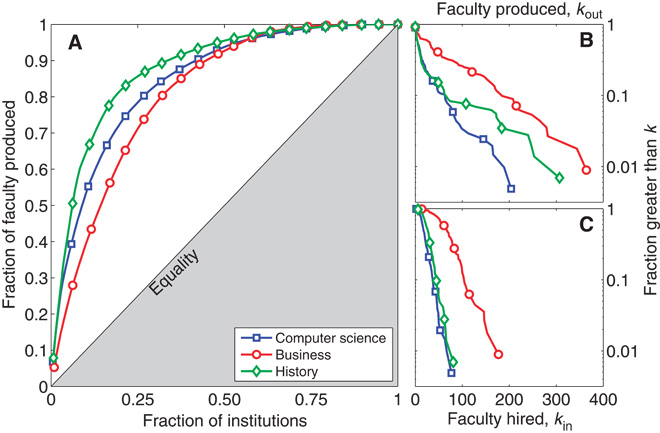
In a perfect world, job success would be a meritocracy, but academia does not really work that way, it has lots of social justice parameters and guidelines and quotas, both stated and implicit, and so once all that has been factored in, all things being equal, it's better to just play it safe and go with someone from a big-name school.

And so, we are left with kind of an 80/20 rule, the Pareto principle which posits that 20 percent of the causes for a given event are responsible for 80 percent of the outcomes.

Nova Southeastern University (NSU) researchers recently discovered that, contrary to prior belief, tissues of different mammalian organs have very different abilities to repair damage to their DNA.

These new findings indicate that the heart has the greatest capacity to repair its DNA, followed by the intestines, kidneys, spleen, testes, and lungs. The brain, however, exhibited no ability to repair damage to its DNA.

These studies were performed in murine cell tissue culture, but, based on previous human studies performed by the same investigators, such "tissue specificity" is true of humans, as well.

Massive elimination of neurons is a critical aspect of normal nervous system development but also represents a defining feature of neurodegenerative pathologies, such as Alzheimer's disease, Parkinson's disease, Huntington's disease and amyotrophic lateral sclerosis.

