Eating dog meat is common in Asia. In two case studies published by PLoS Medicine, researchers analyzed situations in Hanoi where men died from laboratory-confirmed rabies.
The first patient was a 48-year-old male construction worker, with no preceding medical illnesses who was, among other symptoms, unable to swallow due to involuntary inspiratory muscle spasms. The second patient was a 37-year-old male farmer, without any prior medical history and similar symptoms.
A novel motion sensor developed by the Fraunhofer Institutes for Applied Polymer Research IAP in Potsdam-Golm and for Computer Architecture and Software Technology FIRST in Berlin could enable window panes and glass doors to detect movements, thanks to a new pecial coating.
If anything changes in front of the pane, or someone sneaks up to it, an alarm signal is sent to the security guard.
Your cat is going to have a lot of fun with that, right? Luckily, threshold for the alarm can be set, so that small moving objects do not trigger an alarm.
Tiny creatures at the bottom of the food chain called diatoms suck up nearly a quarter of the atmosphere's carbon dioxide, yet research by Michigan State University scientists suggests they could become less able to "sequester" that greenhouse gas as the climate warms. The microscopic algae are a major component of plankton living in puddles, lakes and oceans.
Zoology professor Elena Litchman, with MSU colleague Christopher Klausmeier and Kohei Yoshiyama of the University of Tokyo, explored how nutrient limitation affects the evolution of the size of diatoms in different environments. Their findings underscore potential consequences for aquatic food webs and climate shifts.
The Hubble Space Telescope recently captured a photo sequence of four moons of Saturn passing in front of their parent planet. The moons, from far left to far right, are icy white Enceladus and Dione, the large orange moon Titan, and icy Mimas. Due to the angle of the Sun, they are each preceded by their own shadow.
Though the popular conception has been that "money can't buy happiness," studies have shown that wealth can play a role in enhancing happiness. A study of American woman by a Princeton University psychologist says money doesn't buy happiness - not caring about having no money apparently makes the difference.
Women who concentrated on financial matters were less likely to be happy with their lives, according to Talya Miron-Shatz, a postdoctoral research fellow in the Woodrow Wilson School of Public and International Affairs at Princeton, even though they had plenty of money by conventional standards.
Conversely, those who didn't fixate on finances like retirement savings, tuition for college or simply making ends meet, reported being the happiest of the group.
A new computerized method of testing could help world health officials better identify flu vaccines that are effective against multiple strains of the disease. Rice University scientists who created the method say tests of data from bird flu and seasonal flu outbreaks suggest their method can better gauge the efficacy of proposed vaccines than can tests used today.
Madison, WI, March 16, 2009 -- One of the most significant developments in agricultural growth in modern times has been the continuous and substantial increase in corn yield over the past 80 years in the U.S. Corn Belt.
This extraordinary yield advance has been associated with both breeding of improved hybrids and the ability to grow them at increased density. In a new study, published in the January-February issue of Crop Science, researchers have investigated the importance of the effects of leaves and roots on this dramatic increase in yield in the U.S. Corn Belt, and have found that the root structure may be the key to understanding how these crops have grown so efficient.
New exciting proof that Cleopatra was of African descent and killed her sister!
Really?
Yes, if you believe the BBC. The story, reported by AFP, the
Times, and the Daily Telegraph, goes like this: In the 1920s a tomb at Ephesus in Turkey was opened which contained a single skeleton. The skull was removed, measured, and subsequently lost. More recently, a team of Austrian archaeologists have reexamined what's left of the skeleton, determining it to be the body of an apparently healthy young
female.
Continued from Part 1,
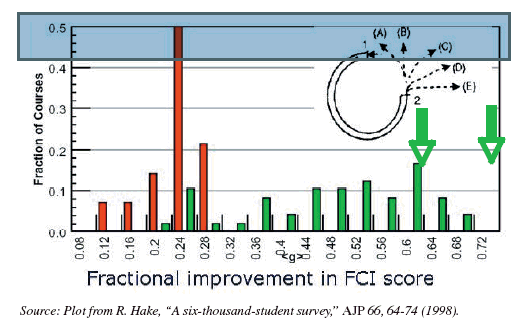
Why Not Try A Scientific Approach To Science Education?In a traditional science class, the teacher stands at the front of the class lecturing to a largely passive group of students. Those students then go off and do back-of-the-chapter homework problems from the textbook and take exams that are similar to those exercises.
With a group of friends, classmates or co-workers, offer to auction a $20 bill. One more rule: both of the top two bidders must pay their final bid.
Imagine that person A and person B are foolish enough to join your auction, with person A bidding $0.25 and person B overbidding to the tune of $0.30. Obviously this should escalate—who wouldn’t bid $7 to earn $20, especially if this could keep you from losing money you previously bid?