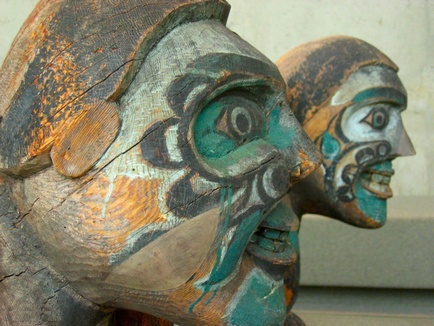
A move from the big city to a small village is always a culture shock, but can it affect just more than your Friday night plans?

Now, I've lived in rural and urban locales. But either the local water utilities people put happy pills in the water supply here, or my overstimulation cup had overfloweth'd, because this latest move seemed more a stark contrast.
Show Me The Science Month Day 24 Installment 24

How do new genes arise? One common way is through gene duplication - the creation of a second copy of a gene when the DNA replication or repair machinery goes awry, followed by the the evolution of a new function for one copy. How genes are accidentally duplicated is reasonably well understood, but once a gene is duplicated, but how does the new copy acquire a new function?
A pair of researchers in New York have looked at the
role of a class of reproductive proteins in the mating behavior of different species of flies. One thing you can learn from this paper is that biologists will go to any length to learn about evolution - nobody watches fly sex for fun. Except for fly number three: (which was apparently put in by Photoshop):
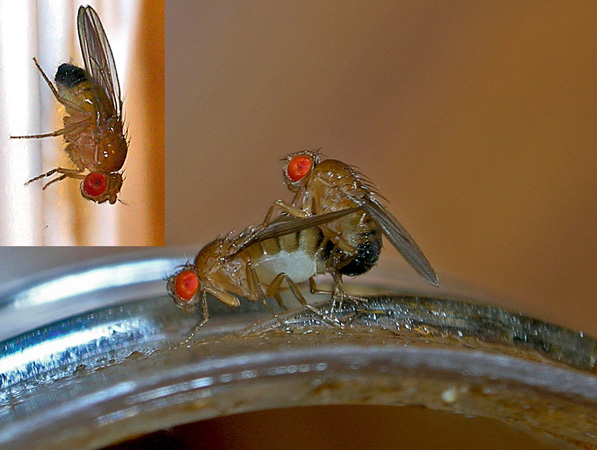
But there are more lessons here. Mating behavior is in fact an excellent place to look for lessons about evolution, since reproduction is subject to strong evolutionary pressures.
While you're sipping that morning cup and looking for excuses to put off work, here's what's interesting in science around the web today (well, ok, not just today - I haven't done one of these in about a month):
Your tax money pays for the research, so shouldn't you be able to read that research without paying an arm and a leg? Biologist Michael Eisen
defends the National Institute Health policy that scientists put copies of their manuscripts in a freely accessible, public repository, as Congress plans to revisit that policy at the behest of for-profit publishers. Eisen argues the policy doesn't hurt publishers, and thus there's no reason to scrap it:
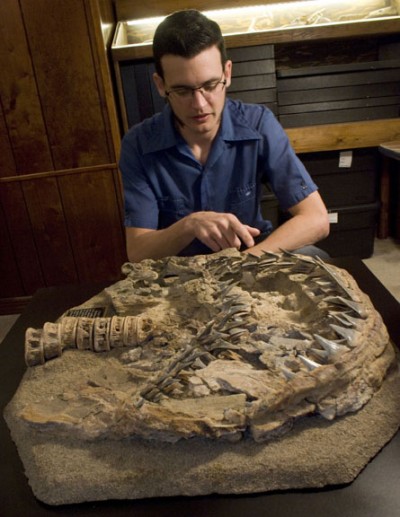
Want to start an argument among shark paleontologists? Ask whether Carcharodon carcharias, the great white shark, evolved from the line that produced Carcharodon megalodon, the largest carnivorous fish known, or from the broad-toothed mako shark.
The mako camp contends megalodon, which grew to a length of 60 feet, should have its genus name switched to Carcharocles to reflect its different ancestry. A study in the Journal of Vertebrate Paleontology says the mako proponents are right and concludes megalodon and modern white sharks are much more distantly related than paleontologists initially believed.
A new dating method found that "Peking Man" is around 200,000 years older than previously thought. So how did he adapt to the cold of even a mild glacial period?
The Zhoukoudian, China, site of the remains of Homo erectus, commonly known as "Peking Man", was found to be 680,000-780,000 years old. Earlier estimates put the age at 230,000-500,000 years old.
Homo erectus is considered to be the ancestor species to humans and the first species that left Africa and moved into Asia. The "Peking Man" site, discovered in the late 1920s, was among the first found for Homo erectus and shaped the thoughts on the age and behavior of the species.
Researchers have found evidence suggesting that stars rich in carbon complex molecules may form at the center of our Milky Way galaxy - and it helps solve a mystery. Namely, why have telescopes never detected carbon-rich stars at the center of our galaxy even though they have found these stars in other places?
This discovery is also significant because it adds to our knowledge of how stars form heavy elements like oxygen, carbon and iron and and then blow them out across the universe, making it possible for life to develop.
Researchers in Japan have turned to mathematics to build a computerized 3D model of the female trunk that could help lingerie and other clothes designers make more sensuous, comfortable, and better fitting product ranges.
According to Kensuke Nakamura of Kyoto Institute of Technology and Takao Kurokawa of Osaka University, identifying body shape components is critical for designing close-fitting products, whether underwear, everyday clothes, or safety garments.
Research at the new School of Creative Arts Therapies at the University of Haifa: Drawing enhances emotional verbalization among children who live under the shadow of drug-addicted fathers
"The use of art seems to help with verbalizing trauma. It is usually difficult to express the trauma through speech, yet the body remembers it," said Prof. Rachel Lev-Wiesel, Head of the Graduate School of Creative Arts Therapies who carried out the study.
Rutgers AIDS researchers Gail Ferstandig Arnold and Eddy Arnold and colleagues say they may have turned a corner in their search for a HIV vaccine.
The researchers say they have been able to take a piece of HIV that is involved with helping the virus enter cells, put it on the surface of a common cold virus, and then immunize animals with it. They found that the animals made antibodies that can stop an unusually diverse set of HIV isolates or varieties.
The NASA/ESA Hubble Space Telescope says a look into the heart of the Perseus galaxy has provided evidence that galaxies are embedded in halos of dark matter. Small galaxies have remained intact while larger galaxies around them are being ripped apart by the gravitational tug of other galaxies.
The explanation? The undisturbed galaxies are enshrouded by a "cushion" of dark matter that protects them.
Dark matter is a theoretical invisible form of matter that accounts for most of the Universe's mass. Astronomers have deduced the existence of dark matter by gravitational influences on normal matter, such as stars, gas and dust.