



Adapting to the global climate change impacts outlined in the IPCC's Working Group 2 Report, "Climate Change 2007: Impacts, Adaptation and Vulnerability", will require new evaluation tools to help choose the best way forward, according to the International Geosphere-Biosphere Programme (IGBP), an international network of environmental scientists.

This quest for adaptation strategies opens a new chapter in global environmental change research that requires not only continued development of sophisticated climate models (and understanding the processes behind them) but also a new integration of those models with predictive descriptions of human behaviour.

A study of herbal kelp supplements led by UC Davis public health expert Marc Schenker concludes that its medicinal use may cause inadvertent arsenic poisoning and health dangers for consumers, especially when overused. Schenker and two researchers evaluated nine over-the-counter herbal kelp products and found higher than acceptable arsenic levels in eight of them.

The new study, published in the April issue of Environmental Health Perspectives (http://www.ehponline.org/) was prompted by the case of a 54-year-old woman who was seen at the UC Davis Occupational Medicine Clinic following a two-year history of worsening alopecia (hair loss), fatigue and memory loss.

If solar power is going to play a significant role in the energy equation of the future, there must be advances in technologies to store that power and more investment by manufacturers, concludes a new federally funded study by University of Massachusetts Amherst scientist Erin Baker.

The report by Baker and colleagues explores the viability of sun-fueled technologies through a combination of evaluations by experts and economic modeling, allowing the researchers to look at solar power’s role in the electricity sector in 15-year chunks through 2095.

Tai Chi, a traditional Chinese form of exercise, may help older adults avoid getting shingles by increasing immunity to varicella-zoster virus (VZV) and boosting the immune response to varicella vaccine in older adults, according to a new study published in print this week in the Journal of the American Geriatrics Society. 

This National Institutes of Health (NIH)-funded study is the first rigorous clinical trial to suggest that a behavioral intervention, alone or in combination with a vaccine, can help protect older adults from VZV, which causes both chickenpox and shingles.

Premenopausal women who were assigned to follow the Atkins diet for one year lost more weight when compared to women who were assigned to follow the Zone, Ornish and LEARN diets, according to a study in the March 7 issue of JAMA.

Overweight and obesity are well-documented problems in the United States. National dietary weight loss guidelines (a diet low in calories and fat, high in carbohydrates) have been challenged, particularly by supporters of low-carbohydrate diets. However, limited evidence has been available to effectively evaluate other diets, according to background information in the article.

"Scientists must improve communication tactics, Science article proclaims"

No, I didn't write that headline. The PR firm for an article written by Seed magazine writer Chris Mooney and American University professor Dr. Matthew Nisbet did.

They are co-authors of an April 6th Science article titled “Framing Science.” The article suggests that as the 2008 election approaches, scientists should adopt new communication techniques, rather than merely seeking to “get the facts out there.”

They highlight global warming, evolution and embryonic stem cell research as politically hot topics that need help from scientists to 'frame' the debate in ways the public understands.

Obviously I couldn't agree more that scientists should be actively getting information out there.

A new study in Journal of Personality shows that selfless and social behavior is not purely a product of environment, specifically religious environment. After studying the behavior of adult twins, researchers found that, while altruistic behavior and religiousness tended to appear together, the correlation was due to both environmental and genetic factors.

According to study author Laura Koenig, the popular idea that religious individuals are more social and giving because of the behavioral mandates set for them is incorrect. "This study shows that religiousness occurs with these behaviors also because there are genes that predispose them to it."

Thanks to Joanna Scott, we've been taking advantage of our invitation to contribute to the Nature island on Second Life. Beth made a copy of the Open Notebook Science building and created a cemetery filled with blue obelisks so that multiple students can take organic chemistry quizzes at the same time.

A commonly told anecdote among my colleaugues is that adventurer Roy Chapman Andrews was the inspiration for Indiana Jones. However, George Lucas never specifically cited a person as his inspiration for the character. He apparently told Steven Spielberg when they first discussed the movie trilogy in 1977 that he had been inspired by movie serials from the 1940s and the 1950s. Though these serials may have taken their inspiration from the real-life adventures of Andrews, he had retired by 1942. Other possible candidates for Indiana Jones include:

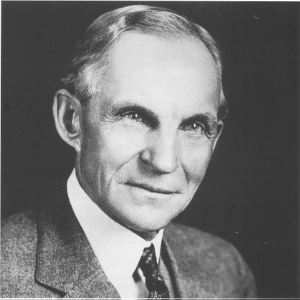
Henry Ford has long been heralded as the father of modern mass automotive production.

However, a controversial new paper by two Cardiff University researchers suggests that history may have got the wrong man. Dr Paul Nieuwenhuis and Dr Peter Wells of the Centre for Automotive Industry Research, Cardiff Business School, suggest it was Edward G Budd of Philadelphia whose development of the pressed steel car body truly developed mass production as it is known today.

