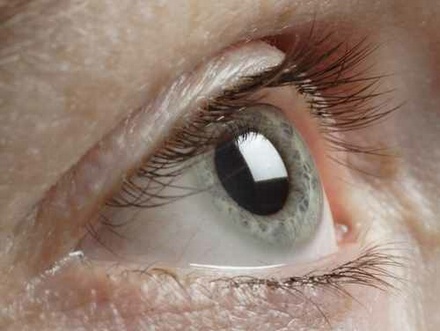
We have two eyes and each differ in their optical properties - you can easily tell by placing a hand over each and seeing the difference.
As a result of the fits and starts and do-overs in evolution that got us eyes, our vision system results in a blur projected in each retina and then the visual system calibrates itself to give us a clear picture. In the past, researchers had people where glasses where images were upside down. Eventually, our brains compensated and the images were correct - until people took off the glasses.
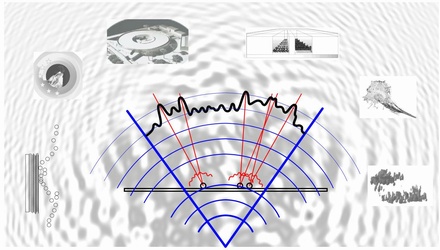
At the XVI Neutrino Telescopes conference going on this week in Venice there was a nice presentation on the results of the Borexino experiment. The text below is a writeup of the highlights from the talk, given by Cristiano Galbiati from Princeton University.
Medical marijuana usage has been proliferating across the United States, primarily due to claims about pain management, but the demographics are baffling. Though women have 60 percent of medical visits for pain, 80 percent of medical marijuana prescriptions for pain have been men.
Yet in instances where the prescriptions have been real, tolerance develops quickly, which means people are inhaling more and more carcinogens, and there are numerous other side effects.
The concept of randomness has intrigued great minds for as long as history of great thinkers has been recorded. From the nature of wind to drunks running into lampposts on their way home, scholars have been intrigued with making random predictable.
A group of chemists say they have challenged traditional interpretations of randomness by computationally generating random and mechanically rigid arrangements of two-dimensional hard disks, think pennies with no thickness, for the first time.
Researchers say they have clear and detailed evidence of the inequitable delivery of mental health care services for disadvantaged Australians. Introduced in 1975, Australia's national health insurance scheme Medicare (originally Medibank) was envisioned to deliver the most equitable and efficient means of providing health insurance coverage for all Australians.
For almost a century, scientists have been puzzled by a process that is crucial to much of the life in Earth's oceans: Why does calcium carbonate, the tough material of seashells and corals, sometimes take the form of calcite, and at other times form a chemically identical form of the mineral, called aragonite, that is more soluble -- and therefore more vulnerable to ocean acidification?
High up in the high Andes mountains of Argentina, a population has adapted to tolerate the toxic chemical arsenic.
For thousands of years, in some regions of the Andes, people have been exposed to high levels of it, because arsenic in volcanic bedrock is released into the groundwater.
How could this population adapt to tolerate arsenic, a potent killer of such ill repute that it's often the overused plot-driver of many murder mysteries?
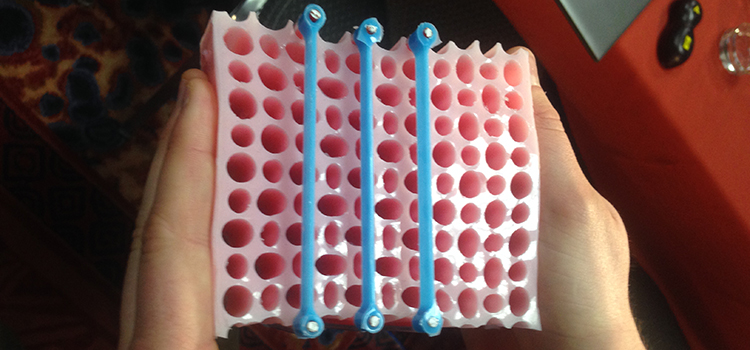
A “mechanically programmable” metamaterial held by Bastiaan Florijn, Leiden University. Photo credit: Ben P. Stein
By Ben Stein, Inside Science
(Inside Science Currents Blog) -- It’s rare when a scientific term is both cool sounding and precise, but the word “metamaterial” might just fit the bill. Although they are made from small, ordinary building blocks such as rods, circles or sticks, metamaterials have striking properties that often do not occur in the natural world.
How much overdetection is acceptable in cancer screening? A UK survey discussed in The BMJ this week affirms what we always knew, that responses are all over the map, depending on how the questions are framed.
The article is part of a series on over-detection (over-diagnosis) looking at the risks and harms to patients of expanding definitions of disease and increasing use of new diagnostic technologies. Over-detection describes cancerous lesions that are picked up and treated but would never have caused symptoms or become fatal in a person's lifetime. This is typically seen if the cancers are so slow growing that they would not have been detected if screening had not taken place.
 Male enigma moth, a new species discovered on Kangaroo Island. George Gibbs, Author provided
The discovery of a new family of moth is one of the most exciting finds in entomology in the past 40 years.
It was found not in some remote and unexplored region of Australia, but right in our backyard on Kangaroo Island in South Australia. The island that is only 100 kilometers from Adelaide and 13
kilometers
from the mainland, that has been settled since 1836 and is one of the loveliest destinations for a holiday.