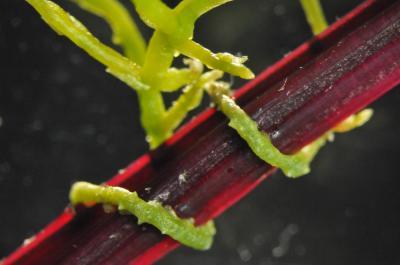




A scientist has discovered a potentially new form of plant communication, one that allows them to share an extraordinary amount of genetic information with one another.

Professor Jim Westwood examined the relationship between a parasitic plant, dodder, and two host plants, Arabidopsis and tomatoes. In order to suck the moisture and nutrients out the host plants, dodder uses an appendage called a haustorium to penetrate the plant. Westwood previously broke new ground when he found that during this parasitic interaction, there is a transport of RNA between the two species. RNA translates information passed down from DNA, which is an organism’s blueprint.

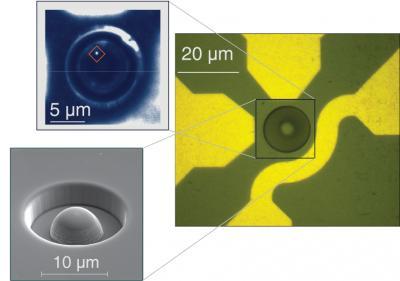
A team of researchers has developed a technique to record the quantum mechanical behavior of an individual electron - contained within a nanoscale defect in diamond.

Their technique uses ultrafast pulses of laser light both to control the defect's entire quantum state and observe how that single electron state changes over time.   

This research contributes to the emerging science of quantum information processing, which demands that science leave behind the unambiguous universe of traditional binary logic—0 or 1—and embrace the counterintuitive quantum world, where behavior is radically different from what humans experience every day. While people are generally content being in one place at a time, electrons can be in many states at once.

Women with a vitamin D deficiency were nearly half as likely to conceive through in vitro fertilization (IVF) as women who had sufficient levels of the vitamin, according to a new study in the Journal of Clinical Endocrinology&Metabolism.

Long known for its role in bone health, vitamin D is a steroid hormone that is emerging as a factor in fertility. Animal studies have shown that the hormone, which is produced in the skin as a result of sun exposure as well as absorbed from some fortified foods, affects fertility in many mammals.

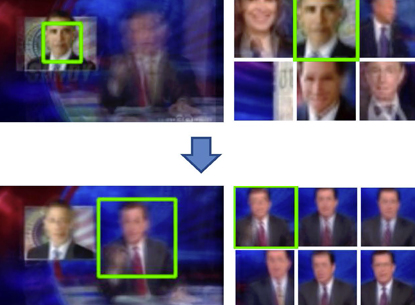
A picture is worth a thousand words, the saying goes, meaning that a picture can tell a big story quickly, but what if it could also represent a hundred thousand other images? 

New software seeks to tame the vast amount of visual data in the world by generating a single photo that can represent massive clusters of images. This tool can give users the photographic gist of a kid on Santa's lap, housecats, or brides and grooms at their weddings. It works by generating an image that literally averages the key features of the other photos. 

Kidney failure is a devastating condition and there are never enough donors for recipients - so it seems strange that anyone would be hesitant about getting one, but a new paper in the Clinical Journal of the American Society of Nephrology suggest that interventions are needed to increase women's acceptance of living donor kidney transplantation.

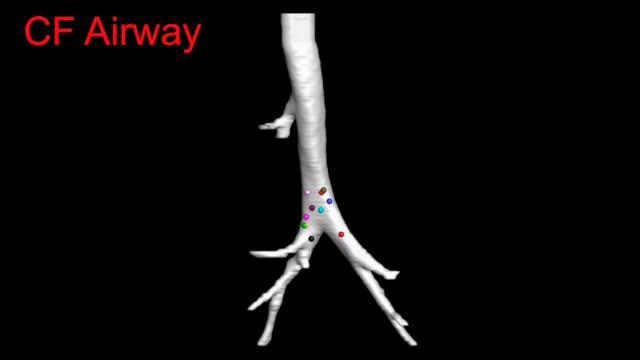
Mucus is key to keeping our lungs clean and clear of bacteria, viruses, and other foreign particles that can cause infection and inflammation. When we inhale microbes and dust, they are trapped in the mucus and then swept up and out of the lungs via a process called mucociliary transport.

New research shows that cystic fibrosis (CF), a life-shortening, inherited condition that affects about 30,000 Americans, causes a specific defect in this process, reducing the ability to clear particles and germs out of the airway. 

An enzyme called 12-LO promotes obesity-induced oxidative stress in the pancreatic cells and that has been linked to diabetes (and pre-diabetes, if you prefer made-up conditions mainstream science wishes studies would stop claiming to be about).

12-LO's enzymatic action is the last step in the production of certain small molecules that harm the cell, according to a team from Indiana University School of Medicine. The findings will enable the development of drugs that can interfere with this enzyme, preventing or even reversing diabetes.  

The first analysis of space dust collected by a special collector onboard NASA's Stardust mission and sent back to Earth for study in 2006 suggests the tiny specks, which likely originated from beyond our solar system, are more complex in composition and structure than previously imagined.

The analysis, completed at a number of facilities including the U.S. Department of Energy's Lawrence Berkeley National Lab (Berkeley Lab) opens a door to studying the origins of the solar system and possibly the origin of life itself.

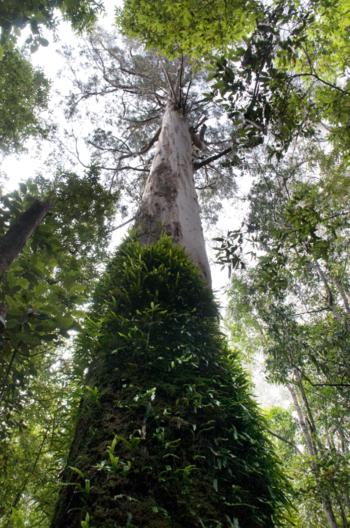
Trees have been a part of the human existence for as long as humans have existed but that doesn't mean we know everything about them, like why they are the size they are. What limits the height of trees? Is it the fraction of their photosynthetic energy they devote to productive new leaves? Or is it their ability to hoist water hundreds of feet into the air, supplying the green, solar-powered sugar factories in those leaves?

The easy and therefore not vary satisfying answer is that both resource allocation and hydraulic limitation might play a role, but the question still becomes which factor (or what combination) actually sets maximum tree height, and how their relative importance varies in different parts of the world.  

It’s hard to focus after a bad night’s sleep and by using mice and flashes of light, scientists have found why; just a few nerve cells in the brain may control the switch between internal thoughts and external distractions.

The study  may be a breakthrough in understanding how a critical part of the brain, called the thalamic reticular nucleus (TRN), influences consciousness.

