


Autism diagnoses have gone up a lot in the last generation. It was to the 2000s what ADD diagnoses were to the 1990s. 

And so people have rushed to attribute blame. Vaccines, GMOs, even BPA. If someone is selling alternative medicine, food or culture they have found a way to link their competition to autism. And then there is the idea that it is simply better diagnoses. And the charge that it has been over-diagnosed.

New diagnosis guidelines by the American Psychiatric Association (APA) have therapists and some families in a panic, because in an effort to be more scientific and less subjectively symptom-based, the new guidelines could leave them without a diagnosis. No diagnosis means no insurance coverage.

A new method for the treatment of phantom limb pain after an amputation has been initially tested on a patient who has suffered from severe phantom limb pain for 48 years. The case study shows a drastic reduction of pain.

It is common for people who lose an arm or a leg to experience phantom sensations, as if the missing limb were still there. 70 percent of amputees experience pain in the amputated limb despite the fact that it no longer exists. Obviously that can be frustrating. Phantom limb pain can become a deteriorating condition that reduces the quality of life considerably, but how do you treat the disease when you don't know the cause? 

Temperature has been driving the fluctuating size of Peru's Quelccaya Ice Cap, not snowfall, according to a new analysis.  The Quelccaya Ice Cap is the largest ice mass in the tropics and sits 18,000 feet above sea level in the Peruvian Andes. The dramatic shrinkage of the tropical glacier in recent decades has made it a poster child for global climate change.

The findings support suspicions that tropical glaciers are shrinking because of a warming climate, and could help scientists to better understand the natural variability of past and modern climate and to refine models that predict tropical glaciers' response to future climate change. 

You might recall that a few years ago, lots of athletes wore magnetic bracelets in the belief that their performance would improve. Like much woo, be it homeopathy or organic food or skull drilling, it proceeded from a reasonable basis; in the case of magnets, are we not governed by inductance? What if we could more optimally guide our bodily functions using mass-produced magnets? Then throw in a bunch of stuff about negative ions and tourmaline and get rich.

Today you can pick up those used for a dollar on Ebay.

In America, after a startling homicide occurs, there is a lot of talk about society and guns and violence culture and what we should ban, everything from guns to video games. Much less discussed, because we don't want to demonize mental illness, is the overwhelming prevalence of psychiatric medications in those events.

It does the public and patients a disservice to dismiss one factor and focus solely on others; we could end up solving the wrong problem and helping no one at all.

To sane people, parents who kill their kids are both horrifying and tragic, though levels of acceptance and blame flow with cultural trends. Once upon a time, when a mother in Texas killed her children in a bath tub, celebrities like Katie Couric blamed everyone but the murderer. Today, there is a lot less exculpatory rationalization about killers.

A new paper in Forensic Science International invokes correlations to psychology and biology and therefore might be used to make filicide exculpatory once again - with enough data, epidemiology can prove anything. 

People who live in cities love the infrastructure, the nightlife, the hobos, the fact that you can find a Starbucks on every corner. People who live in the country love the cleaner air, the openness, the fact that you can go for a walk without being accosted by hobos.

Is it just personal choice? If so, birds face many of the same dilemmas about how best to live life. Larger groups bring risks of disease and aggression by neighbors.

What other factors may be involved? 

A study led by Manchester scientists has shown promising results for a new treatment approach in follicular lymphoma.

Follicular lymphoma is a type of non-Hodgkin's lymphoma, a blood cancer, that usually develops slowly but the majority of patients are diagnosed when their disease is already at an advanced stage.

Recent improvements in treatment have included the use of antibodies to specifically target the tumour cells and to stimulate the patient's own immune system to attack their tumor. The use of such antibodies has improved treatment response, but unfortunately most patients still relapse. Radioimmunotherapy – where a radioactive substance is attached to the antibody – has been shown to be successful in treating patients who had previously relapsed. 

Do you think pharmaceutical companies are creating problems that don't exist in order to keep selling drugs to an increasingly over-medicated population? Do you think scientists are unethical if they work at a corporation like DuPont or in nuclear science, rather than being funded by the government?

Such beliefs have become so increasingly mainstream among a particular political and cultural demographic that we can quite easily make lots of accurate determinations about them, the same way we can infer things about someone if they don't buy into global warming.

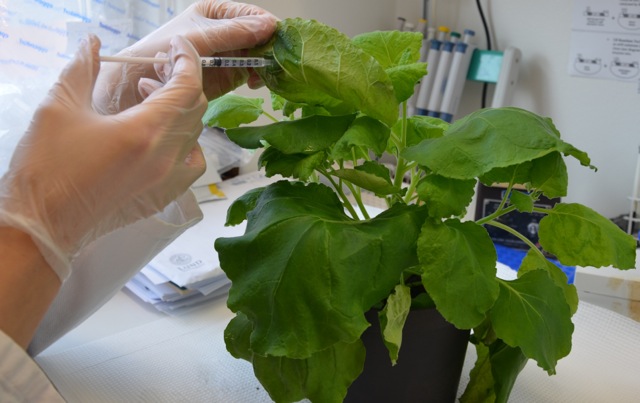
Genetic engineering of tobacco plants so that they produce moth pheromones demonstrates the potential of genetically modified plants to act as factories for the synthesis of insect pheromones, write the authors of a Nature Communications paper.

Pheromones are widely used as an environmentally friendly alternative to traditional pesticides for trapping insects and the new work presents an opportunity for the cost-effective production of an environmentally safe alternative to insecticides. The demographic most likely to ban GMOs and tobacco aren't going to be happy, but they aren't happy with most science. Maybe if the work were done with marijuana it would be more acceptable.

