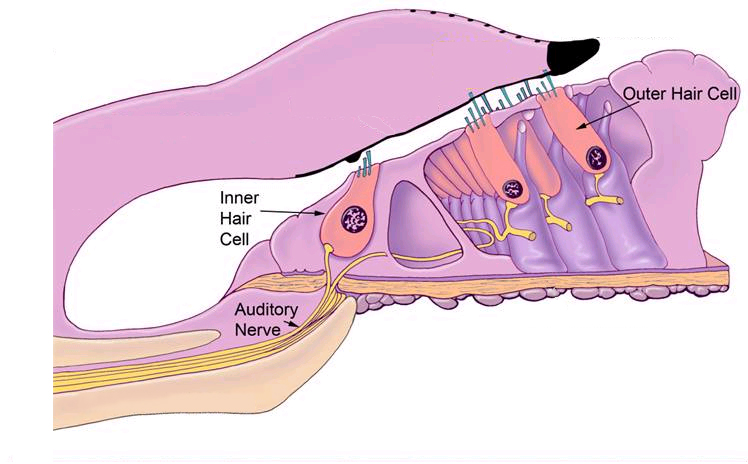
Utah and Texas researchers have learned how quiet sounds are magnified by bundles of tiny, hair-like tubes atop “hair cells” in the ear: when the tubes dance back and forth, they act as “flexoelectric motors” that amplify sound mechanically.
“We are reporting discovery of a new nanoscale motor in the ear,” says Richard Rabbitt, the study’s principal author and a professor and chair of bioengineering at the University of Utah College of Engineering. “The ear has a mechanical amplifier in it that uses electrical power to do mechanical amplification.”
For those of us who are savvy on health food, what I’m about to tell you will come as no surprise, if not, hold onto your hats. If you have heard about “good fats” such as poly-unsaturated fats and omega fatty acids, found in fish and olive oil, then you know that researchers and nutrition professionals agree that these fats should replace the “bad fats” including trans fats and saturated fats found in junk food.
The body does need some fats, and the “good fats” in olive oil and fish are much more easily broken down and utilized by the body instead of the saturated fats, which instead of being broken down, may be allocated to fat storage, and add inches to the waistline and pounds to your physique.
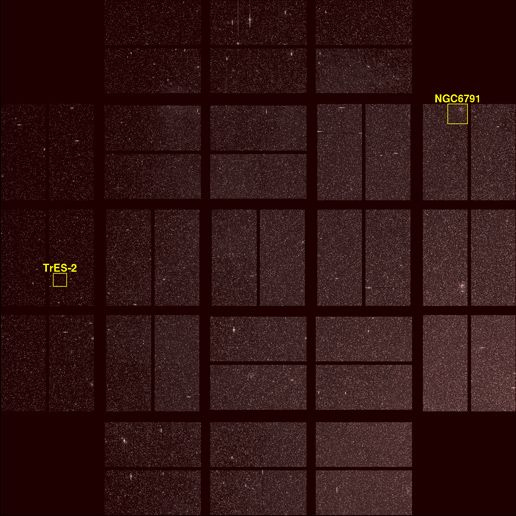
"Kepler is like Field of Dreams meets Cosmos" says Padi Boyd, a scientist with the Kepler planet-hunting mission. This set the stage for an enjoyable short interview. Earlier I wrote why Kepler is
awesomeness squared, and now we look at how the motivation of the people involved leads to better science success.
Kepler was conceived, proposed, and lead by Bill Borucki. It is NASA Discovery mission #10, designed to be low cost and focused towards one task. For Kepler, that's planet-hunting.
A team of astronomers from University College London (UCL) have discovered that an exotic world passes directly in front of the Sun-like star it orbits, revealing for the first time that it is about the same size as Jupiter.
The team were alerted by the exoplanet science website
http://www.oklo.org, run by Greg Laughlin of the University of California Santa Cruz. Using infrared space observations, Greg predicted that a planet (HD 80606b) would pass in front of its parent star (HD 80606) in a so-called transit event.
Rather than travelling to one of the major observatories in Hawaii or Chile, the students used a telescope at UCL's University of London Observatory (ULO) in the capital's northern suburb of Mill Hill.
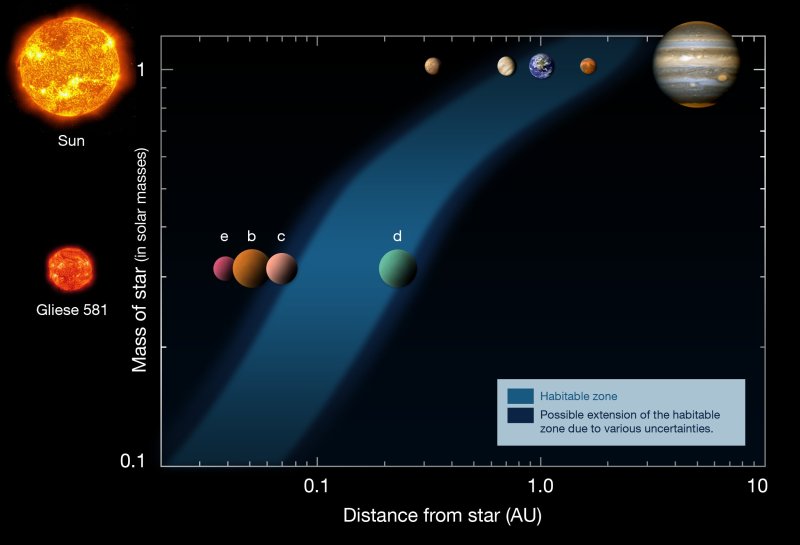
Exoplanet researcher Michel Mayor today announced the discovery of the lightest exoplanet found so far. The planet, Gliese 581 e, in the famous system Gliese 581, is only about twice the mass of our Earth. The team also refined the orbit of the planet Gliese 581 d, first discovered in 2007, placing it well within the habitable zone, where liquid water oceans could exist.
These amazing discoveries are the outcome of more than four years of observations using the most successful low-mass-exoplanet hunter in the world, the HARPS spectrograph attached to the 3.6-meter ESO telescope at La Silla, Chile.
Want to hunt down enemy bacteria? Look at the sugars on the germs' surface where they start building a 'structure' that helps the microbes resist efforts to kill them.
Scientists have determined that the bacterial cell-surface sugar, a polysaccharide called Psl, is anchored on the surface of the bacterium as a helix, providing a structure that encourages cell-to-cell interaction. When multiple bacterial cells join together with the help of such a structure, they form what is called a biofilm, a persistent community of bugs that is able to resist the effects of a human immune response, as well as antibiotic drugs.
Dartmouth researchers have determined that the presence of the rare element osmium is on the rise globally. They trace this increase to the consumption of refined platinum, the primary ingredient in catalytic converters, the equipment commonly installed in cars to reduce smog. A volatile form of osmium is generated during platinum refinement and also during the normal operation of cars, and it gets dispersed globally through the atmosphere.
Thinking your memory will get worse as you get older may actually be a self-fulfilling prophecy. Researchers at North Carolina State University have found that senior citizens who think older people should perform poorly on tests of memory actually score much worse than seniors who do not buy in to negative stereotypes about aging and memory loss.
If you have recently given a close enough look at the search results that the CDF and DZERO experiments have been producing at a regular pace on the Higgs boson - every six months, that is: for summer and winter conferences - and your exposure to particle physics results is not broad enough, you might have gotten a biased perception of how searches for new particles are performed nowadays.
Fields are alive with the promise of medicine. Consider my list of dozen alkaloids found in nature. They exist in whole plant or its organ(s). Some of these chemical compounds are in minute amounts. For example, vincristine, the cancer chemotherapeutic compound in Catharanthus roseus, occurs at concentrations under 0.0003% on a dry basis. The root of Strychnos nux-vomica contains about 6% strychnine, a pesticide and a former stimulant.[1]