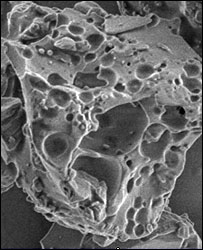






In the 1960s and early 1970s, the Apollo Moon Program struggled with a formidable enemy that was sometimes more formidable than others: sticky lunar dust. Four decades later, a new study says they now know why; forces that compel lunar dust to cling to surfaces change during the lunar day - with the elevation of the sun.

The study analyzes the interactions on the Moon among electrostatic adhesive forces, the angle of incidence of the sun's rays, and lunar gravity. It concludes that the stickiness of lunar dust on a vertical surface changes as the sun moves higher in the sky, eventually allowing the very weak lunar gravity to pull the dust off.


A project supported by the Austrian Science Fund FWF wants to uncover the history, significance and precise origins of Islamic art contained in Viennese art collections; comprehensive work to reconstruct the background of several Ottoman flags has already been carried out with impressive results.

Traces of the era of the Turkish wars - such as the tradition of the Vienna coffee house and the Ring boulevard that encircles the city centre - are still evident today in the day-to-day culture and street layout of the Austrian capital. The Turkish sieges of Vienna (16th/17th century) led to an expansion of the city's fortifications and heralded the introduction of coffee.
People are always going on about the life expectancy of babies and people in general.   Now quantum states are getting their due.

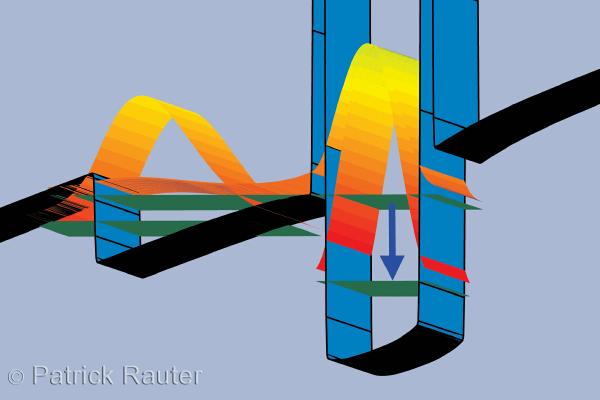
For the first time, scientists have succeeded in measuring and controlling the lifetime of quantum states with potential use in optoelectronic chips. This achievement is highly significant for the ongoing development of this cutting-edge technology. The breakthrough involved measuring the intersubband relaxation time of charge states in silicon-germanium SiGe structures on a picosecond scale. Experiments have also shown that it is possible to control and extend these times. As a result, this body of work  represents a major advance in the development of data processing based on optoelectronic chips.
Fat people require more food and that requires more farming and greenhouse gas emissions.  Therefore, maintaining a healthy body weight is also good for the environment, according to a study which appears today in the International Journal of Epidemiology.

They highlight poor, third world countries like Vietnam as a model because they they can't afford food so they consume almost 20% less of it (and therefore cause fewer greenhouse gases to be produced) than a population in which over 40% of people are obese, where the USA and a few nations in Europe are heading by 2020.
Global warming gets all the press today but there was a time when pollution-caused global cooling was the concern - and if you map the planet's recent history, 90,000 out of every 100,000 years were ice ages and it's been 12,000 years since the last one so the historical reason for concern was not unfounded.  A new book, "The Late Eocene Earth - Hothouse, Icehouse, and Impacts" tackles what global cooling was like.
New evidence gleaned from CT scans of fossils locked inside rocks may flip the order in which two kinds of four-limbed animals with backbones were known to have moved from fish to landlubber.

Both extinct species, known as Ichthyostega and Acanthostega, lived an estimated 360-370 million years ago in what is now Greenland. Acanthostega was thought to have been the most primitive tetrapod, that is, the first vertebrate animal to possess limbs with digits rather than fish fins. 

Health and death have genetic risk factors. International research has linked ten gene variations to sudden cardiac death (SCD). What is SCD? It is death resulting from an abrupt loss of heart function -- cardiac arrest. Was this perhaps what the first famous poly-marathoner suffered?

Recent - The American Heart Association (AHA) says about 850 Americans die each day without being hospitalized or admitted to an emergency room. Most are sudden deaths caused by cardiac arrest. Death occurs within minutes after symptoms appear. Yet this health problem has received much less publicity than heart attack.


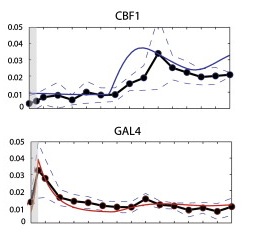
Many computational biologists are interested in taking gene expression data, and using that data to computationally infer the underlying regulatory network that controls the observed pattern of gene expression.

Why? Because doing the experiments to determine the structure of these regulatory networks is hard; if we could use more easily obtained data to reliably tease out the network structure, we'd be able to quickly characterize networks in unexplored cell types or in poorly studied microbes.

Kepler has First Light. It is On! Team is a Go! Photons are Arriving!

This provocativly-titled NASA release states "NASA's Kepler Captures First Views of Planet-Hunting Territory", and has a good explanation of Kepler's capabilities. What I wish to tackle is why Kepler matters.

Kepler is a new space telescope with an awesomely wide field of view, seeing a huge 100 square degrees in a single frame, then zooming in closer with two other 'scopes. It is primarily a planet-hunting mission, but there will be much good science coming from Kepler-- some of which we can't even imagine yet.

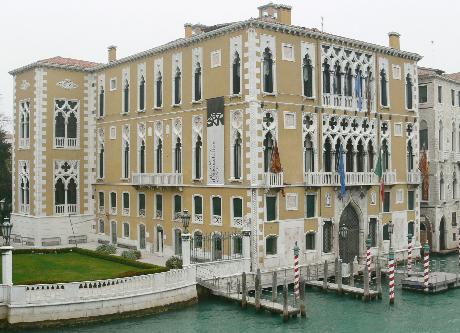
Palazzo Franchetti in veniceI participated with pleasure last month to a four-day conference devoted to neutrino telescopes, NEUTEL 2009, in Venice. Venice is my home town, and walking in the morning to the conference venue in Palazzo Franchetti (see left), a big and beautiful palace on the Canal Grande, was a pleasant change from my usual commute by train with Padova.

