I am a firm believer in the possibility and promise of embryonic stem cells. In a politically, religiously and even scientifically charged climate, this is a risky thing to announce. But as a journalist, I must divorce myself from my own personal opinions and biases and present the facts.
That being said, it is still satisfying writing upon a topic that you believe in. This was the case when
I wrote an article about Geron Pharmaceuticals recently launched human clinical trials using embryonic stem cell research to repair spinal cord damage.
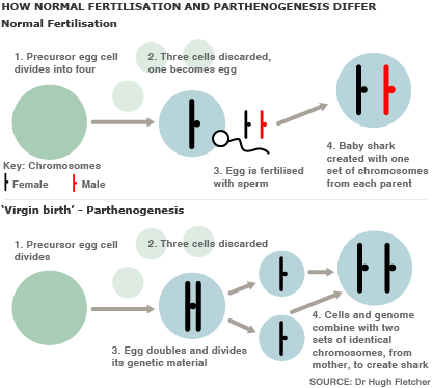
Today, of all days, anything is possible. The laws of man and god are subverted by that of Murphy. This day is made doubly potent by its placement before the geek's darkest day of the year: Valentine's Day. And during this day on which anything that can go wrong will go wrong, it seems that even the cold truth of mathematics itself has failed. Specifically, two equals one. Damn. You shoulda been more consistent with the salt, garlic and Haitian door totems.
A York University research team has tracked the migration of songbirds, the most common type of bird in our skies, by outfitting them with tiny geolocator backpacks – a world first and interesting because they are too small for conventional satellite tracking. They now say we have underestimated the flight performance of songbirds dramatically.
Adaptation is one of the driving forces behind evolution, along with selection and the appearance of new species, say a group of Ludwig-Maximilians-Universität München researchers, but they say that the interpretation familiar since Darwin - these processes increase the "fitness" of the species overall, since, of two competing species, only the fittest would survive - is actually a case of the fittest being the 'weakest' most often.
University of Leicester biologist Dr David Harper has conducted research for over 25 years at Lake Naivasha in Kenya and says today that your cheap boyfriend's (unless you are are the cheap boyfriend, in which case he means you) cut-price Valentine roses which are exported for sale to the UK are 'bleeding that country dry.'
Harper claimed that cheap roses grown by companies that had no concern for the environment were having a devastating effect on the ecology of Lake Naivasha - the center of Kenya's horticultural industry. Instead, he urged UK shoppers to buy Fair Trade roses produced by companies that he says are environmentally conscientious and had a transparent supply chain.
Are you smarter than a pigeon? We don't mean smarter as in able to figure out why it's $14 a day for lousy internet access in a hotel or $14 to see an old movie in your hotel room or the hospitality industry's general preference for the number 14, we mean practical social smarts, like meeting the opposite sex. Animals have "social smarts" too, it turns out, with a range of behaviors that can enhance species survival, according to studies being presented here in Chicago at the American Association for the Advancement of Science (AAAS) annual meeting.
Evolution shouldn't leave out social behavior, it seems.
Neandertals were the closest relatives of currently living humans. They lived in Europe and parts of Asia until they became extinct about 30,000 years ago. For more than a hundred years, paleontologists and anthropologists have been striving to uncover their evolutionary relationship to modern humans.
A multi-institutional team of researchers has reported the sequences for all of the 99 known strains of cold virus, nature's most ubiquitous human pathogen. The feat exposes, in precise detail, all of the molecular features of the many variations of the virus responsible for the common cold, the inescapable ailment that makes us all sneeze, cough and sniffle with regularity.
Conducted by teams at the University of Maryland School of Medicine, the University of Wisconsin-Madison and the J. Craig Venter Institute, the work to sequence and analyze the cold virus genomes lays a foundation for understanding the virus, its evolution and three-dimensional structure and, most importantly, for exposing vulnerabilities that could lead to the first effective cold remedies.
Within the next few years it may be possible to go to
Walmart, pick up a gallon of milk, and then stop by and have your genome sequenced while you wait. Sound unbelievable? Recent developments in the sequencing of your genome may make this a reality in the near future.
A company called
Complete Genomics has recently announced that they intend to market the $5000 complete genome sequencing package. $5000 is not cheap, but it is definitely cheaper than some of the earlier efforts at genome sequencing.