

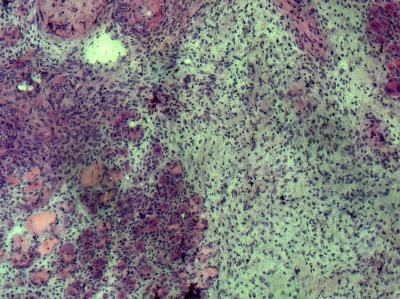





The off-label use of a drug given with RU-486 to terminate a pregnancy may be responsible for a handful of rare, fatal infections seen in women taking the drugs since 2000, a study by University of Michigan scientists suggests. Preliminary U-M studies indicate that oral use of RU-486's companion drug misoprostol is safe, but vaginal use may undermine body's immune responses

The drug misoprostol is FDA-approved to be taken by mouth along with RU-486 to end a pregnancy. But many women have received the drug vaginally as part of the two-drug combination, a method of delivery not evaluated by the FDA.

In animal and cell culture studies, the U-M researchers found that misoprostol, when given directly in the reproductive tract, suppresses key immune responses and can allow a normally non-threatening bacterium, Clostridium sordellii, to gain the upper hand and cause deadly infection. When absorbed through the stomach, however, the drug did not compromise immune defenses or cause illness.

Since the Women's Health Initiative study found that long-term therapy with estrogen or estrogen plus progestin may increase the risk of heart attack and stroke, many women have found it difficult to decide whether to take hormone therapy at menopause.

Subsequently, several researchers have speculated that the timing of estrogen treatment may be important for estrogen's effects.

A group of authors therefore designed an animal study to determine if estrogen would be beneficial for females who are going through menopause (perimenopausal) but not for women who are postmenopausal for many years. Since it is not possible to measure "risk" in animal studies, the authors measured severity of stroke injury.

Garth Sundem and his 'Foolproof Equations For The Perfect Life' will be on the Science Channel tonight at 6PM.

If it's hosted somewhere online (legally) we'll post a link to it afterward.

Bioengineers at the University of California, Berkeley in a new study published in Nature say they have identified two key regulatory pathways that control how well adult stem cells repair and replace damaged tissue. They then tweaked how those stem cells reacted to those biochemical signals to revive the ability of muscle tissue in old mice to repair itself nearly as well as the muscle in the mice's much younger counterparts.

Because the findings relate to adult stem cells that reside in existing tissue, this approach to rejuvenating degenerating muscle eliminates the ethical and medical complications associated with transplanting tissues grown from embryonic stem cells.

The researchers focused on the interplay of two competing molecular pathways that control the stem cells, which sit next to the mature, differentiated cells that make up our working body parts. When the mature cells are damaged or wear out, the stem cells are called into action to begin the process of rebuilding.

Whether your summer vacation plans involve staying close to home or crossing the globe, you'll want to put as much thought into protecting your health while traveling as you do choosing your destination. A new report, Healthy Travel: A 10-Minute Consult from Harvard Medical School, includes this list of important health-related items to take along:

Lockheed Martin's Aegis Ballistic Missile Defense (BMD) Weapon System successfully detected, tracked and intercepted a short- range unitary ballistic missile target in the terminal phase of its trajectory during a test at the Pacific Missile Range off the coast of Hawaii.

In the test mission, the SPY-1B radar on the Aegis BMD cruiser USS Lake Erie (CG 70) detected and tracked the ballistic missile target, and computed a targeting solution to guide two SM-2 Block IV missiles to a successful endo-atmospheric (within the atmosphere) intercept. Once the SM-2s were launched from the ship’s Lockheed Martin-developed MK-41 Vertical Launching System (VLS), Aegis guided the missiles through the terminal phase of the intercept. The SM-2 Block IV missiles were recently modified to perform the terminal phase endo-atmospheric intercept of a ballistic missile.

If you are curious about Earth's periodic mass extinction events such as the sudden demise of the dinosaurs 65 million years ago, you might consider crashing asteroids and sky-darkening super volcanoes as culprits.

But a new study suggests that it is the ocean, and in particular the epic ebbs and flows of sea level and sediment over the course of geologic time, that is the primary cause of the world's periodic mass extinctions during the past 500 million years.[1]

"The expansions and contractions of those environments have pretty profound effects on life on Earth," says Shanan Peters, a University of Wisconsin-Madison assistant professor of geology and geophysics and the author of the new Nature report.

Overweight men are not more likely to be infertile, as past research has shown to be true in obese women, according to a new study. The results will be presented at The Endocrine Society’s 90th Annual Meeting in San Francisco.

Findings of the study, performed in New York in nearly 300 very overweight men, were unexpected, said coauthor Nanette Santoro, MD, an Albert Einstein College of Medicine obstetrician-gynecologist who is trained in reproductive endocrinology.

Santoro and her colleagues studied 292 men who gave semen samples at fertility clinics. The men were ages 18 to 50 and, on average, had a body mass index (BMI) of 28, which is considered nearly obese. The authors found that greater body weight was not associated with worse sperm production or sperm motility. Impaired sperm production is the cause of infertility in 90 percent of infertile men, according to Santoro. About 6 percent of reproductive-age men are infertile, she said.

One of the nation’s leading joint specialists, Javad Parvizi, M.D., Ph.D., of the Rothman Institute at Thomas Jefferson University Hospital, says you should believe your grandmother, friend or co-worker when they tell you it’s going to rain — even if it’s simply because their aching knees, hips, hands or shoulders “say so.”

Dr. Parvizi, who is also director of clinical research at the Rothman Institute at Jefferson, and associate professor of Orthopaedic Surgery at Jefferson Medical College of Thomas Jefferson University in Philadelphia, explains that even though individuals can experience pain fluctuations with the slightest change in barometric pressure, most patients report significant increases in pain before and during severe changes in weather, like summer downpours and thunderstorms.

Why would humans evolve allergy problems? A team from the Randall Division of Cell & Molecular Biophysics, King's College London are working on a molecule vital to the chicken's immune system which represents the evolutionary ancestor of the human antibodies that cause allergic reactions.

Crucially, they have discovered that the chicken molecule behaves quite differently from its human counterpart, which throws light on the origin and cause of allergic reactions in humans and gives hope for new strategies for treatment.

The chicken molecule, an antibody called IgY, looks remarkably similar to the human antibody IgE. IgE is known to be involved in allergic reactions and humans also have a counterpart antibody called IgG that helps to destroy invading viruses and bacteria. Scientists know that both IgE and IgG were present in mammals around 160 million years ago because the corresponding genes are found in the recently published platypus genome. However, in chickens there is no equivalent to IgG and so IgY performs both functions.

