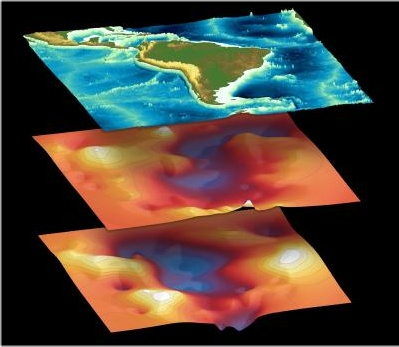




Last summer, researchers writing in the international journal Tectonics concluded that geological faults in the Sichuan Basin, China “are sufficiently long to sustain a strong ground-shaking earthquake, making them potentially serious sources of regional seismic hazard."

An international team of scientists including Dr. Alexander Densmore (Institute of Hazard and Risk Research, Durham University), Dr. Mike Ellis (Head of Science for Climate Change at the British Geological Survey) and colleagues from research institutes in Chengdu, carefully mapped and analysed a series of geologically young faults that cross Sichuan Province like recently healed scars.

The team mapped the densely populated Sichuan Basin and adjacent mountains using what is known as ‘tectonic geomorphology’. This technique can demonstrate significant changes in ground movement over time, such as observations of offset river channels, disrupted floodplains, abnormally shaped valleys and uplifted landscape features. These subtle signals of deformation, when combined with the ability to measure the age of the disfigured landscapes (using cosmogenic nuclides that bombard the Earth from all corners of the universe), produced surprising results.

Changing the sugars attached to a hormone produced in the pituitary gland increased fertility levels in mice nearly 50 percent, a research group at Washington University School of Medicine in St. Louis has found. The change appears to alter a reproductive "thermostat," unveiling part of an intricate regulatory system that may one day be used to enhance human fertility.

Sugars are the most common addition to hormones and other proteins after they have been assembled from instructions in DNA. Nearly all proteins in the blood and on the surface of cells have sugars attached. Scientists believe sugar attachments modify and adapt proteins, enabling them to fill more than one job or changing the way they do their jobs in different contexts. But direct demonstration of such changes has been challenging.

"To adjust for the right amount of key reproductive hormones such as estrogen and testosterone, we may someday alter the sugars that are added to this hormone or others like it," says the group's leader, Jacques Baenziger, M.D., Ph.D., professor of pathology and immunology and of cell biology and physiology.

New data from an international, multicenter Phase III clinical trial has found that the experimental targeted therapy everolimus (RAD001) significantly delays cancer progression in patients with metastatic kidney cancer whose disease had worsened on other treatments. The study was led by Robert Motzer, MD, an attending physician at Memorial Sloan-Kettering Cancer Center (MSKCC), who will present the findings on May 31 at the annual meeting of the American Society for Clinical Oncology.

“This study has given us a new and clearly useful tool for treating renal cell tumors, and everolimus is an important step forward in terms of disease management and quality of life for patients living with this disease,” said Dr. Motzer.

Kidney cancer is among the ten most common cancers in both men and women. The American Cancer Society estimates that there will be about 54,390 new cases of kidney cancer diagnosed in the US in 2008, and that about 13,010 people will die from the disease.

When a child has a medical problem, doctors see the child and parent together. It would be unusual to have a clinician meet alone with a minor with an illness or injury or a regular check-up. But this situation is reversed in child psychology. Parents are often asked to wait outside while a child is evaluated, and young patients are assured that nothing they say has to be discussed with mom and dad. This safeguard is meant to make children feel safe, and allow safe disclosure of abuse, but parents unfamiliar with this convention in psychological treatment often report feeling uncomfortable and even judged as bad parents.

An obese oddball of a star has left astronomers wondering how it could have formed.

Found with the Arecibo radio telescope in Puerto Rico, the star is a pulsar – a compact, rapidly spinning star – called J1903+0327. It lies 20,000 light-years away spinning at a rate of 465 revolutions per second – the fifth fastest-spinning pulsar known in our Galaxy.

Astronomers believe such super-fast pulsars started life as the more common, sedate pulsars that spin only a few times a second, but were later ’reborn‘ in their present hyperactive state. This re-birthing or recycling can take place, astronomers think, if the pulsar has a nearby companion that it orbits. At a certain point in its life cycle, the companion pours its own matter onto the pulsar and this extra material ‘spins-up‘ the pulsar.

A new study reveals the genetic identity of human immunodeficiency virus (HIV), the version responsible for sexual transmission, in unprecedented detail.

The finding provides important clues in the ongoing search for an effective HIV/AIDS vaccine, said researchers at the University of Alabama at Birmingham (UAB). The UAB team found that among billions of HIV variants only a few lead to sexual transmission.

Earlier studies have shown that a ‘bottleneck’ effect occurs where few versions of the virus lead to infection while many variants are present in the blood. The UAB study is the first to use genetic analysis and mathematical modeling to identify precisely those viruses responsible for HIV transmission.

Sweden's mountains are growing greener. At the border between woods and bare mountain, trees that require warm temperatures, such as oak, elm, maple, and black alder, have become established for the first time in 8,000 years. This is shown in current studies led by Leif Kullman, professor of physical geography at Umeå University in Sweden.

Over the last century, the temperature has risen by more than one degree. The cooling trend over several thousand years is broken, and this has triggered changes in flora, fauna, and landscapes. In important respects, the present state is similar to what occurred directly after the latest ice age.

“Most noticeable, alongside the melting of glaciers, is an elevating of the timberline by 200 meters. Bare alpine areas are shrinking, and typical Nordic mountain birch forests are losing ground to spruce and pine, which are more competitive in a warmer and drier climate,” says Leif Kullman.

Physics can explain the cycle of the earth around the sun, but what drives cellular cycles? Two of the most important cycles in cells are the series of events that take place when cells divide, and circadian rhythms - the cycle of day-night events that even bacteria participate in.

Unlike a planet, a cell's cycle can't be described by simple physical laws, nor does it have a CPU like a computer to keep time and and control the order of events. So how do cells control their cycles? Researchers have been trying to reverse engineer cell cycles, and two recent successes give a fascinating molecular view of what's going on.

The human race was divided into two separate groups within Africa for as much as half of its existence, says a Tel Aviv University mathematician. Climate change, reduction in populations and harsh conditions may have caused and maintained the separation.

Dr. Saharon Rosset, from the School of Mathematical Sciences at Tel Aviv University, worked with team leader Doron Behar from the Rambam Medical Center to analyze African DNA. Their goal was to study obscure population patterns from hundreds of thousands of years ago.

Rosset, who crunched numbers and did the essential statistical analysis for the National Geographic Society's Genographic Project, said the team was trying to understand the timing and dynamics of the split into at least two separate groups.

Professor John Burn is Medical Director of the Institute of Human Genetics at Newcastle University, where some of the most controversial stem cell research in the UK takes place.

He's taking on a formidable task as the UK parliament debates controversial amendments to the 1990 Human Fertilisation and Embryology Act - namely helping determine at what point a cell becomes a human.

Concerns about the misuse of funds, threats to the structure of the family, and the dangers of admixed (hybrid) embryos can all be adequately addressed without an act of parliament. Stem cell research is done in a highly regulated environment, with statutory bodies such as the Human Fertilisation and Embryology Authority (HFEA) having access to the requisite expertise. The authority has already proved its ability to reach reasoned conclusions on similarly touchy subjects.



