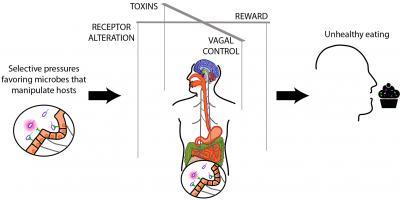



It sounds like science fiction, but a new paper in the journal BioEssays
 says that bacteria within us — which outnumber our own cells about 100-fold — may very well be affecting both our cravings and moods to get us to eat what they want, and often are driving us toward obesity. 

The scholars from UC San Francisco, Arizona State University and University of New Mexico concluded that from a review of the recent scientific literature that microbes influence human eating behavior and dietary choices to favor consumption of the particular nutrients they grow best on, rather than simply passively living off whatever nutrients we choose to send their way.

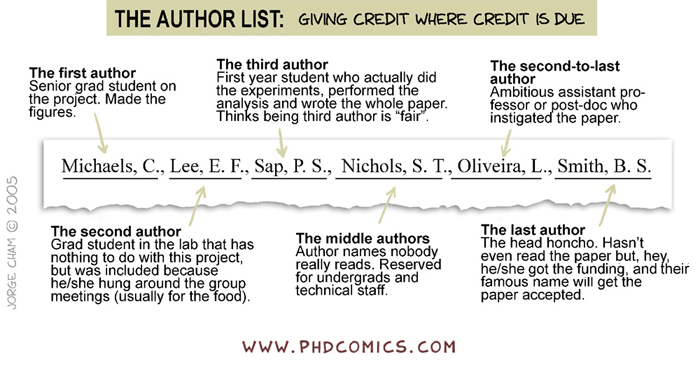
There has always been a bit of good-natured humor when it comes to who gets credit for what in a long line of citations.

Occasionally, it can be strange, like when one person who contributed to the I.P.C.C. claims to be a Nobel laureate, but most often there is a pecking order to science papers.

This does not keep science humorosts like Jorge Cham at PhDComics.com from cutting to the heart of the matter, as they did on figuring out citations way back in 2005:

There's evidence that a child's future health is influenced by more than just their parents' genetic material and can be impacted by environmental factors, but what is being done with that is something of a concern.

Astronomers have produced new maps of the material located between the stars in the Milky Way, which could move science closer to cracking a stardust puzzle nearly a century old.

 The researchers say their work demonstrates a new way of uncovering the location and eventually the composition of the interstellar medium—the material found in the vast expanse between star systems within a galaxy. 

This material includes dust and gas composed of atoms and molecules that are left behind when a star dies. The material also supplies the building blocks for new stars and planets.

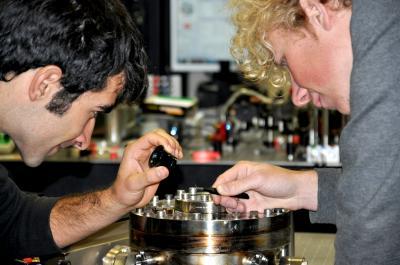
Laser physicists have found a way to make atomic-force microscope probes 20 times more sensitive, using laser beams to cool a nanowire probe to minus 265 degrees Celsius. 

Atomic force microscopes achieve extraordinarily sensitivity measurements of microscopic features by scanning a wire probe over a surface.
The technique makes it capable of detecting forces as small as the weight of an individual virus.

The development could be used to improve the resolution of atomic-force microscopes, which are the state-of-the-art tool for measuring nanoscopic structures and the tiny forces between molecules.

Transport accounts for an up to 30% of CO2 emissions in the EU, with estimates claiming that emissions from that sector rose 36% between 1990 and 2007. 

A new analysis conducted by Lund University and the University of Surrey takes on the widely-held view that new technologies, such as biofuel and improved aircraft design, will result in carbon reduction targets being met. 

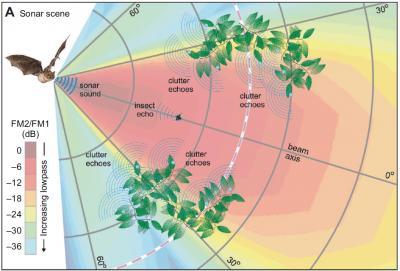
How people and animals focus on distinct objects within cluttered scenes is a long-standing neuroscience debate and a great deal of research has looked to the way bats "see" with their ears for answers.

There has been discussion among cosmologists about galileons, a hypothetical class of effective scalar fields which are extremely universal and arise generically in describing the short distance behavior of the new degrees of freedom introduced during the process of modifying gravity, and in describing the dynamics of extra dimensional brane worlds.  They might be able to explain dark matter - no cosmological constant needed.

Despite prolific use of the term 'theory', they are math that hopes to become physics.

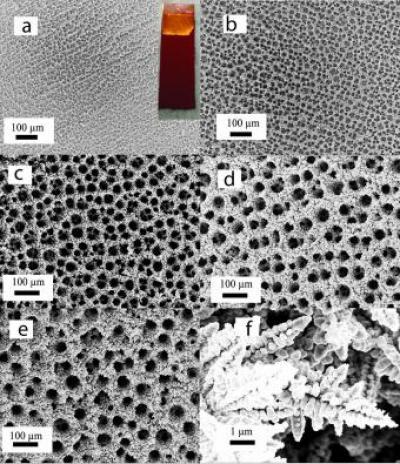
A catalyst made from a foamy form of copper has vastly different electrochemical properties from catalysts made with smooth copper in reactions involving carbon dioxide, a new study shows. The research suggests that copper foams could provide a new way of converting excess CO2 into useful industrial chemicals.

As levels of carbon dioxide in the atmosphere continue to rise, researchers are looking for ways to make use of it. One approach is to capture CO2 emitted from power plants and other facilities and use it as a carbon source to make industrial chemicals, most of which are currently made from fossil fuels. The problem is that CO2 is extremely stable, and reducing it to a reactive and useful form isn't easy.

A new study identifies a novel gene, Inpp4b, that controls nerve conduction velocity. Investigators report that even minor reductions in conduction velocity may aggravate disease in multiple sclerosis (MS) patients and in mice bred for the MS-like condition experimental autoimmune encephalomyelitis (EAE).

