



With hot, new technologies, biologists are taking higher-resolution snapshots of what's going on inside the cell, but the results are stirring up controversy. One of the most interesting recent discoveries is that transcription is everywhere: DNA is transcribed into RNA all over the genome, even DNA that has long been thought to have a non-functional role. What is all of this transcription for? Does the 'dark matter' of the genome have some cryptic, undiscovered function?

BOSTON ––– In a new study of terminally ill cancer patients, researchers at Dana-Farber Cancer Institute found that those who draw on religion to cope with their illness are more likely to receive intensive, life-prolonging medical care as death approaches –– treatment that often entails a lower quality of life in patients' final days.

Previous research has shown that more religious patients often prefer aggressive end-of-life (EOL) treatment. The new study –– to be published in the March 18 issue of the Journal of the American Medical Association –– examined whether these patients actually receive such care. The study's findings suggest that physicians tend to comply with religious patients' wishes for more aggressive care.

Preliminary research in healthy men suggests that the narcolepsy drug modafinil, increasingly being used to enhance cognitive abilities, affects the activity of dopamine in the brain in a way that may create the potential for abuse and dependence, according to a study in the March 18 issue of JAMA.

DURHAM, N.C. -- Somewhere out there in the ocean, SpongeBob SquarePants has a teeny-tiny cousin and a humongous uncle.

That's just what one would expect from a new analysis of body sizes across all orders of animal life that was conducted by researchers at the National Evolutionary Synthesis Center (NESCent), in Durham, N.C. and the University of North Carolina, Chapel Hill.

Researchers Craig McClain and Alison Boyer created a giant database on body sizes across all orders of animal life and found that phyla -- families of animals grouped together by a similar body plan -- with the greatest diversity of species were also those with the largest range of body sizes.

When the Chinese invented gunpowder round about the 800s, they founded one half of the science of chemistry, namely bangs, the other half of course being stinks

They quickly applied it to warfare, both as an explosive in bombs, and as a propellant in rockets.  It remained the explosive for about a millennium, but in the 19th century demands both from the military and from industry created a demand for new explosive.unpowder was a low explosive which burns swiftly rather than detonates.  

How many times have you wondered where did I leave my keys?  Activity in your hippocampus and medial temporal lobes encodes the answer.
It's hard not to see the world through the lens of our own preconceptions and biases.  We tend to be more interested in other large mammals.  We're drawn to human-like qualities in pets.  But even the most benign insect is disturbingly alien when seen up close.  We also tend to use the familiar as a metaphor for understanding the unfamiliar.  Sometimes this gives us additional insight.  Other times, it leads us down the wrong path.
Okay, my last blog was a list of Spam haikus. I offer this post as self-flagellation before the scientific community at large.

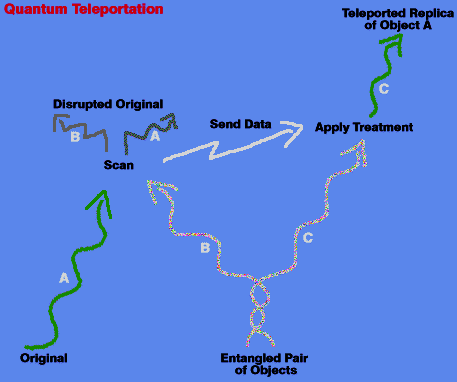
Traditionally, the crux of teleportation has been its seeming contradiction of the Uncertainty Principle, which states that you can never measure and thus know all the information contained within an atom (the more you measure, the more you disturb, until the thing no longer looks like what you started with). Without knowing the make-up of the original object, how could you replicate it across space?
NASA's Fermi Gamma-ray Space Telescope, launched June 2008, has certainly started its career with a (big) bang, discovering a new class of pulsars and watching flaring jets in galaxies billions of light-years away.

Now it's going after another cosmic mystery; high-energy particles in cosmic rays.
The description of compounds and interactions between atoms is one of the basic objectives of chemistry. Admittedly, chemical bonding models, which describe these properties very well, already exist. However, any deviation from the normal factors may lead to improving the models further. Chemists with Professor Thomas M. Klapötke at Ludwig-Maximilians-Universität (LMU) München have now analyzed a molecule, which has an extremely short bond length.

