








Prof. Leonid Yaroslavsky from Tel Aviv University believes that humans may have an ability to "see" colors and shapes - with their skin.

He outlines his 'optic-less imaging model' in a chapter of a new book, "Advances in Information Optics and Photonics", and even says it could lead to a new form of optical imaging technology that beats the limitations of today's lens-based imaging devices. This model, he says, may also explain how a controversial primordial instinct might have evolved over millions of years.

Mayo Clinic investigators have demonstrated that stem cells can be used to regenerate heart tissue to treat dilated cardiomyopathy, a congenital defect, according to research published in Stem Cells.

The study expands on the use of embryonic stem cells to regenerate tissue and repair damage after heart attacks and demonstrates that stem cells also can repair the inherited causes of heart failure.

The team reproduced prominent features of human malignant heart failure in a series of genetically altered mice. Specifically, the "knockout" of a critical heart-protective protein known as the KATP channel compromised heart contractions and caused ventricular dilation or heart enlargement.


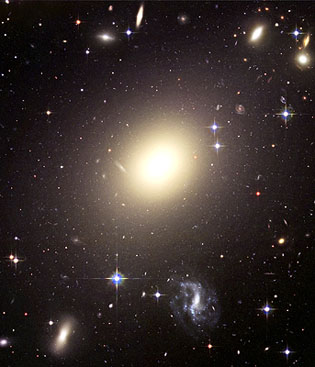
Natarajan found that ultra-massive black holes, which lurk in the centers of huge galaxy clusters like the one above, seem to have an upper mass limit of 10 billion times that of the Sun. (Credit: NASA)

There appears to be an upper limit to how big the universe’s most massive black holes can get, according to new research led by Yale University astrophysicist Priyamvada Natarajan and Ezequiel Treister, a postdoctoral fellow at the University of Hawaii.

The University of Southampton is launching the world's largest-ever study of near-death experiences this week.

The AWARE (AWAreness during REsuscitation) study is to be launched by the Human Consciousness Project of the University of Southampton - an international collaboration of scientists and physicians who have joined forces to study the human brain, consciousness and clinical death.

The study is led by Dr Sam Parnia, an expert in the field of consciousness during clinical death, together with Dr Peter Fenwick and Professors Stephen Holgate and Robert Peveler of the University of Southampton. Following a successful 18-month pilot phase at selected hospitals in the UK, the study is now being expanded to include other centres within the UK, mainland Europe and North America.

Yeast, the essential microorganism for fermentation in the brewing of beer, converts carbohydrates into alcohol and other products that influence appearance, aroma, and taste. In a study published online today in Genome Research, researchers have identified the genomic origins of the lager yeast Saccharomyces pastorianus, which could help brewers to better control the brewing process.

For thousands of years, ale-type beers have been brewed with Saccharomyces cerevisiae (brewer's or baker's yeast). In contrast, lager beer, which utilizes fermentations carried out at much lower temperature than for ale, is a more recently developed alcoholic beverage, appearing in Bavaria near the end of the Middle Ages.

Arthroscopic surgery is widely accepted as an effective treatment for osteoarthritis of the knee. It's a minimally invasive surgical procedure involving insertion of an arthroscope and other instruments into the joint through small incisions in order to remove cartilage fragments and smooth the joint surfaces. Osteoarthritis is the most common form of arthritis affecting one in ten Canadians and 27 million Americans.

A landmark study conducted in London, Canada at The University of Western Ontario and Lawson Health Research Institute shows that a routinely practiced knee surgery is ineffective at reducing joint pain or improving joint function for sufferers of osteoarthritis. The study appears in the September 11th New England Journal of Medicine.

Burst Alert! March 19th was an exciting day for NASA. We know “why” it was special, but we don’t know “why why” it was special. They finally explain the why why today, and you can read all about it in Nature tomorrow. There was something amazing about GRB 080319B and the other cosmic bursts that NASA’s Swift satellite detected that day. (See NASA's animation of what they think happened). "Even by the standards of gamma-ray bursts, this burst was a whopper," says Swift lead scientist Neil Gehrels of NASA. "It blows away every gamma ray burst we’ve seen so far." Here’s the why (we'll get to the why why in a second):

It sounds like common sense to say the level of nutrients in soil determines how many different kinds of plants and trees can thrive in an ecosystem, but it's only now that mathematicians have modelled all the different possible relationships between nutrients and biodiversity in lab-based experimental ecosystems.

Writing in Nature, they found that although nutrient availability definitely has an impact on biodiversity, the precise relationship between the two depends on which species are present in the ecosystem. This means that in some cases low levels of nutrients can lead to high levels of biodiversity.

Contrary to the national "carbon budgets" as outlined in the Kyoto Protocol, a new analysis in Nature suggests that old growth forests are "carbon sinks" and they continue to absorb carbon dioxide from the atmosphere and mitigate climate change for centuries.

Old growth forests around the world are not protected by international treaties and have been considered of no significance in the Kyoto Protocol. That perspective was largely based on findings of a single study from the late 1960s and these scientists now say it needs to be changed.

An analysis of 519 different plot studies found that about 15 percent of the forest land in the Northern Hemisphere is unmanaged primary forests with large amounts of old growth, and that rather than being irrelevant to the Earth's carbon budget, they may account for as much as 10 percent of the global net uptake of carbon dioxide.

What do you call a supernova that is not as powerful and doesn't destroy the star?

A babynova? Subnova?

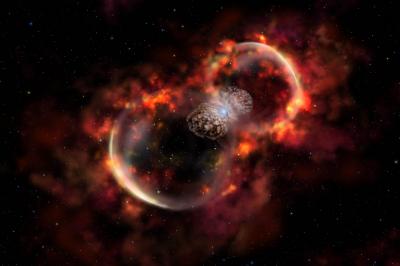
We'll need to think of something, according to Berkeley astronomer Nathan Smith, because that is what happened in 1843 to Eta Carinae, the galaxy's second most studied star.

Eta Carinae (η Car) is a massive, hot, variable star visible only from the Southern Hemisphere, and is located about 7,500 light years from Earth in a young region of star birth called the Carina Nebula. It was observed to brighten immensely in 1843, and astronomers now see the resulting cloud of gas and dust, known as the Homunculus nebula, wafting away from the star. A faint shell of debris from an earlier explosion is also visible, probably dating from around 1,000 years ago.

