Calculations by Ryan O'Leary and Avi Loeb of the Harvard-Smithsonian Center for Astrophysics suggest that hundreds of massive black holes, left over from the galaxy-building days of the early universe, may wander the Milky Way. Rogue black holes roaming our galaxy, threatening to swallow anything that gets too close? Do we call the UN?
No, Earth is safe. The closest rogue black hole should reside thousands of light-years away. Astronomers are eager to locate them, though, for the clues they will provide to the formation of the Milky Way.
As you know, when different species directly compete for the same finite resource, only the fitter will survive. A new study in Proceedings of the National Academy of Sciences (PNAS) says they have demonstrated that in a laboratory environment, along with how, when given a variety of resources, the different species will evolve to become increasingly specialized, each filling different niches within their common ecosystem.
We're big fans of
oxytocin understanding. It generally makes people nicer and and relationships are difficult. When you introduce stressful issues into relationships, such as home finances, it can only get worse. Oxytocin has been found to make relationships a little less difficult because it can take the "edge" off sensitive discussions.
The actual biology of human social relationships is just beginning to emerge as research on social cognition conducted in animals is now informing research in humans.
According to a 19th century nursery rhyme, the biological distinctions between males and females are thus:
What are little boys made of?
What are little boys made of?
Frogs and snails
And puppy-dogs' tails,
That's what little boys are made of.
What are little girls made of?
What are little girls made of?
Sugar and spice
And all things nice,
That's what little girls are made of.
This was pre-Mendel but we bet he agreed. Boys seem to really get cheated on cute rhymes about gender differences. But what came first, the rhyme or the differences?
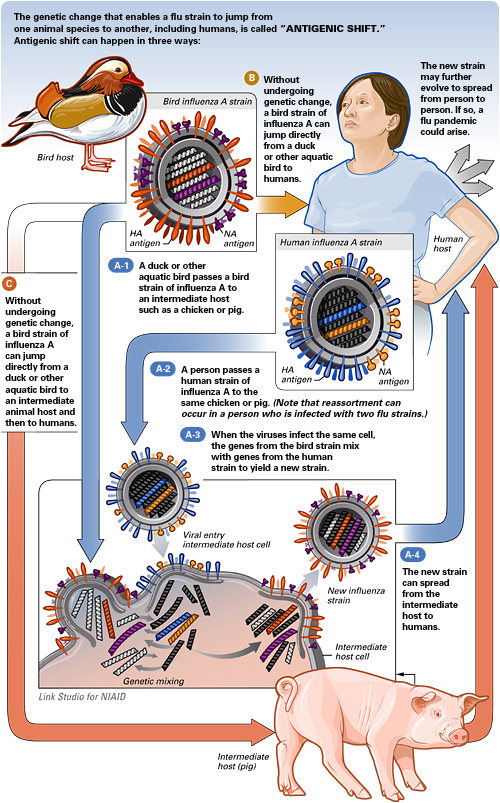
If you haven't heard of swine flu - Influenza A H1N1 - by now... well, you have unless you can't read, which means you aren't on this website. Reading too many popular media articles may have led you to believe there's an epidemic on your doorstep. Fortunately, it's just an epidemic of hysteria. The number of reported swine flu cases (no deaths edit - okay, one death, still not worth a panic) in the US is 1/1000th of the regular flu deaths that occur each year. Although a H1N1 vaccine is a few months off and would undoubtedly cure your hysteria, perhaps in the mean time learning more about thine swine flu enemy will lessen your inner fears of the microbial unknown.

Summer is coming. The time of camping and icy cold drinks. I've been working on developing a freeze dried beer that comes in a small pack and rehydrates fully carbonated with all its alcohol intact.
The march toward understanding the etiology of autism took a giant step foward today.
In a landmark genome-wide association study, published online today in Nature, researchers found that a variant on chromosome 5 was about 20 percent more common in autistic children.
Researchers examined DNA from more than 3,100 people in 780 families (with at least two autistic children), and then looked at an additional 1,200 individuals from families affected by autism, as well as nearly 6,500 healthy controls.
These are hard times for evil guys like me, who are always willing to speculate wildly on particle physics results -only to secretly chuckle at the ripples their extrapolations make, knowing for a fact that the Standard Model is as solid as it has ever been.
Suggestive new results which offer themselves as the first hint of a breakdown of the Standard Model are indeed quite rare nowadays. In a
famous post which originated a $1000 bet (taken up in part by Prof. Gordon Watts and in part by Prof. Jacques Distler), no less than 32 months ago I was writing in my old blog:
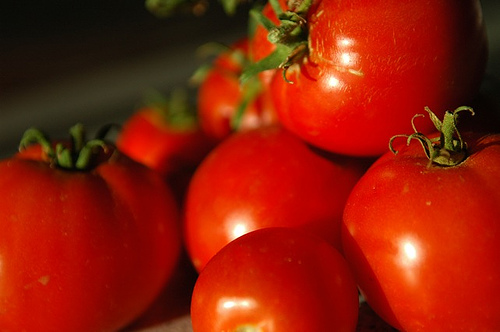
We all know that we should eat our fruits and vegetables, but a new study suggests that they could also help prevent inflammation. According to a study conducted by researchers from UC Davis in cooperation with National Center for Food Safety and Technology in Illinois and Penn State University investigated the effects of certain tomato products and found some interesting results.
Scientists have grown increasingly interested in properties of tomatoes, as they contain the compound lyocpene, a powerful antioxidant, as well as vitamins A, C, fiber, potassium and beta-carotene. All of these nutrients do a body good, but tomatoes may also help stave off chronic conditions, aided by increased inflammation.
Richard Dawkins doesn’t usually strike me as being naïve, but one has to wonder when Dawkins abandons himself to the following sort of writing about his favorite topic these days, the incompatibility between science and religion, on his web site: