
Indiana Jones isn't the only one who has great adventures, apparently proteins do also. Researchers have uncovered a a slippery tube that funnels proteins into a 'chamber of doom' where they are shredded and recycled into the building blocks of new proteins.

The tube is part of the 26S proteasome, an enzyme that acts as the cell’s protein garbage disposal. As described by researchers from the Technion-Israel Institute of Technology and the University of Texas Health Science Center at San Antonio, the tube is a concentric stack of rings wrapped in molecular motors that speed the proteins toward the proteasome’s slicing and dicing core.

Bats, outnumbered only by rodents in number of species and thus the second largest group of mammals, are a remarkable evolutionary success story. Now they have gotten even more interesting. Researchers of the Leibniz-Institute for Zoo and Wildlife Research in Berlin (Germany) and Boston University (U.S.A.) have discovered a place that harbors the highest number of bat species ever recorded.

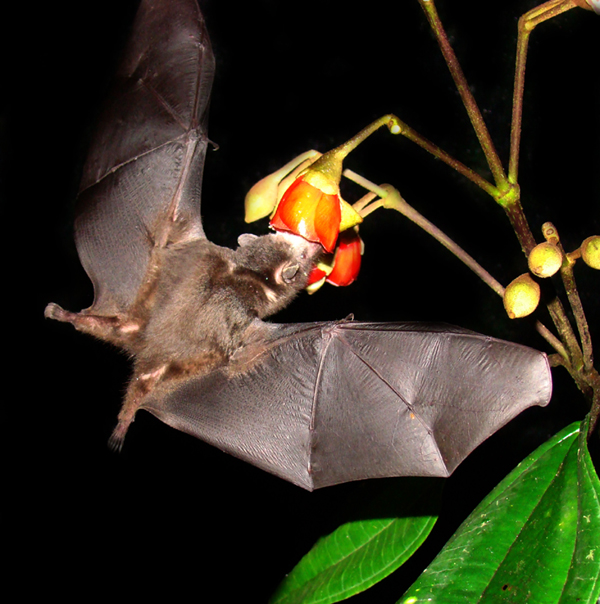
In just a few hectares of rainforest in the Amazon basin of eastern Ecuador, they have found more than 100 species of bats.

Dr. Katja Rex and colleagues captured bats at several biodiversity hotspots in the New World tropics, in the lowland rainforest of Costa Rica, the slopes of the Andes and a site in the Amazon rainforest of Eastern Ecuador, at the Tiputini Biodiversity Station located adjacent to the Yasuní Biosphere Reserve.

Like birds of a feather bikers in a peloton stick together. The formation used by competitive bikers, especially in the Tour De France, has to do with energy conservation and courtesy.
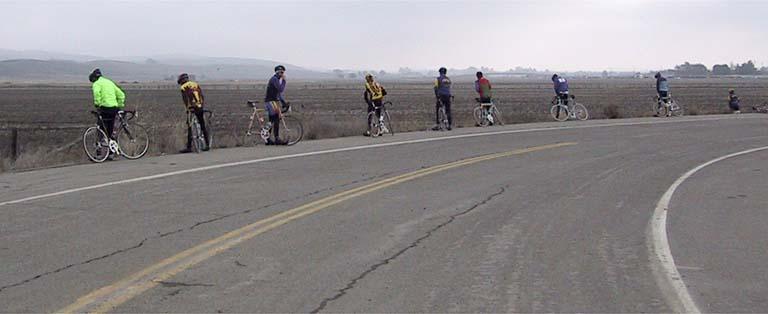
Peloton is a French word meaning “rolled up ball.” In English it is referred to as a “platoon.” It is crucial for cyclists who are expending a lot of energy for a significant amount of time to take advantage of this pack.

In the 2003 book “High-Tech Cycling” by Edmund R. Burke, he talks about the peloton as a huge source of energy in some cases reducing drag against wind up to 40 percent.

Like birds of a feather bikers in a peloton stick together. The formation used by competitive bikers, especially in the Tour De France, has to do with energy conservation and courtesy.

Peloton is a French word meaning “rolled up ball.” In English it is referred to as a “platoon.” It is crucial for cyclists who are expending a lot of energy for a significant amount of time to take advantage of this pack.

In the 2003 book “High-Tech Cycling” by Edmund R. Burke, he talks about the peloton as a huge source of energy in some cases reducing drag against wind up to 40 percent.

It looks almost scary with its one armed, three fingered, 1.45-meter-high, flexible physique. However the extent that it will rid its master’s house of any mess is anything but daunting.

Research scientists at the Fraunhofer Institute for Manufacturing Engineering and Automation IPA in Stuttgart, Germany have developed a new top-of-the-line robot they call “Care-O-bot® 3,” which is predicted to revolutionize modern housekeeping styles.

Maxine Clarke highlights a bit of recent controversy regarding Open Notebook Science that has been bouncing around the blogosphere and FriendFeedosphere. There are some who interpret the ongoing publication of our laboratory notebook as an expectation for the world to read it like a magazine. For someone who is not a collaborator or working in a related area that would make about as much sense as reading the phone book. Here is an example of how an Open Notebook should be used:

Fairbanks, Alaska—A 150-meter ice core pulled from the McCall Glacier in the Arctic National Wildlife Refuge this summer may offer researchers their first quantitative look at up to two centuries of climate change in the region.

The core, which is longer than 11/2 football fields, is the longest extracted from an arctic glacier in the United States, according to Matt Nolan, an associate professor at the University of Alaska Fairbanks Institute of Northern Engineering who has led research at McCall Glacier for the past six years. The sample spans the entire depth of the glacier and may cover 200 years of history, he said.

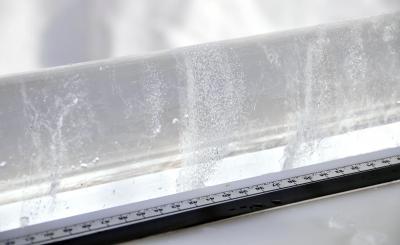
 A section of ice core shows bands of bubbles frozen within the ice of McCall Glacier.

The nation's fourth and eighth graders scored higher in reading and mathematics than they did during their last national assessment, according to the federal government's latest annual statistical report on the well-being of the nation's children. Not all the report's findings were positive; there also were increases in the adolescent birth rate and the proportion of infants born at low birthweight.

These and other findings are described in America's Children in Brief: Key National Indicators of Well-Being, 2008. The report is compiled by the Federal Interagency Forum on Child and Family Statistics, a working group of Federal agencies that collect, analyze, and report data on issues related to children and families, with partners in private research organizations. It serves as a report card on the status of the nation's children and youth, presenting statistics compiled by a number of federal agencies in one convenient reference.

The report: Fuel for thought – The future of transport fuels: challenges and opportunities addresses two serious issues – the need to dramatically reduce the transport sector's greenhouse gas emissions and, how to deal with the economic risks associated with increasingly costly and scarce oil supplies.

The report is the result of a year's deliberations by the Future Fuels Forum (FFF) which was convened by CSIRO to engage leading community, industry and government bodies in discussions about a range of plausible scenarios for establishing a secure and sustainable transport fuel mix to 2050.

Director of CSIRO's Energy Transformed Flagship, Dr John Wright, said Australia's transport fuel mix will substantially change in response to issues such as climate change and oil prices.

Genetic recombination in germ cells leads to offspring with a new genetic make-up and influences the course of evolution.

In the current issue of Nature, researchers at the European Molecular Biology Laboratory (EMBL) in Heidelberg, Germany, and the EMBL-European Bioinformatics Institute (EMBL-EBI) in Hinxton, UK, have presented the most precise map of genetic recombination yet and they say it sheds light on fundamental questions about genetic shuffling and has implications for the tracking of disease genes and their inheritance.

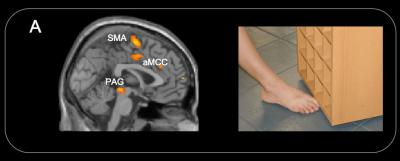
Children between the ages of seven and 12 appear to be naturally inclined to feel empathy for others in pain, according to researchers at the University of Chicago, who used functional Magnetic Resonance Imaging (fMRI) scans to study responses in children.

The responses on the scans were similar to those found in studies of adults. Researchers found that children, like adults, show responses to pain in the same areas of their brains. The research also found additional aspects of the brain activated in children, when youngsters saw another person intentionally hurt by another individual.

"This study is the first to examine in young children both the neural response to pain in others and the impact of someone causing pain to someone else," said Jean Decety, Professor in the Departments of Psychology and Psychiatry at the University of Chicago, who reported the findings in the article, "Who Caused the Pain? An fMRI Investigation of Empathy and Intentionality in Children," published in the currrent issue of Neuropsychologia. Joining him as co-authors were University students Kalina Michalska and Yuko Aktsuki.