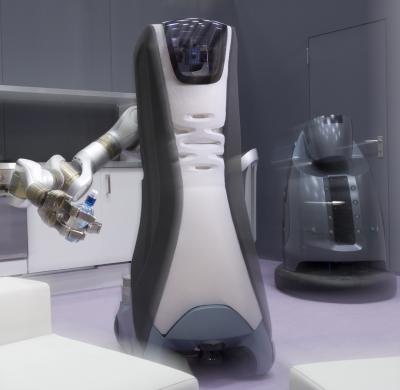








It looks like the folks behind Disney's WALL-E have some real-world competition. It's Care-O-bot® 3, the 1,45 meter tall prototype of a new generation of service robots designed to help humans in the household. The quick-to-learn assistant was developed by research scientists at the Fraunhofer Institute for Manufacturing Engineering and Automation IPA in Stuttgart.

But how does the robot know where to find the items it needs? And what has been done to make sure the robot does not inadvertently touch a human with its arm? It is fitted with numerous sensors to prevent this from happening. Stereo-vision color cameras, laser scanners and a 3-D range camera enable Care-O-bot® 3 to register its surroundings in three dimensions in real time. If a person moves into the radius of its arm, it stops moving. Another feature of the small, flexible helper is that it can move in any direction. "This is made possible by an omnidirectional platform with four separately steered and driven wheels," explains Birgit Graf, who heads the domestic and personal service robotics group at IPA. "In this way, the robot can even pass safely through narrow places in an apartment." The new Care-O-bot® has a highly flexible arm with seven degrees of freedom and a hand with three fingers. This allows it to pick up bottles, cups and similar objects and to operate machines. Force sensors prevent it from gripping too hard. The arm and the grippers were developed by Schunk.

 The new Care-O-bot has a highly flexible arm and a three-finger hand with which it can pick up items such as a bottle. Force sensors prevent it from gripping too hard.

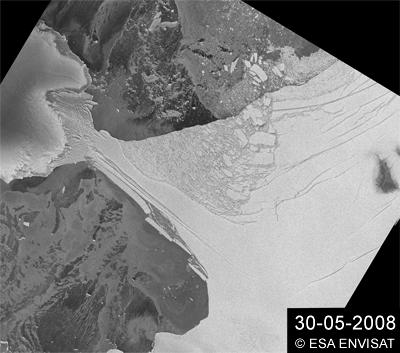
The Wilkins Ice Shelf is experiencing further disintegration that is threatening the collapse of the ice bridge connecting the shelf to Charcot Island. Since the connection to the island in the image centre helps to stabilise the ice shelf, it is likely the break-up of the bridge will put the remainder of the ice shelf at risk.

This animation, comprised of images acquired by Envisat's Advanced Synthetic Aperture Radar (ASAR) between 30 May and 9 July 2008, shows the break-up event which began on the east (right) rather than the on west (left) like the previous event that occurred last month. By 8 July, a fracture that could open the ice bridge was visible.

According to the image acquired on 7 July 2008, Dr Matthias Braun from the Center for Remote Sensing of Land Surfaces at Bonn University estimates the area lost on the Wilkins Ice Shelf during this break-up event is about 1350 km² with a rough estimate of 500 to 700 km² in addition being lost if the bridge to Charcot Island collapses.

Scientists and journalists get along much better than the anecdotal 'horror stories' would lead us to believe, according to new research published today in the journal Science, which has found that 57% of researchers were 'mostly pleased' with their media interaction, while only 6% percent were 'mostly dissatisfied'.

Previous research as well as anecdotal evidence has tended to focus on the negative aspects of scientists' media interaction, but today's survey, based on the responses of 1354 scientists working in the high-profile research fields of epidemiology and stem cell research in the UK, US, France, Germany and Japan, suggests that, for the most part, scientists are comfortable dealing with journalists.

The international team who produced the study asked the scientists how much they had to do with the media, and to evaluate their interactions with them, including whether they were 'misquoted' by 'biased' journalists, or whether they were able to 'get their message out'.

A third of reef-building corals around the world are threatened with extinction, according to the first-ever comprehensive global assessment to determine their conservation status. The study findings were published today by Science Express.

Leading coral experts joined forces with the Global Marine Species Assessment (GMSA) – a joint initiative of the International Union for Conservation of Nature (IUCN) and Conservation International (CI) – to apply the IUCN Red List Categories and Criteria to this important group of marine species.

"The results of this study are very disconcerting," stated Kent Carpenter, lead author of the Science article, GMSA Director, IUCN Species Programme. "When corals die off, so do the other plants and animals that depend on coral reefs for food and shelter, and this can lead to the collapse of entire ecosystems."

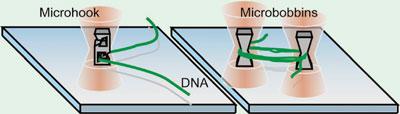
Japanese scientists have made a micro-sized sewing machine to sew long threads of DNA into shape. The work published in the Royal Society of Chemistry journal Lab on a Chip demonstrates a unique way to manipulate delicate DNA chains without breaking them.

Scientists can diagnose genetic disorders such as Down's syndrome by using gene markers, or "probes", which bind to only highly similar chains of DNA. Once bound, the probe's location can be easily detected by fluorescence, and this gives information about the gene problem.

Detecting these probes is often a slow and difficult process, however, as the chains become tightly coiled. The new method presented by Kyohei Terao from Kyoto University, and colleagues from The University of Tokyo, uses micron-sized hooks controlled by lasers to catch and straighten a DNA strand with excellent precision and care.

However much popular television chefs like Jamie Oliver or Gordon Ramsay might want to shake up our diets, culinary evolution dictates that our cultural cuisines remain little changed as generations move on, shows new research in the New Journal of Physics.

The research shows that three national cuisines - British, French and Brazilian – are affected by the founder effect which keeps idiosyncratic and nutritionally ambivalent, expensive and sometimes hard to transport ingredients in our diets.

Using the medieval cookery book, Pleyn Delit, and three authoritative cook books from Britain, France and Brazil, the New Penguin Cookery Book, Larousse Gastronomique and Dona Benta respectively, the researchers from the University of Sao Paulo, Brazil, compiled statistics which could be compared to see how time and distance effect the three different national cuisines.

The economic and psychological term known as “sunk-cost fallacy” is a bias that leads someone to make a decision based solely on a previous financial investment. For example, a baseball fan might attend every game of the season only because he already purchased the tickets. But not everyone would force themselves to brave the pouring rain for a single game in one season simply because they previously paid for the seats.

So who is more likely to commit or avoid the sunk-cost fallacy and why?

A group of researchers at the Technical University of Denmark and the University of Copenhagen have developed models of neural networks that make it possible to simulate how the body protects itself from disease and predict the immune system’s access codes.

The human body has its own natural inbuilt defence mechanism which uses access or “pincodes” to stop microorganisms that invade the body from discovering how the entire human immune system works. Every human being on the planet has their own unique version of this defence mechanism. But the sheer complexity of the immune system has, up until now, also made it difficult for researchers to understand how the immune system functions and develop precise immunological treatments.

Scientists have identified about two dozen genes that control embryonic stem cell fate. The genes may either prod or restrain stem cells from drifting into a kind of limbo, they suspect. The limbo lies between the embryonic stage and fully differentiated, or specialized, cells, such as bone, muscle or fat.

By knowing the genes and proteins that control a cell's progress toward the differentiated form, researchers may be able to accelerate the process – a potential boon for the use of stem cells in therapy or the study of some degenerative diseases, the scientists say.

Their finding comes from the first large-scale search for genes crucial to embryonic stem cells. The research was carried out by a team at the University of California, San Francisco and is reported in a paper in the July 11, 2008 issue of Cell.

Kombucha starts with a mushroom, but this is not a real mushroom it’s actually the skin that forms over the top of fermenting tea after it’s combined with yeast and the bacteria Acetobacter. Once the tea ferments in about one week, it has successfully become the much loved kombucha tea. In order for the tea to ferment sugar needs to be added and the bacteria can be used to ferment other liquids as well.


