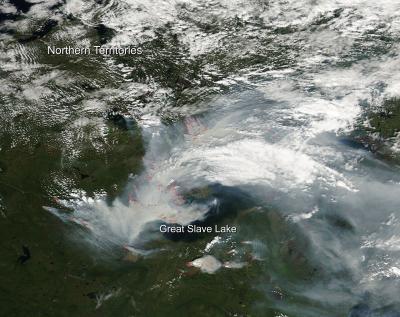

Fires and the resultant smoke that comes from them are both just as widespread and heavy as they were in the month of July. Hundreds of fires dot the landscape and the Northwest Territories Live Fire map shows the extent of the wildfires and hot spots that have been reported. Fire danger around this area of the Northwest Territories remains in either the high or extreme range.

On the live fire map, notated detections of new fires number in the dozens. These fires are ones having been detected within the last 24 hours. Residents of Yellowknife were witness to red lightning recently due to the amount of smoke in the atmosphere coloring the lightning strikes.

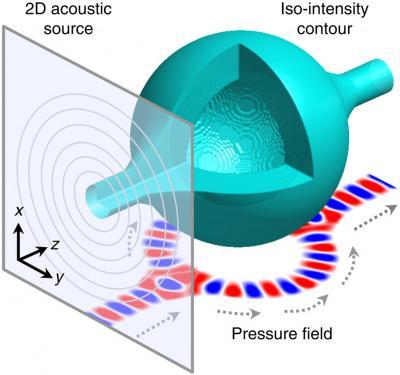
There's a new wave of sound on the horizon carrying with it a broad scope of tantalizing potential applications, including advanced ultrasonic imaging and therapy, acoustic cloaking, and levitation and particle manipulation. Researchers with the Lawrence Berkeley National Laboratory (Berkeley Lab) have developed a technique for generating acoustic bottles in open air that can bend the paths of sound waves along prescribed convex trajectories.

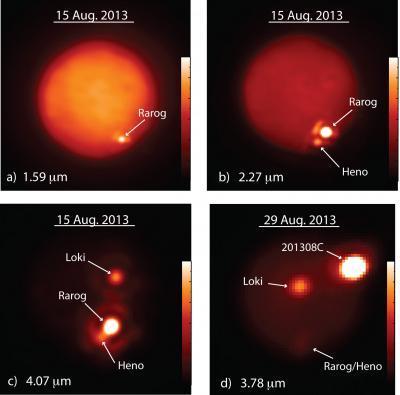
Io, the innermost of Jupiter's four large "Galilean" moons, is about the same size as Earth's moon, some 2,300 miles across, but it is very different than our moon. So different it is the only other place in the solar system that shares one trait that Earth has - volcanoes erupting extremely hot lava.

Because of Io's low gravity, large volcanic eruptions produce an umbrella of debris that rises high into space and that can be seen from Earth. Last August, astronomers did just that, capturing three massive volcanic eruptions within a two-week period.

It may be that these rare "outbursts", sending material hundreds of miles above the surface, might be much more common than astronomers thought.

Hydraulic fracturing is in the news because more natural gas has meant substantially fewer carbon emissions - and it has also been implicated in a variety of environmental issues.

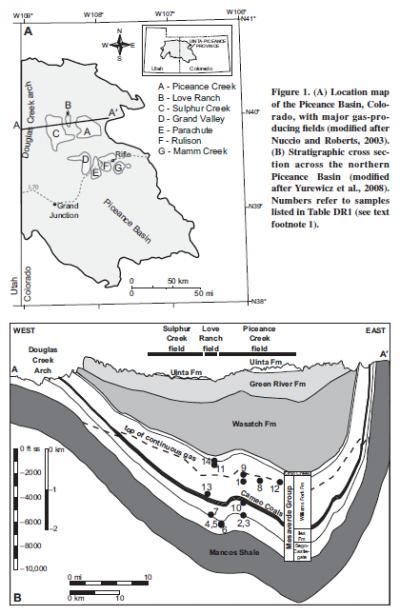
Man is doing what nature has always done, albeit on a different time scale. A new GSA BULLETIN study  examines how long it takes natural Earth processes to form hydraulic fractures and whether the formation is driven by sediment compaction, oil and gas generation or something else. Plus, in order to make environmental models about modern hydraulic fracturing production, it's important to know what role these natural fractures play.

Why are scientists at the apex of their careers least likely to adopt new technology? The quick answer is obvious, they got to where they are doing things their way and there is no reason to fix something unbroken. Younger scientists don't have much choice because they don't write the checks, the use the tools the principal investigator has.

It's scientists in the middle most likely to adopt new tools, or adopt the tools of collaborators and even competitors.

What it means for Thermo Fisher Scientific is that high-status scientists may not be the most effective use of their marketing budget. For Science 2.0 it means that adoption will not happen from the top down, counting on that will slow the pace. The sweet spot for influencers is in the middle.

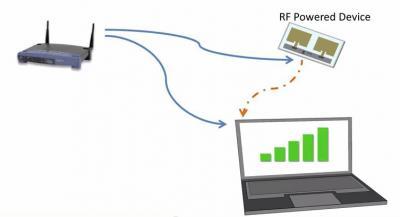
This not-so-distant "Internet of Things" will extend connectivity to billions of devices. Sensors could be embedded in everyday objects to help monitor and track everything from the structural safety of bridges to the health of your heart.

But having a way to cheaply power and connect these devices to the Internet has kept this from taking off. People are sick of batteries. They are sick of having to change them and they are irritated when they can't change them. In a world of information, there will need to be battery-free sensors.

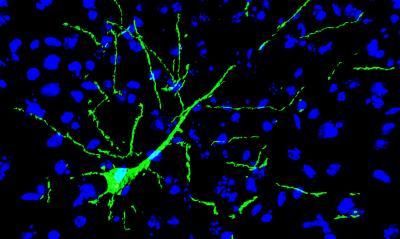
Scientists have grafted neurons reprogrammed from skin cells into the brains of mice with long-term stability for the first time. Six months after implantation, the neurons had become fully functionally integrated into the brain. 

That's equivalent to about 20 years in human terms. Successful, stable implantation of neurons raises hope for future therapies that will replace sick neurons with healthy ones in the brains of Parkinson's disease patients, for example. 

Was Spanish hurdler María José Martínez-Patiño a male or female athlete? If science can't answer such a basic biological question as that, how can it determine if Lance Armstrong took performance-enhancing drugs? Yet the answer is sometimes cloudy. 

Males and females compete in different categories because men are biologically different. If men competed against women in many events, the participation of women would be scant because men would hold win all of the events and hold most of the records.  Martínez-Patiño
was a successful hurdler in the Spanish nationals but a persistent rumor - invoked again and again by female competitors - turned out to be true; Martínez-Patiño

There's a mythology about the native Americans, that they were all peaceful and in harmony with nature - it's easy to create narratives when there is no written record.

But archeology keeps its own history and a new paper finds that the 20th century, with its hundreds of millions dead in wars and, in the case of Germany, China, Russia and other dictatorships, genocide, was not the most violent - on a per-capita basis that honor may belong to the central Mesa Verde of southwest Colorado and the Pueblo Indians.

Writing in the journal American Antiquity, Washington State University archaeologist Tim Kohler and colleagues document how nearly 90 percent of human remains from that period had trauma from blows to either their heads or parts of their arms.

Issues of crime and punishment and vengeance and justice date back to time when people first gathered and in the last few years why people decide just punishment has captured the attention of psychologists and certainly defende attorneys. 

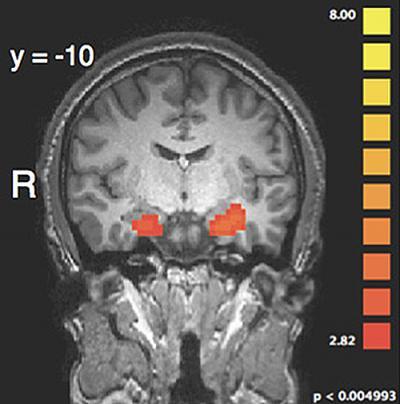
A brain imaging study in Nature Neuroscience says it can identify the brain mechanisms that underlie our judgment of how severely a person who has harmed another should be punished. Specifically, the study looked at how the area of the brain changes when an act was believed to be intentional or unintentional. They found that the imaging is different and unintentional acts  trump the emotional urge to punish the person, however gruesome the harm may be.

