



WASHINGTON — For a rare form of cancer called thymoma, researchers have discovered a single gene defining the difference between a fast-growing tumor requiring aggressive treatment and a slow-growing tumor that doesn't require extensive therapy.

Thymoma is a cancer derived from the epithelial cells of the thymus, an organ critical to the lymphatic system where T-cells, or so-called "killer cells," mature. Very little is known about the role of the gene mutation GTF2l in human tumors, but scientists from Georgetown Lombardi Comprehensive Cancer Center and the National Cancer Institute say almost all indolent (slow growing and non-aggressive) forms of thymoma they tested have the mutation. They report their finding in the ?? issue of Nature Genetics.

Optogenetics is a technology that allows scientists to control brain activity by shining light on light-sensitive proteins that can suppress or stimulate electrical signals within cells.  In the last 15 years,  optogenetics has become a common laboratory tool for shutting off or stimulating specific types of neurons in the brain, allowing neuroscientists to learn much more about their functions. 

Chlorinated chemicals perform a host of societally useful functions, but they're not perfect. Once their use life has ended, they can become environmental contaminants and even resistant to bioremediation.

In a series of new studies, Anca Delgado, a researcher at Arizona State University's Biodesign Institute, examines unique groups of microorganisms, capable of converting hazardous chlorinated chemicals like trichloroetheene (TCE) into ethene, a benign end product of microbial biodegradation. The new studies explore the metabolic activities of a group of microbes known as Dehalococcoides, and propose strategies to improve their effectiveness for environmental cleanup projects involving chlorinated chemicals.

Girls and boys learn to use language differently, according to a new study which found that girls were more likely to remember words while boys were more likely to create words and sentences in ‘real-time’.

Language scholars believe language uses both a mental dictionary and a mental grammar. The mental ‘dictionary’ stores sounds, words and common phrases, while mental ‘grammar’ involves the real-time composition of longer words and sentences. For example, making a longer word ‘walked’ from a smaller one ‘walk’. Most research into understanding how these processes work has been carried out with adults.
A new study in mice shows that even short-term consumption of a Western diet rich in saturated fats and fructose is more damaging for healthy liver development than following a high fat diet alone, which provides new insight into the effects of adding fructose to a Western diet high in fat. 

Dr. Susanna Iossa, who led the study at the University of Naples, Italy, said, “This result points to the harmful effect of adding fructose to the usual western, high-fat diet and, together with other related findings, should stimulate the discussion on the use of fructose and fructose-containing sweeteners in beverages and packaged foods.

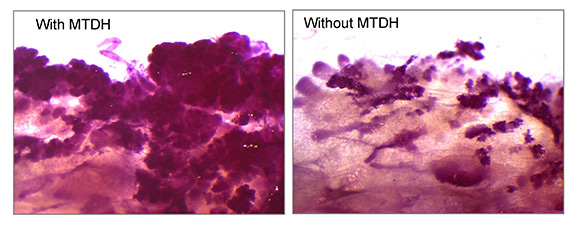
The gene Metadherin - MTDH - which is implicated in promoting the spread of breast cancer tumors, only stimulates tumor growth when the protein made by the gene interacts with a second protein known as SND1, according to a paper in Cancer Cell.

Invasive breast cancer strikes 1 in 8 women and causes roughly 40,000 deaths each year in the United States. About 20 percent of women with breast cancer go on to develop tumors that spread throughout body, are resistant to chemotherapy, and are often fatal.

In quantum physics, you can't precisely measure momentum and position simultaneously. They are an example of conjugate variables, connected by Heisenberg's Uncertainty Principle. There are workarounds, such as "weak measurement," to measure both at the same time but a new study says that a technique called compressive sensing also offers a way to measure both variables at the same time, without violating the Uncertainty Principle.

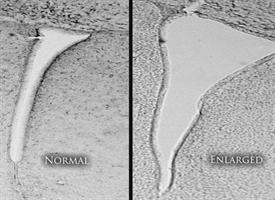
A recent paper found that exposure to air pollution early in life produces harmful changes in the brains of mice, including an enlargement of part of the brain that is seen in humans who have autism and schizophrenia, and that led them to conclude that smog causes autism.

Male mice had more changes and the mice also performed poorly in tests of short-term memory, learning ability, and impulsivity.

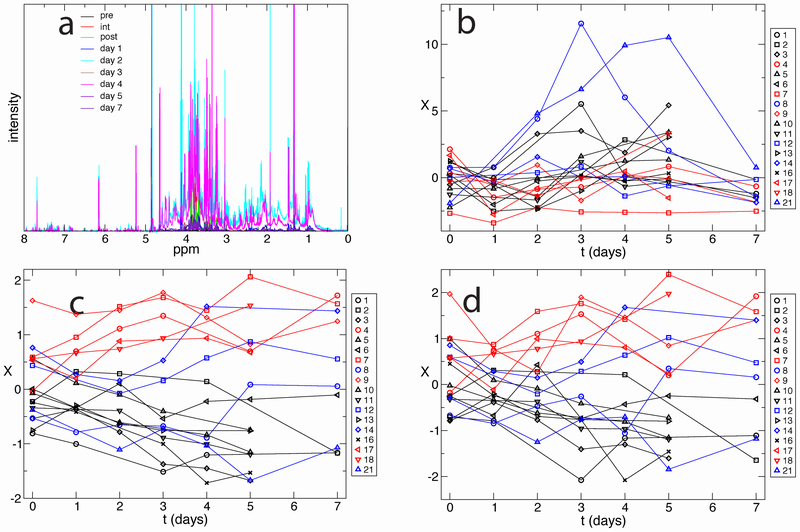
A new data analysis technique
in the journal PLoS Computational Biology improves monitoring of kidney patients and could lead to changes in the way we understand our health.

The research uses the Science 2.0 approach to make sense out of the huge number of clues about a kidney transplant patient's prognosis contained in their blood. Using big data analysis of the samples, scientists were able to crunch hundreds of thousands of variables into a single parameter indicating how a kidney transplant was faring.

That allowed the team of physicists, chemists and clinicians to predict poor function of a kidney after only two days in cases that may not previously have been detected as failing until weeks after transplant.

Kids with glasses were once stereotypically considered smarter - expensive prescription specs did not lend themselves to sports so it made some sense they would focus on books due to the biological hand that was dealt them

But it may be that needing glasses is an indicator of knowledge if other ways - glasses may be created by learning. A recent paper found hat attaining a higher level of education and spending more years in school were associated with a greater prevalence and severity of myopia - nearsightedness.

The authors say they are the first population-based study to demonstrate that environmental factors may outweigh genetics in the development of myopia.

