



The U.S. Department of Energy has approved a Small Business Innovative Research (SBIR) Phase 1 grant proposal for $149,900 to study the differential data from retrofitting a concentrated solar thermal array to the existing geothermal electrical generation system currently installed at the Oregon Institute of Technology (OIT) in Klamath Falls Oregon.

Marc Rappaport of Rappaport Energy Consulting LLC, Ridgefield, WA wrote the proposal with the assistance of Don Jeter, P.E. of Eagle Engineering&Testing Services of Bellingham, WA, and Tanya Boyd of the Oregon Institute of Technology, Geo Heat Center.
You’ve probably heard of the uproar that has recently been caused by a bill introduced by Texas Representative Lamar Smith, the chair of the US House of Representatives’ Science Committee.

Some groups insist that eating meat is bad for the environment. They even invented a bogus metric, it takes a gallon of gas to make a pound of beef, to show the environmental harm of not being a vegetarian.

It's not easy traveling to play 81 games a year across multiple time zones and the major league baseball schedule, 162 games, is the most grueling in professional sports.

Two papers outline how sleep and fatigue are key issues in performance, which makes sense. Fatigue may impair strike-zone judgment during the 162 game Major League Baseball season and a player's sleepiness can predict his longevity in the league, the authors conclude.

One study found that MLB players' strike-zone judgment was worse in September than in April in 24 of 30 teams. When averaged across all teams, strike-zone judgment was significantly worse in September compared with April. The statistical model demonstrated strong predictive value through the season.

If you live in an arid region, you know keeping it green is an environmentally stressful activity. But some arid regions have been getting greener on their own and scientists have long suspected that a flourishing of green foliage around the globe, observed since the early 1980s in satellite data, springs at least in part from the increasing concentration of carbon dioxide in Earth's atmosphere.

A study of arid regions around the globe looked into the potential of a "fertilization effect" of   carbon dioxide and found that it has, indeed, caused a gradual greening from 1982 to 2010.

How can paying less for energy cost more? When activists advocating their technology start doing math.

The EU paid 406 billion Euros for oil and gas imports in 2012 (1.1 billion Euros per day), 3.2% of its GDP, notes the European Wind Energy Association. If Europeans simply paid more to increase domestic wind power, it would increase Europe's competitiveness, they say.  Cheaper fossil fuels undermine Europe by not being cheap enough, the result of increasing fossil fuel import costs.

"The massively increasing prices for fossil fuels over the last ten years - crude oil by 14% a year, gas 10% and coal 8% - are the real danger for Europe's competitiveness", said Thomas Becker , Chief Executive Officer of the EWEA in Brussels.
[The title of this article comes from a T-shirt with ten advices on what to do when everything else fails]

It has always surprised me to realize how confident we physicists are of the good faith of our colleagues. We may argue endlessly over one graph or result, getting to the point of publically casting doubts on the dexterity or intelligence of our peers (yes, I've seen that), but we never seem to doubt -privately or otherwise- their scientific integrity.
The U.S. Food and Drug Administration (FDA) has lifted the clinical hold previously placed on a proposed Phase II study of SparVax, a next generation recombinant anthrax vaccine, PharmAthene, Inc. announced.

The clinical hold was enacted in August 2012, prior to the commencement of a proposed Phase II clinical trial of SparVax. In its notification to the Company, the FDA requested that PharmAthene provide additional stability data for both its engineering and GMP lots of U.S. manufactured Final Drug Product, as well as additional information about the intended stability indicating assays. 
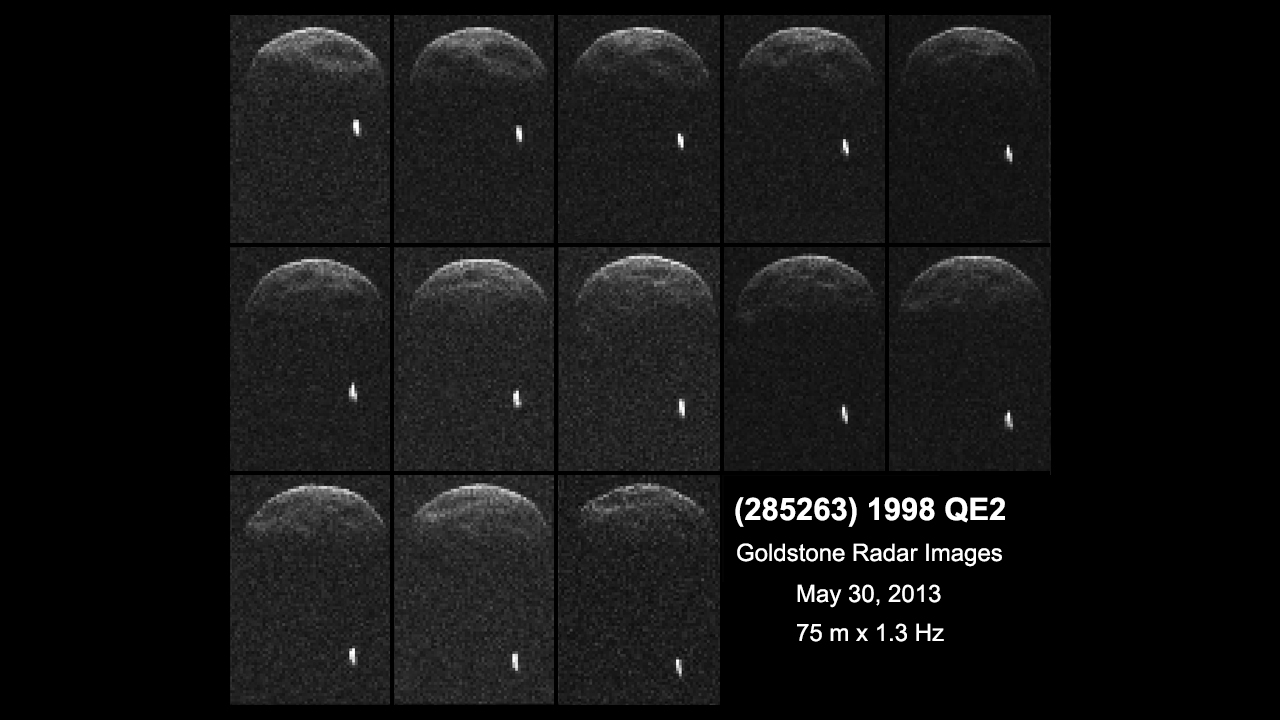
Asteroid 1998 QE2 will be its closest to Earth on Friday at 1:59 p.m. Pacific time. At 1.7 miles wide it is one of the larger asteroids to swing by Earth - about the size of the rock that wiped out the dinosaurs.

Luckily,  Asteroid 1998 QE2 will be a comfortable 3.6 million miles away.

Astronomical bonus: it even has its own moon, a smaller rock circling it that is about about 2,000 feet wide.

A sequence of radar images of asteroid 1998 QE2 was obtained on the evening of May 29, 2013, by NASA scientists using the 230-foot (70-meter) Deep Space Network antenna at Goldstone, Calif., when the asteroid was about 3.75 million miles (6 million kilometers) from Earth, which is 15.6 lunar distances.

