The British may think they 'colonized' Kenya to teach them about civilization and the modern world, but it would be the other way around today. While over 80 percent of Europeans admit they are against any GMO regardless of whether or not they can be 'proved' safe - an impossibility anyway - and some Americans on the kooky anti-science left insist they are allergic to any product that has anything to do with GM sugar beets, Kenyans are downright enlightened about food science.
Humans inherit more than three times as many mutations from their fathers as from their mothers, and mutation rates increase with the father's age but not the mother's, researchers have found in the largest study of human genetic mutations to date.
A study based on the DNA of around 85,000 Icelanders, the largest study of human genetic mutations to date, has found that humans inherit more than three times as many mutations from their fathers as from their mothers and mutation rates increase with the father's age but not the mother's.
Reading media accounts, it seems the past decade has witnessed what seems to be a cluster of large earthquakes, with massive events in Sumatra, Chile, Haiti and Japan since 2004.
Some hypothesize that this cluster has occurred because the earthquakes may be "communicating" across large distances, possibly triggering each other.
King Richard III, the last of the Plantagenets, ruled England from 1483 until he was defeated at the Battle of Bosworth in 1485, the next-to-last major battle in what would later be called The Wars of the Roses. If you're watching "Game of Thrones" on HBO, the Wars of the Roses were Lancasters instead of Lannisters and Yorks rather than Starks - the show has more dragons and less sex than the real thing. Richard III was a York and if you think that show has a lot of characters and craziness, try to follow the actual Wars of the Roses.
The anti-vaccination culture is making headway. CDC has reported 17 outbreaks and 222 measles cases from 211, mostly in unvaccinated people - the highest since 1996.
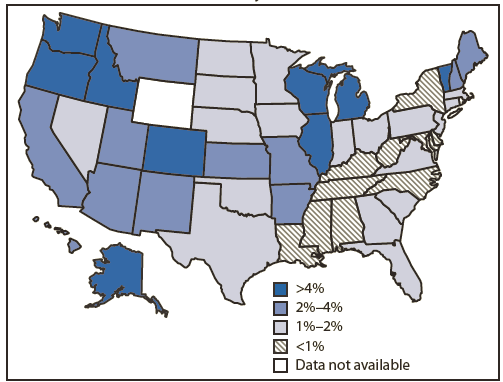
To identify areas of under-vaccination for measles and other vaccine-preventable diseases, state and local health departments monitor compliance with school immunization requirements using annual school vaccination assessment reports, supported as a CDC immunization funding objective for the 64 grantees, including the 50 states, the District of Columbia (DC), five cities, and eight other reporting areas. CDC also monitors progress toward meeting Healthy People 2020 objectives for the vaccination of children entering kindergarten.
Despite extensive regulations and preventative efforts, lead poisoning, which can damage the brain, kidneys, and nervous and reproductive systems, still occurs in the United States. Babies are also at risk. Fetal exposure to lead can adversely affect neurodevelopment, decrease fetal growth, and increase the risk for premature birth and miscarriage.
21% of adults in the United States
have at least one tattoo, according to the Centers for Disease Control (CDC) and on occasion
outbreaks of nontuberculous mycobacterial (NTM) skin infections have been reported after tattooing.
In January 2012, public health officials in New York received reports of Mycobacterium chelonae skin infections in 14 New York residents who received tattoos during September–December 2011. All infections were associated with use of the same nationally distributed, pre-diluted gray ink manufactured by "company A".
"Man, know thyself" was the challenge of ancient Greek philosophers and it has been the goal of mankind since.
Thousands of years later, neuroscientists are trying to decipher how the human brain constructs our sense of self, with mixed results. Pretty pictures mapped to activity can only tell us so much. But if self-awareness is defined as being aware of oneself, including traits, feelings, and behaviors, there are three brain regions critical for self-awareness, they say: the insular cortex, the anterior cingulate cortex and the medial prefrontal cortex.
In a long-term marriage, men tend to drink less than they did while single. That's good. But women drink more, say sociologists.