




You've seen it everywhere by now - Earth's sixth mass extinction: Is it almost here? and other articles discussing an article in Nature (471, 51–57 doi:10.1038/nature09678) claiming the end of the world is nigh.  

Hey, I like to live in important times.  So do most people.  And something so important it has only happened 5 times in 540 million years, well that is really special.    But is it real? 
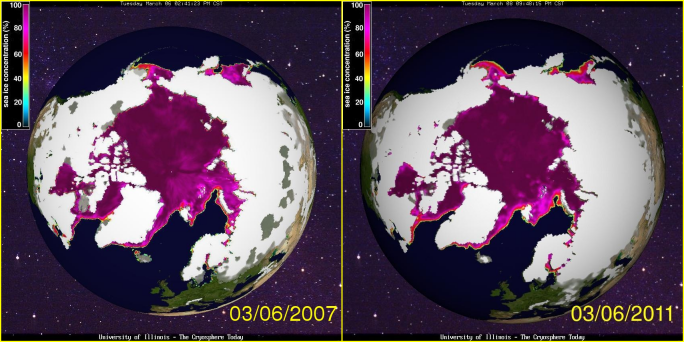
Arctic Ice March 2011 - Update #1

Edited March 11 2011 - content added below ice prediction chart to address points raised in readers' comments.

The Arctic sea ice extent has grown a little recently. 
Ice extent as of  March 10 2011 is  13749688 km2 (as reported by IJIS).  Ice extent commonly grows until the end of March.  But any ice which forms now will still be very young, thin, salty ice when the temperatures begin to rise - not forgetting that temperatures are already anomalously high over much of the Arctic.

If you want to win the NCAA College Basketball Tournament office pool and know nothing about basketball, the good news is you have just as much chance as devoted college basketball fans unless you get all crazy about it.   

One solution is to try and play it safe by picking all the top seeds in the brackets to make it to the Final Four and then using a back-azimuth strategy to determine the winners among the early games.   But upsets are almost a guarantee in the NCAA Tournament.   So what is the optimum strategy for people without a clue?

José Marian, the author of this paper about sperm injection, very kindly and promptly provided me with a copy. I began reading with an enthusiasm which only increased as I proceeded through the article. It's short, clear, and tantalizing.

Mendeley, which bills itself as the world's largest crowd-sourced research database, today announced the Mendeley API Binary Battle, challenging developers to build an application on top of Mendeley's open database of over 70 million research papers, usage statistics, reader demographics, social tags, and related research recommendations.

The prize?  $10,001. 

Modeled after Last.fm, Mendeley seeks to use its social reference manager and collaboration platform to make research more productive and transparent. This challenge is all about creating applications that open up its academic data to others. 

Some researchers have wondered why a few credibility issues in particular studies (see Marc Hauser in psychology and parts of the IPCC report in 2007 and anything at all related to cold fusion in physics) would damage the image of researchers across an entire discipline.  It's plain old psychology.
Despite what some sociologists want you to believe, it isn't always men doing the objectification of women.  At least on Facebook, some women go out of their way to be noticed.

The millenia-old contention that women care more about their appearance and use it in competition is still alive in the digital age.   A new study published in Cyberpsychology, Behavior and Social Networking contends that females who base their self worth on their appearance tend to share more photos online and maintain larger networks on online social networking sites. 
While wireless Internet has been wonderful, true wireless devices - with no need for batteries - are the real revolution needed in technology to make a more positive environmental scenario for the future.   

We're getting closer.  A doctoral student at Rensselaer Polytechnic Institute has demonstrated a new system that uses ultrasound to simultaneously transmit large quantities of data and power wirelessly, even through thick metal walls like the hulls of ships and submarines.
Booze has likely inspired many an action in researchers but any actual science effect was second order.   No more.   Scientists from the National Institute for Materials Science in Japan found that immersing pellets of an iron-based compound in heated alcoholic beverages for 24 hours greatly increase their superconducting ability.

And red wine, which has been shown to have numerous health benefits, is apparently tops in physics experiments as well.
Some people accept that the world's climate systems are changing, but try to argue that humans are too puny to be any part of the cause.

The reason for putting forward such an argument in the face of a wealth of historical and scientific data seems to be a matter of political agenda: if humans are too puny to cause climate change then they must surely be too puny to put matters right.  It follows that 'right thinking people' should oppose any attempt to 'do something' about climate change - especially at the taxpayers expense.

