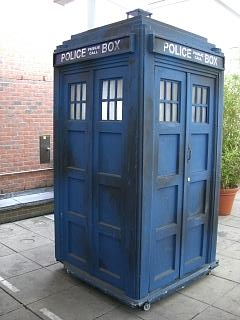




Doctor Who is always getting into some pickle or another.  Luckily he has advanced technology (and a time traveling police box/telephone booth) to help solve problems.

If defeating Daleks and keeping a temperamental TARDIS functional is in your future, we have good news;  Doctor Who's trusty sonic screwdriver gadget could become a reality for DIY types, according to Bristol University engineers who are out to show how a real life version of the fictional screwdriver, which uses sonic technology to open locks and undo screws, could be created.

Does science really need to give Tiger Woods/Brett Favre an excuse?

"Sorry, sweetheart, I didn't mean to bang anything with a hole and a heart beat that came my way/text that chick pictures of my junk. But you have to forgive me because it's in my DNA. Oh look, it's tee time/game time again."

This is PART III of the four part series about the Edge discussion between Lee Smolin and Leonard Susskind. After criticizing Smolin the last time in PART II, it is now time to turn on Susskind.

Leonard Susskind is well read, certainly enough to know about the measure (not “measurement”) problem in modern quantum physics (introduced in PART I).

Our present understanding of fundamental physics implies the existence of three generation of matter particles, which we consider structureless and "elementary", both in the sense that they cannot be divided into smaller entities, and in the sense that they are the building blocks of all observed manifestations of matter.
Back in October I wrote on the subject of the Kraken, stating rather emphatically and cantankerously that
whales eat squid. It is a unidirectional ecological interaction.
I received a very thoughtful response from one Daniel Rolph, who commented
I sat down and started writing a column on Sonification for today, then I realized I'd already written that piece-- several months ago. Whoops.

So instead, I've built an index of the Project Calliope columns by topic, so you can read the full story (so far). This index is current as of Dec 6 2010. Consider it the first half of a DIY satellite builder's guide, plus all the framing material you need to work out your own satellite high concept.  Enjoy!

Alex, projectCalliope.com, 'Around the world in 48 beats', reporting weekly on building a music/science satellite in his basement for launch in 2011.

Underlying Principals

Did you get visit here after quickly vanquishing my puzzles in this morning's New York Times Science section? If so, you're likely ready for a new challenge.

Below are the puzzles the Times cut — because they're too darn tricky or perhaps because the first gently pokes fun at the sacred cow that is Mariano Rivera. But they're certainly not too tricky for you, gentle reader.

No, no, if  you've made it this far, they're right up your alley. 
In the midst of all the lamentations that their isn't enough spending on science outreach (read: grants to do it rather than simply doing it, like we do here) or enough spending on turning people who want to be veterinarians (insert any alternative career choice here) into scientists, young people who want to excel in science are still doing it, just like they always have.

Guerin Catholic High School senior Mark Babbey is co-author of a paper in Physical Review A on the properties of quantum particles that hop from site to site on a chain in which one site can absorb them and another can emit them, known as a PT-symmetric chain. 
Why does religion still exist?  It is something we have pondered many times because its demise has been predicted for centuries.    It turns out that religious people are happier, studies show, and that makes sense; answers to otherwise unsolvable puzzles are comforting and if you've ever been to an 'skeptic' conference, the only times they are happy are when they are making fun of religion so, technically, religion even makes atheists happier.
We know that light has mass and that beaming enough light at something can push it away - solar sails that will move a craft through the cosmos are based on this idea and NASA tested that concept earlier today when it launched NanoSail-D, a nanosatellite (cubesat) which will unfold to a 100 square foot polymer sail and travel in low earth orbit for a few months.

solar sail on a cubesat.
Sails?  We don't need no stinking sails.  Credit: NASA

