Multitasking is a part of everyday home life but increasingly a part of the workplace as well - as in anything, not all people will be suited to it. How workers feel about multitasking and how they have adapted to it (or will) may influence their job satisfaction and the likelihood of quitting, an important factor in hiring decisions.
The scientific elite have been moving forward with their advancements in science at an accelerated pace over the past one hundred years. It is this exponentially speedy development that is providing modest hope to even the Gen-X babies at reaching the moment in the near future--maybe as early as 2042--where living forever will be a technological reality.
Soybean cookies sound pretty disgusting, right? Soybeans and soybean oil were among the many approaches to healthier unhealthy food once it was discovered that saturated fats, which can be found in foods such as cream, cheese and butter, were bad for the heart.
But soybean oil spoiled when heated so producers had to hydrogenate the oil to keep it stable, thus creating trans fats. Guess what turned out to also be bad for you?
Can playing "Call of Duty 2" improve your brain power? University of Rochester researchers say that, and other action video games, train people to make the right decisions faster. Video games help players develop a heightened sensitivity to what is going on around them and that improves a wide variety of general skills that can help with everyday activities like driving, reading small print, keeping track of friends in a crowd, and even navigating around town. Bring on "Halo:Reach" then!
If you are a man aged 55 to 74 years with low baseline blood levels of prostate specific antigen (PSA), you don't need further screening, says a new study in Cancer. Aggressive investigation was instead associated with a large increase in cumulative incidence and potential overtreatment for men from 1993 to 1999.
Prostate cancer is the most commonly diagnosed malignancy and the third leading cause of death from cancer in men in Western countries. While a man in the United State has about a one in six chance of being diagnosed with prostate cancer during his lifetime, his risk of dying from the disease is relatively low, about one in 36.
Artificial skin, dubbed "e-skin" by the researchers, is the first such material made out of inorganic single crystalline semiconductors.
It's a pressure-sensitive electronic material made from semiconductor nanowires and this sort of touch-sensitive artificial skin would help overcome a key challenge in robotics: adapting the amount of force needed to hold and manipulate a wide range of objects.
Thought I'd weigh in on the is "Is Science a Form of Dance" discussion by turning it on its head. Dance may well be a form of art as well as science - but what about the scientists themselves? Can they express their work through the art form of dance?
Yesterday
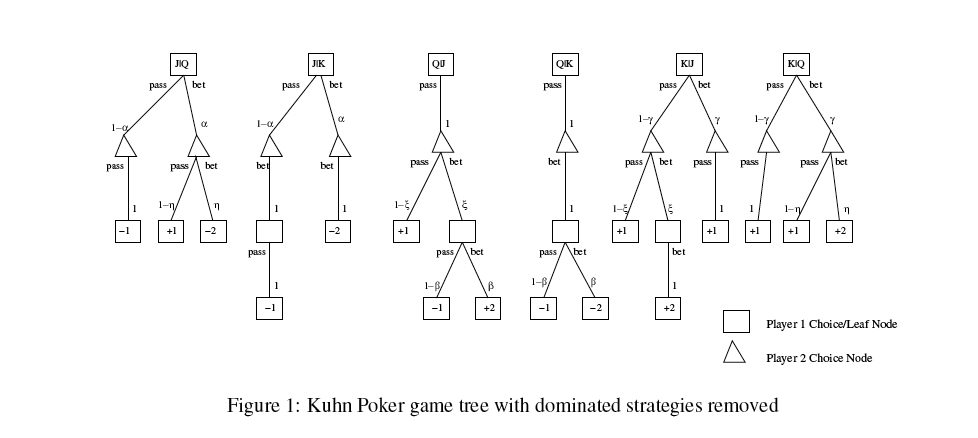
I posted the rules of the very cool Kuhn poker. Here's optimal play:
Playing first:
Interestingly, you can either check or bet a King or a Jack—this is poker, after all and in this case bluffing/slow-playing is as good as playing your cards straight. But holding a Queen is tricky: If you bet, your opponent folds with a Jack or raises with a King. Half the time, you win your opponent's one-chip ante, and half the time you lose your ante plus your bet.
This is not good. In fact, it's bad. You're losing twice as many chips as you're winning.
So you check.
Strange so-called Green Pea galaxies were first discovered in 2007 by citizen scientists and it has now been shown that these extraordinary and extremely compact star cities have low amounts of complex elements after being diluted by streams of gas and strong supernova winds.
Green Pea galaxies were discovered by participants in
Galaxy Zoo, which grew out of the need to provide more help to astronomers with a huge number of night sky images produced by the Sloan Digital Sky Survey.
People can learn to control the activity of some brain regions when they get feedback signals provided by functional magnetic resonance brain imaging (fMRI), according to researchers who used fMRI during training sessions with three groups of healthy participants who were asked to assess visual emotional stimuli (negative or neutral pictures).
They were interested in the signals generated by the insula, a brain region implicated in emotion regulation. While performing the test, the investigators provided the subjects with specific, unspecific, or no feedback about the extent of the activation of the insula.