Altitude training is a popular training method expected to improve the physical performance of athletes …and horses!
Recently, several national football teams spent some time at altitude on the Austrian Alps in preparation for the World Cup. Athletes from a number of endurance disciplines use altitude training as part of their yearly training program. However, scientific evidence is not clear at all as to whether altitude training is beneficial for human performance or otherwise.
Social networks are a great help for this kind of news: a new paper by a FB friend does not go unnoticed (at least by me) as it once would. I learned today that Garrett Lisi (picture below), the surfer and theoretical physicist, has deposited another paper in the Cornell arxiv. And it looks as a significant addition to his previous studies of the E8 group. He explicitly calls it "a companion" to the
previous article, "An Exceptionally Simple Theory of Everything".
23andMe, Inc., a direct-to-consumer personal genetics company, is arguably the most well-funded and therefore highest profile group out there (being married to a Google co-founder will do that) and by doing a somewhat humorous new study associating traits with single-nucleotide polymorphisms (SNPs - a type of common DNA sequence variation), they may have spurred discussion of some new ethics guidelines to help future science policy.
Scientific Consensus
Some scientific ideas are so easily grasped that they are easily explained to the general public. Other ideas can only be fully understood after a minimum level of training and studies in the relevant area. A few ideas are so obscure, so far removed from everyday experience that only a very few specialists fully understand the topic.
Science is a landscape in which anyone may wander. How pleasant to sit in the green pastures of accumulated knowledge and dip the fingers in a stream of certainty. But how much more exciting it is to scuba-dive through flooded caves in search of the foundations of science: how much more satisfying it is to climb the highest peak and see the bigger picture.
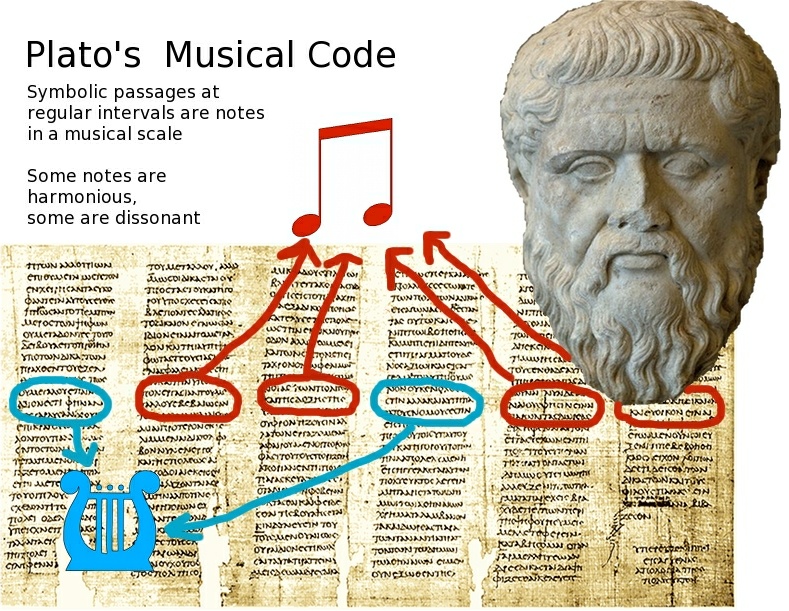
A science historian at The University of Manchester says he has cracked 'The Plato Code', secret messages purported to be hidden in the writings of history's most famous philosopher.
Plato likely needs no introduction here but, in brief, he was one of the most influential authors in history; philosopher, mathematician and founder of the Academy in Athens, the first institution of higher learning in the West, which laid the foundations of both Western philosophy and science.
Men will sometimes blame hormones for how women act but it isn't just one gender - one thing that sets off hormone changes in men is competition, says a new PNAS study.
The average man experiences hormone changes similar to the henpecked bonobo prior to competition, but a more competitive man undergoes changes more like those found in a chimpanzee, say researchers from Duke and Harvard universities. Chimpanzees live in male-dominated societies where status is paramount and aggression can be severe but in bonobo culture a female is always the most dominant and tolerance can allow for more flexible cooperation and food-sharing.
Researchers at Harvard and MIT using what is called programmable matter have demonstrated how a single thin sheet composed of interconnected triangular sections could transform itself into a boat- or plane-shape, all without the help of people.
They envision creating smart cups that could adjust based upon the amount of liquid needed or maybe a Swiss army knife that could change from a wrench to a tripod - obviously readers here envision giant robots that could smite our foes.
Despite some of the more outrageous claims to the contrary, SecondLife, while an abstract 3-D world, is not actually a teaching platform. It had its moment and devolved rather quickly into another marketing tool for companies but conceptually it provides a good foundation for one.
To become one, a tool muct include things a training program with a sequence of activities for students to acquire knowledge as well as a methodology to evaluate previously defined learning results.
Inhibition in the brain seems simple but there is an underlying complexity that makes it one of the most challenging aspects of brain function to understand. Its kind of like soccer, it seems to be a simple game, but it is difficult to play simple.
The main inhibitory neurotransmitter at synapses in the cerebral cortex is gamma-Aminobutyric acid or GABA. This small molecule plays a crucial role in how the brain functions and the tiny inhibitory synapses are the targets of alcohol, barbiturates, and benzodiazepines such as Valium.
Frustrated in dealing with the public? You are not alone. It may seem to researchers that the public is either stupid or intentionally ignoring evidence but
it's not that one-sided, writes
Chris Mooney in the Washington Post.
Chris generally doesn't think a lot of the science IQ of Americans (and don't even get him started on Republicans!) but he recognizes something more scientists should (and most do here, thus the whole Science 2.0 thing) - making scientifically smarter people does not mean they will always agree with you.