A previously unknown function that regulates how stem cells produce different types of cells in different parts of the nervous system has been discovered. The results improve our understanding of how stem cells work, crucial for our ability to use stem cells to treat and repair organs.
A group of bioelectronics researchers say they have made a major step toward being able to regulate nerve cells externally. Their breakthrough is based on an ion transistor of plastic that can transport ions and charged biomolecules and thereby address and regulate cells.
Previously, use has been made of nano-canals and nano-pores to actively control the concentration and transport of ions but those components are difficult to produce and function poorly when the salt content is high, obviously something that would be an issue in interaction with biological systems.
In the final chapter of the book
Complexity: A Guided Tour, Mitchell gets to the heart of the real issues that I've been griping about in this blog. She begins by citing a harsh, 1995 piece by John Horgan, “Is Complexity A Sham?”
The article contained two main criticisms. First, in Horgan’s view, it was unlikely that the field of complex systems would uncover any useful general principles, and second, he believed that the predominance of computer modeling made complexity a “fact-free science.”
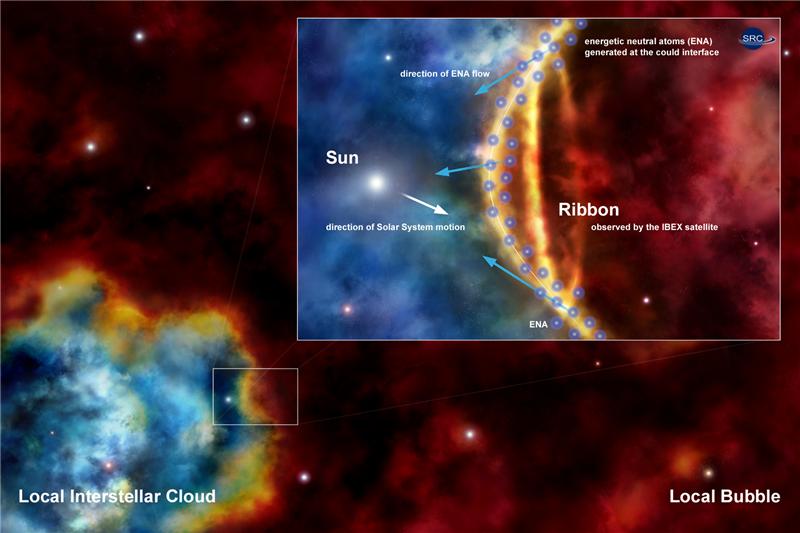
Is the Sun going to enter a million-degree galactic cloud of interstellar gas?
A group of scientists are suggesting that the Ribbon of enhanced emissions of Energetic Neutral Atoms(ENA) discovered last year by the NASA Small Explorer satellite IBEX could be explained by a geometric effect coming up because of approach of the Sun to the boundary between the Local Cloud of interstellar gas and another cloud of a very hot gas called the Local Bubble.
If their hypothesis is correct, IBEX is catching matter from a hot neighboring interstellar cloud, which the Sun might enter in a hundred years.
I read with pleasure today a proceedings writeup of the Moriond 2010 talk given by S. Andringa on behalf of the Pierre Auger Observatory. It is too bad that I did not visit La Thuile this year: the venue of the Moriond conferences is always a very pleasant place to spend a week, with talks scheduled in the morning and evening which leave the central hours of the day free for skiing. My last trip there was in 2005: I need to make the case for another visit next year!
Since the rediscovery of the cancer stem cell hypothesis by Peter Dirks at the University of Toronto, researchers often use these cancer stem cells (or cancer initiating cells) as the scapegoat to explain why cancers are so hard to treat.
'Hollywoood's job is not to educate but to entertain and inspire', but it turns out they find science inspirational. In the
Going Hollywood podcast, you can listen (or read) about just how scientists get to, well, Go Hollywood.
There are 3 ways for a scientist to enter that bastion of decadence we call "where I'd like to be". The first is basically a dating service for Movie Makers and Scientists. Since Nov 2008, Jennifer Oullette has run the "Science and Entertainment Exchange", a National Academies of Science program that is in LA, that tries to match scientists and writers.
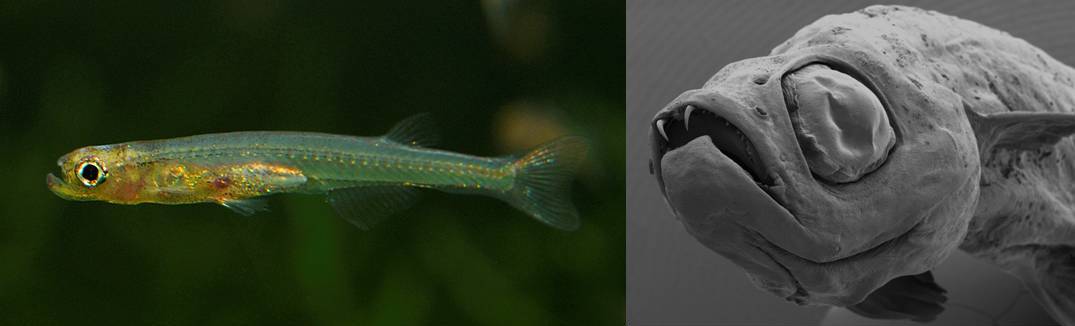
The International Institute for Species Exploration has announced their top 10 new species described in 2009.
Making the cut are a minnow with fangs, golden orb spider and carnivorous sponge.
Using a super-sensitive camera/spectrometer on the Herschel Space Observatory, astronomers have mapped the skies as they appeared 10 billion years ago, giving them a better look at the bright galaxies in the distant universe that appear to be forming stars at phenomenal rates.
They found that these glistening galaxies preferentially occupy regions of the universe containing more dark matter and that collisions probably caused the abundant star production. Results of the research were published in Astronomy&Astrophysics.
Scientists analyzing the temperature and salt levels of the Western Mediterranean Sea between 1943 and 2000 have found that the deep water has become progressively hotter and saltier, and that, since the 1990s, this process has speeded up.
Each year the temperature of the deep layer of the Western Mediterranean increases by 0.002ºC, and its salt levels increase by 0.001 units of salinity. These changes, although minimal from year to year, have been continuously and constantly occurring at a faster pace since the 1990s.
The results are consistent, "but to confirm this accelerating trend, we need to monitor it over the years to come", said Manuel Vargas-Yáñez, researcher at the Oceanic Centre of Malaga of the Spanish Institute of Oceanography (IEO).