Researchers at the University of Bonn have found evidence indicating that some Sauropod dinosaurs, typically known for their enormous size, were island dwellers and evolved into dwarfs.
By studying the structure of their fossils, researchers confirmed that the sauropod dinosaur Magyarosaurus dacus never grew any larger than a horse. The results appear this week in PNAS.
An international team of researchers has captured an enormous cloud of cosmic gas and dust - BYF73 - in the process of collapsing in on itself, a discovery which could help explain how massive stars form. The team’s findings have been published in the Monthly Notices of the Royal Astronomical Society.
Astronomers have a good grasp of how stars such as our Sun form from clouds of gas and dust, but how heavier stars form is still largely unknown.
Using ancient DNA preserved in bones from Siberian mammoths 25,000 to 43,000 years old, scientists have brought the primary component of the specimens' blood "back to life."
The seven-year research effort, detailed this week in
Nature Genetics, reveals special evolutionary adaptations that allowed the mammoth to cool its extremities down in harsh Arctic conditions to minimize heat loss.
The findings will also help scientists study the DNA of other extinct species, such as Australian marsupials.

Astronauts could one day tend their own crops on long space missions, and researchers from Purdue say a variety of strawberry called Seascape seems to meet the requirements for becoming a space crop.
Seascape strawberries are day-neutral, meaning they aren't sensitive to the length of available daylight to flower. Seascape was tested with as much as 20 hours of daylight and as little as 10 hours. While there were fewer strawberries with less light, each berry was larger and the volume of the yields was statistically the same.
The findings are detailed in
Advances in Space Research.
 It almost looks like they're floating
At M.I.T. the philosopher, critic and essayist Boris Groys, Global Distinguished Professor of Russian and Slavic Studies, New York University, in a talk based on his paper, "Religion in the Age of Digital Reproduction", draws freely on such predecessors as Gilles Deleuze, Walter Benjamin, Martin Heidegger and Nietzsche to draw a bead on fundamentalism.
Oil Spills And Troubled Waters
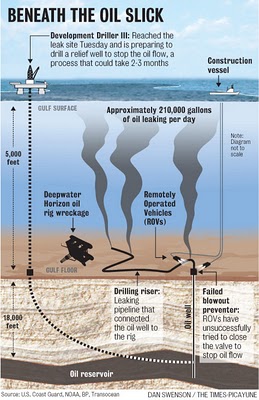
The ongoing environmental disaster in the Gulf of Mexico has much of the anti-environmentalist bloggersphere ducking its collective head beneath the parapet. Suddenly, America is aware that offshore oil drilling has the potential to wipe out the livelihoods of entire coastal communities. Perhaps, now, proposals to drill for oil in the Arctic will be examined more closely, and the views of indigenous populations considered more adequately. If disaster mitigation in the Gulf is difficult, imagine how much more difficult it would be in Arctic waters.
Latest news and updates
The matter has indeed been discussed ad nauseam in the recent past. Blog posts, internal discussions, conferences, workshops, other blog posts, threads. But there is always the chance to add some bit of information to the soup, or -more easily- misinformation. In this case, the discussion invests mostly italian blogs, so I figured I would give you a summary here.
1. “Arizona Legislature Passes Bill Banning Ethnic Studies Programs.”I thank my Alliant University colleague Eduardo Morales for an email summarizing that story:
“After making national headlines for a new law on illegal immigrants, the Arizona Legislature sent Gov. Jan Brewer a bill Thursday that would ban ethnic studies programs in the state that critics say currently advocate separatism and racial preferences. The bill, which passed 32-26 in the state House, had been approved by the Senate a day earlier.... The new bill would make it illegal for a school district to teach any courses that …[among other things] 'advocate ethnic solidarity instead of the treatment of pupils as individuals.'
Support for science comes in many forms. I've discussed
being a research scientist and
what citizen scientists can do when they donate their time. Now let's bring up the third leg of the Tripod of Science-- cash. This is about the triumph of capitalism over adversity.
There are so many causes one can give to. Haiti received huge economic support because, for whatever reason, they caught the public's fancy and got significant media attention. That's hard to predict, or arrange.
If you ever looked at the inside of a computer, you would find intricate wirings and connections. But the computer is essentially useless until you’ve downloaded all the necessary software and applications. In a way, this analogy could be applied to the workings of the brain. The brain is essentially a circuitry consisting of billions of neuronal connections (or synapses) that is infinitely more complex than the typical computer hardware.