This is an oft mentioned safety rule that one should employ when driving to ensure an adequate distance is maintained with the vehicle in front of you. When conditions are wet or icy, the rule has been extended to recommend four seconds and up to 10 seconds respectively.
This effectively fixes the traffic volume to a constant arrival rate regardless of the speed of the vehicles. In other words, it presumes to maintain a constant flow of traffic despite the variations in individual drivers and makes the traffic volume absolutely dependent on the number of traffic lanes available.
Since we have a fixed arrival rate of 1 car every 2 seconds (per lane), then we can calculate how many vehicles per hour a road can handle.
Apollomania is sweeping the nation!
Well, not quite mania, perhaps just Apollostalgia. That's defined as showing an interest in the Apollo program history, while lacking the will to actually recommit to exploring space.
As we look at the 40th anniversary of humankind's first setting foot on a celestial body other than the Earth, I will state clearly that Apollo 12 was the peak of the Apollo program.
Now, it's true Apollo 11 is when humans first set foot on the moon. It's Apollo 11's anniversary, it's getting the lion's share of the attention right now.
But I maintain Apollo 12, launched a scant 4 months later, was the most important moon landing in all of history. Let's review:
New genetic research in BMC Evolutionary Biology found telltale mutations in modern-day Indian populations that are exclusively shared by Aborigines. The new study indicates that Australian Aborigines initially arrived via south Asia.
Dr Raghavendra Rao worked with a team of researchers from the Anthropological Survey of India to sequence 966 complete mitochondrial DNA genomes from Indian 'relic populations'. He said, "Mitochondrial DNA is inherited only from the mother and so allows us to accurately trace ancestry. We found certain mutations in the DNA sequences of the Indian tribes we sampled that are specific to Australian Aborigines. This shared ancestry suggests that the Aborigine population migrated to Australia via the so-called 'Southern Route'."

Plant fossils from the Okanagan highlands, an area centred in the Interior of British Columbia, provide important clues to an ancient climate.
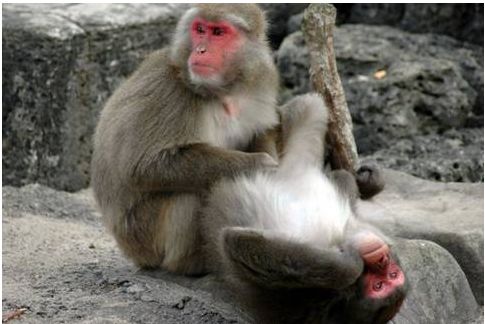
Last week, scientists announced the interim results of one of modern physiology’s most closely watched experiments: the effects of caloric restriction on the lifespan of non-human primates.
The report was maddeningly mixed.
Caloric restriction seemed to reduce the incidence of several diseases, but when it came to mortality—a somewhat important factor when it comes to longevity— the data were statistically not significant. We still do not know if caloric restriction works in primates, which, of course, we are.
A new impact on Jupiter is getting all the attention this week but it can happen here - and has. Nanosized diamonds found just below the surface of Santa Rosa Island off the coast of Santa Barbara are evidence of a 'cosmic impact' approximately 12,900 years ago
The hypothesis by the researchers behind the study is that fragments of a comet struck across North America at that time.
Purdue University researchers have created magnetically responsive gold nanostars that gyrate when exposed to a rotating magnetic field and can scatter light to produce a pulsating or "twinkling" effect. This twinkling allows them to stand out more clearly from noisy backgrounds like those found in biological tissue.
Alexander Wei, a professor of chemistry, and Kenneth Ritchie, an associate professor of physics, led the team that created the new gyromagnetic imaging method.
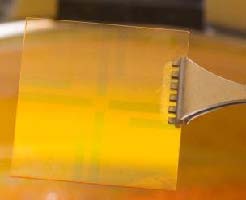
'Sun power for soldiers' sounds like aging hipsters have taken over the military, right? No, this is still manly; a special "conductive ink" that can be used to make printed organic photovoltaic solar cell panels on very thin, flexible surfaces using ink-jet printing.
The research was done by scientists at the Air Force Research Laboratory Materials and Manufacturing Directorate (AFRL/RX), with Plextronics, Inc., and the Pennsylvania NanoMaterials Commercialization Center, both located in the City of Champions, Pittsburgh, PA.
The ready-to-use, technology captures sunlight and stores it as energy to power Global Positioning System components, portable communications, and other devices for U.S. soldiers.
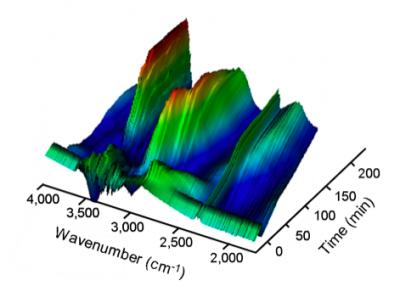
How do individual cells survive conditions that should kill them? It's long been a mystery of nature but a team of researchers recently tracked the chemical changes in Desulfovibrio vulgaris, which is a single-cell bacterium that normally can only exist in an oxygen-free environment. They exposed the cells to the most hostile of conditions — air — and watched as some cells temporarily survived by initiating a well-orchestrated sequence of chemical events.
In all the talk about using skin cells to create pluripotent stem cells that don't need human embryonic destruction, dental and tissue engineering researchers at Tufts University School of Dental Medicine and the Sackler School of Graduate Biomedical Sciences have gone the other way and used human embryonic stem cells (hESCs) to generate complex tissues that mimic human skin and the oral mucosa (the moist tissue that lines the inside of the mouth).
Their proof-of-concept study is published in Tissue Engineering Part A.