



The biomedical community has become too risk-averse, according to a recent NY Times piece. I agree, although I don't agree with the dramatic presentation (it's not some dirty scientific secret - it's not hard to find scientists, and the leaders of the funding agencies themselves talking about it). Here are the basic issue:
Yet the fight against cancer is going slower than most had hoped, with only small changes in the death rate in the almost 40 years since it began.

I spent last week in Boston, attending the Open Mobile Alliance meeting. Whenever one goes to meetings, one does the dance of the business card exchange. Because it was my first OMA meeting, I had more of it going on than usual, as I met a lot of people for the first time. So I’ve collected a batch of 2-inch × 3.5-inch cards, which I then have to copy information from and put it into my address book. And there’s no hope of reading these things without my reading glasses.

They’re inconvenient, to be sure, but they do work, and we’re used to them. Everyone has them.

The evidence is in. The scientific community has reached a clear consensus that vaccines don’t cause autism. There is no controversy.” So begins an in-depth discussion of the vaccines-cause-autism nonsense penned by “SkepDoc” Harriet Hall in a recent issue of eSkeptic. It is a must read for any thinking person who has been baffled by the likes of Jenny McCarthy and her unconscionable sponsors, boyfriend Jim Carrey (who bankrolls McCarthy’s dangerous ignorance) and Oprah Winfrey (who provides McCarthy with television time so that she can endanger the lives of even more children).
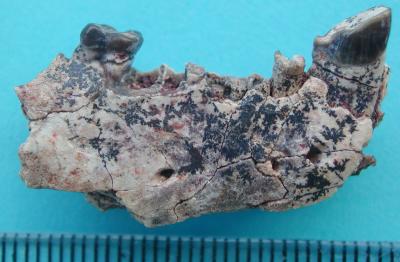
Look out, Ida.   Hot on the heels of one overhyped mishmash of media hysteria, a new fossil primate from Myanmar/Burma called Ganlea megacanina is causing researchers to speculate that the common ancestor of humans, monkeys and apes evolved from primates in Asia, not Africa, as many researchers believe. 

A major focus of recent paleoanthropological research has been to establish the origin of anthropoid primates (monkeys, apes and humans) from earlier and more primitive primates known as prosimians (lemurs, tarsiers and their extinct relatives).
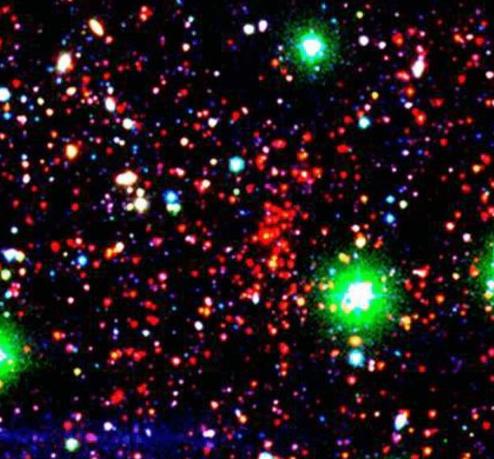
Researchers have completed the largest ever survey for very distant clusters of galaxies. 

Named the Spitzer Adaptation of the Red-sequence Cluster Survey, "SpARCS" detects galaxy clusters using deep ground-based optical observations from the CTIO 4m and CFHT 3.6m telescopes, combined with Spitzer Space Telescope infrared observations. 

SpARCS is designed to find clusters as they appeared lwhen the universe was 6 billion years old or younger.  Astronomers believe the universe was formed 13.7 billion years ago.
Are individuals, families and employers getting their money's worth from US healthcare?

You'd think not, given the media full court press by the Obama administration for a federal health care plan at a cost of trillions that will allegedly be paid for by 'savings' in current health care.    Like 'jobs saved', it isn't a number anyone can really track so it's up to individual belief - and likely political party registration.    The federal government wants to provide more services to more people.   And that may not be good health policy.
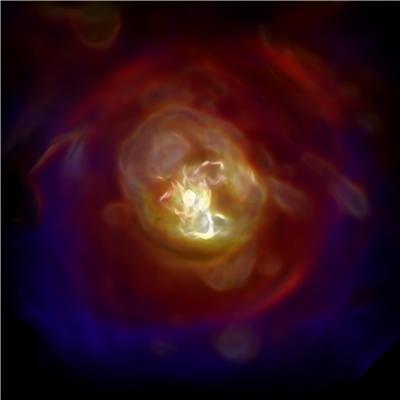
Why did our Milky Way galaxy survive while others failed?    Ill-defined, convenient catch-all dark matter gets the credit, according to a new paper.   Dark matter is thought to make up 85 per cent of the Universe’s mass and it may also be one of the building blocks of galaxy formation.

The researchers say that the early Milky Way, which had begun forming stars, held on to the raw gaseous material from which further stars would be made. This material would otherwise have been evaporated by the high temperatures generated by the “ignition” of the Universe about half-a-billion years after the Big Bang.
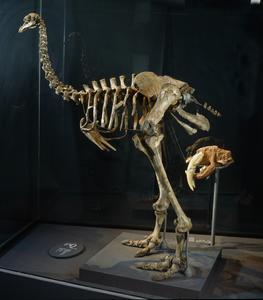
Welcome back, Moa.   Scientists say they have performed the first DNA-based reconstruction of the giant extinct moa bird using prehistoric feathers recovered from caves and rock shelters in New Zealand.

The researchers from the University of Adelaide and Landcare Research in New Zealand have identified four different moa species after retrieving ancient DNA from moa feathers believed to be at least 2500 years old.

The giant birds, measuring up to 2.5 meters and weighing 250 kilograms, were the dominant animals in New Zealand’s pre-human environment but were quickly exterminated after the arrival of the Maori around 1280 AD.

moa bird
Moa bird
Interested in Michael Jackson now that he is dead?   So are cyber criminals who are exploiting public interest in his death with spam messages that infect computers with a virus able to steal bank account numbers and passwords, according to Gary Warner, University of Alabama at Birmingham (UAB) director of research in computer forensics. Warner and the other researchers at the UAB Spam Data Mine began tracking the celebrity-focused spam early on Tuesday, June 30.

“We’ve been tracking the cyber criminals behind this spam and the associated virus for many weeks, but it is just today that they have shifted their strategy by embedding their virus into an e-mail that claims to link you to a Web site that will reveal Michael Jackson’s killer,” Warner said. 
With the increasing popularity of whitening teeth, and some studies showing negative effects of teeth whitening, researchers at the Eastman Institute for Oral Health at the University of Rochester Medical Center set out to learn if there are negative effects on the tooth from using whitening products.

Eastman Institute's YanFang Ren, DDS, PhD, and his team determined that the effects of 6 percent hydrogen peroxide, the common ingredient in professional and over-the-counter whitening products, are insignificant compared to acidic fruit juices. Orange juice markedly decreased hardness and increased roughness of tooth enamel.

