Astronomers have turned to an unexpected place to study the evolution of planets -- dead stars.
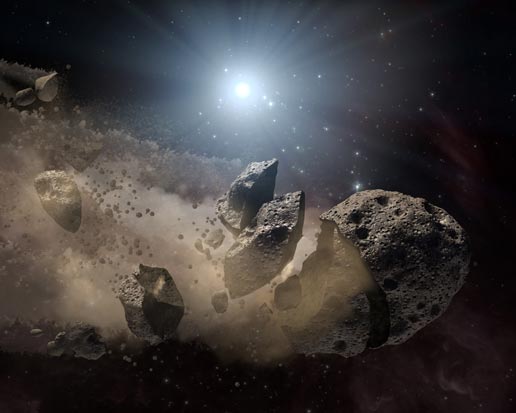
Observations made with NASA's Spitzer Space Telescope reveal six dead "
white dwarf" stars littered with the remains of shredded asteroids. This might sound pretty bleak, but it turns out the chewed-up asteroids are teaching astronomers about the building materials of planets around other stars.
So far, the results suggest that the same materials that make up Earth and our solar system's other rocky bodies could be common in the universe. If the materials are common, then rocky planets could be, too.
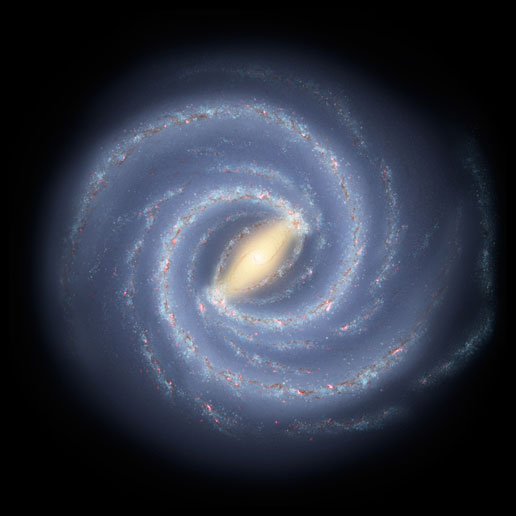
Iowa State University's Martin Pohl is part of a research team that has developed the first complete map of the Milky Way galaxy's spiral arms.
The map shows the inner part of the Milky Way has two prominent, symmetric spiral arms, which extend into the outer galaxy where they branch into four spiral arms.
"For the first time these arms are mapped over the entire Milky Way," said Pohl, an Iowa State associate professor of physics and astronomy. "The branching of two of the arms may explain why previous studies – using mainly the inner or mainly the outer galaxy – have found conflicting numbers of spiral arms."
The mystery of why ancient South American peoples who created the mysterious Nazca Lines also collected human heads as trophies has long puzzled scholars who theorize the heads may have been used in fertility rites, taken from enemies in battle or associated with ancestor veneration.
A recent study using specimens from Chicago's Field Museum throws new light on the matter by establishing that trophy heads came from people who lived in the same place and were part of the same culture as those who collected them. These people lived 2,000 to 1,500 years ago.
With cold and flu season in full swing, the fact that viruses and bacteria rapidly 'evolve' is apparent with every sneeze, sniffle, and cough. A new report in The FASEB Journal seeks to explain how humans keep up with microbes by rearranging the genes that make antibodies to foreign invaders. This research fills a significant gap in our understanding of how the immune system helps us survive.
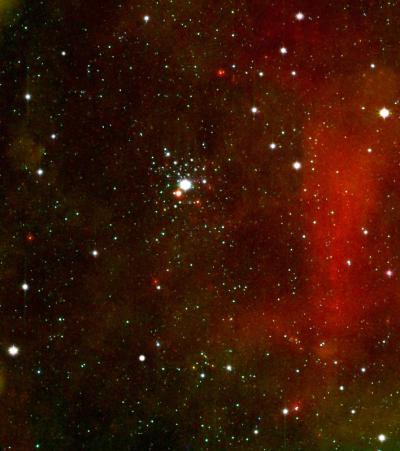
Smithsonian Center for Astrophysics astronomers examined the 5 million-year-old star cluster NGC 2362 with NASA's Spitzer Space Telescope, which can detect the signatures of actively forming planets in infrared light, and found that all stars with the mass of the Sun or greater have lost their protoplanetary (planet-forming) disks.
Only a few stars less massive than the Sun retain their protoplanetary disks. These disks provide the raw material for forming gas giants like Jupiter. Therefore, gas giants have to form in less than 5 million years or they probably won't form at all.
So baby Jupiter had to gain weight quickly.
Sometimes studies are done that are common sense but, without them, people would say, about things that are common sense, 'no studies actually show that... so that is why we mention a recent study showing that shade trees on the west and south sides of a house in California can reduce a homeowner's summertime electric bill by about $25.00 a year.
The study, conducted last year on 460 single-family homes in Sacramento, is the first large-scale study to use utility billing data to show that trees can reduce energy consumption.
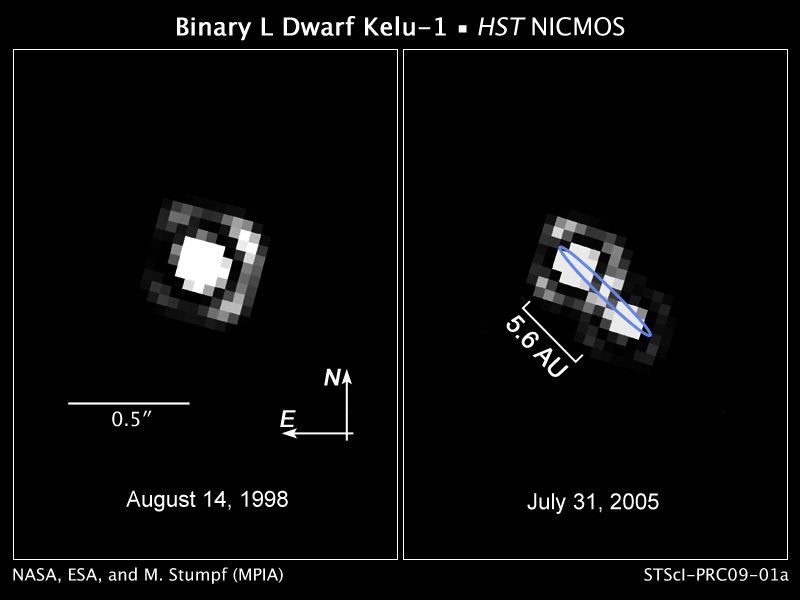
Brown dwarfs, objects that are less massive than stars but larger than planets, just got more elusive, based on a study of 233 nearby multiple-star systems by NASA's Hubble Space Telescope. Hubble found only two brown dwarfs as companions to normal stars. This means the so-called "brown dwarf desert" (the absence of brown dwarfs around solar-type stars) extends to the smallest stars in the universe.
The 233 stars surveyed are part of the RECONS (Research Consortium on Nearby Stars) survey meant to understand the nature of the sun's nearest stellar neighbors, both individually and as a population. The current primary goals are to discover and characterize "missing" members of the sample of stars within 32.6 light-years (10 parsecs) of Earth.
Big volcanic eruptions over the past 450 years have temporarily cooled weather in the tropics but suggest that such effects may have been masked in the 20th century by rising global temperatures, say researchers. The paper, which shows that higher latitudes can be even more sensitive to volcanism, appears in the current issue of Nature Geoscience.
Ian Ramjohn recently posted an interesting (but far too short) article on Scientific Blogging titled Competition and Coexistence in which he discussed various theoretical scenarios that could develop if a new species formed and began competing with its parent species for resources.
Brian Swimme is fond of saying, "Four billion years ago, the earth was molten rock and now it sings opera." In their 1992 book "The Universe Story," Swimme and Thomas Berry attempted to bridge the gap between science, religion and the humanities. When Michael Dowd read it, he got goose bumps and says he wept at the realization that "this is what I’m going to spend the rest of my life doing, popularizing this perspective."