Injury of the peripheral nerves, such as the nerves in your arms, is common and often results in a loss of function or sensation. Although these nerves have the capacity to regenerate and reconnect, recovery is often limited to short distances and outcomes remain relatively poor.
With school budgets already sub-par, and the purse strings futher tightened in this current economic state, teachers have to find ways to do more with less. One suggestion, if I may, is to combine chemistry and history. Checking off the list of U.S. presidents while also teaching children about the periodic table is a great way to kill two birds with one stone, and who knows, it may even help retention of each subject.

(I use U.S. presidents as one example; you could easily apply the venerable Table to a whole host of subjects.)
Let's start easy.
The idea of the “selfish gene” was intended to shift focus from the organism to the gene to provide a different perspective on natural selection. It was been described as a metaphor, or simply a semantic issue. However, without precision in our use of such words, we risk creating assumptions and assigning values where none exist. This is the same problem that occurs in describing animal behavior when one anthropomorphizes.
“The key question, as we shall see, is how natural selection can produce selfish genes that prescribe unselfishness.”
Bert Hölldobler and Edward.O.Wilson, The Ants
The premise behind the pokerbot is simple: there are many, many bad players in online, low-limit poker games, and thus by playing a tight, mistake-free strategy, you will win over time. Unfortunately, because the worst players are in low-limit games and because Joe from Topeka takes his allotted thirty seconds every time he’s confronted with a $0.05 raise, you might make a better hourly wage mowing lawns, flipping burgers, or participating in medical trials, even if you play multiple tables at once (see earlier blog "Internet Poker: By the Numbers").
Enter the pokerbot: instead of doing the drudgery of playing mechanical, low-limit poker yourself, why not use a program to do it for you—better yet, use many programs each taking in a little money at a time.
If you're a man, somewhere at some time some woman has said you just don't make love long enough. Okay, for some men all women have said that. But there are other extremes as well. Male flies of the species Drosophila montana are all about reproductive success so they keep going ... and going ... and going. And there's an evolutionary reason.
Researchers writing in the BMC Evolutionary Biology say that that females engaged in extended intercourse wait longer before they mate again, increasing the first fly's chances of fathering offspring.
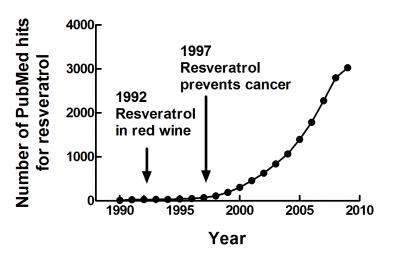
Most people won't eat two cups of blueberries a day but tell them a cup of red wine will make them healthier and they seem downright happy. Red wine has cultural and historical mystique blueberries lack so it has a psychological edge.
Red wine contains a complex mixture of bioactive compounds, including flavonols, monomeric and polymeric flavan-3-ols, highly colored anthocyanins, as well as phenolic acids and the stilbene polyphenol, resveratrol. Some of these compounds, particularly resveratrol, appear to have health benefits.
But look at the PubMed citations and you'd think red wine is curing cancer and halting global warming.
Graying hairs that crop up with age could be more than just nature, they could be signs of stress, according to a new report in the June 12 issue of Cell.
The researchers say that the kind of "genotoxic stress" that does damage to DNA depletes the melanocyte stem cells (MSCs) within hair follicles that are responsible for making those pigment-producing cells. Rather than dying off, when the going gets tough, those precious stem cells differentiate, forming fully mature melanocytes themselves. Anything that can limit the stress might stop the graying from happening, the researchers said.
Who says politics and science can't mix? Well, we say they shouldn't mix but we're rare in science media. Yet sometimes political events can make for great science studies too.
Case in point, the value neuroscientists at the University of Washington got when former President George W. Bush and Iraq's Prime Minister Nouri al-Maliki had shoes thrown at them by a crazy Iraqi 'reporter' during a Baghdad news conference.
When Bush ducked and Maliki didn't flinch as the first shoe sailed toward them, it was a real-world example supporting the theory that there are two independent pathways in the human visual system.
Can you tell when your dog has done something wrong by his appearance? Not really, says Alexandra Horowitz, Assistant Professor from Barnard College in New York, in Behavioural Processes. It's mostly what you want to see.
Horowitz was able to show that the human tendency to attribute a "guilty look" to a dog was not due to whether the dog was indeed guilty. Instead, people see 'guilt' in a dog's body language when they believe the dog has done something it shouldn't have – even if the dog is in fact completely innocent of any offense.
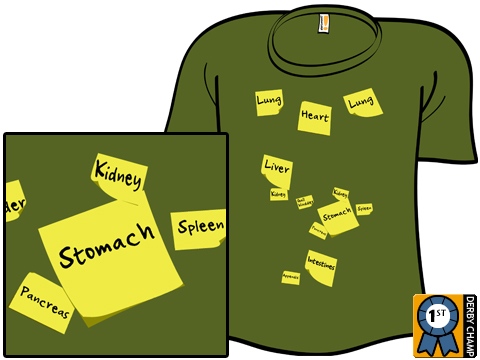
A study of patients and members of the public has shown that most lack even basic knowledge of human anatomy. The research, featured in the journal BMC Family Practice, found that people were generally incapable of identifying the location of major organs, even if they were currently receiving relevant treatment.