What? NASA wants to make Earth Day about space?
Not at all, NASA is instead asking the public to vote for the most important contribution the space agency has made to exploring and understanding Earth and improving the way we live on our home planet. That's right, they call this our home planet, which means there may be a vacation planet on the way. That's thinking big, people.
Combating several human pathogens, including some biological warfare agents, may one day become a bit easier thanks to research reported by a University of Iowa chemist and his colleagues in the April 16 issue of the journal Nature.
Amnon Kohen, associate professor of chemistry in the UI College of Liberal Arts and Sciences, said that the study indicated a new mechanism by which certain organisms manufacture the DNA base thymidylate. This new mechanism is so very different from the way humans synthesize this base that drugs targeting this biosynthetic path in the pathogens are unlikely to affect the human path, thus resulting in very reduced side effects or no side effects at all.
An unmapped reservoir of briny liquid chemically similar to sea water, but buried under an inland Antarctic glacier, appears to support unusual microbial life in a place where cold, darkness and lack of oxygen would previously have led scientists to believe nothing could survive, according to newly published research.
After sampling and analyzing the outflow from below the Taylor Glacier, an outlet glacier of the East Antarctic Ice Sheet in the otherwise ice-free McMurdo Dry Valleys of Antarctica, researchers believe that, lacking enough light to make food through photosynthesis, the microbes have adapted over the past 1.5 million years to manipulate sulfur and iron compounds to survive.
Scientists have found an ancient ecosystem below an Antarctic glacier and learned that it survived millions of years by transforming sulfur and iron compounds for growth.
Sanger F, Nicklen S, Coulson AR. 1977. DNA sequencing with chain-terminating inhibitors. Proceedings of the National Academy of Sciences, U S A 74: 5463-7.
This paper describes the most important (IMHO) technical breakthrough in the biological sciences: DNA sequencing using a single-stranded DNA template, a DNA primer, a DNA polymerase, radioactively or fluorescently labeled nucleotides, and modified nucleotides that terminate DNA strand elongation.
Science is great at finding new rules for expectant mothers. They already can’t have alcohol, caffeine, or cigarettes. They also need to stay away from their cat’s litterbox, stay off of planes and rollercoasters, stay off of antidepressants, drop their acne medication, and forgo even a well-considered vegan diet.
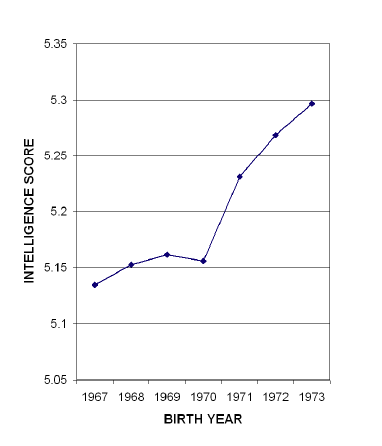
Now they have to avoid the Hong Kong flu, too. The Annals of Neurobiology recently published a study that suggested that exposure to the Hong Kong virus during the first trimester of pregnancy may contribute to decreased adult intelligence.
The Hong Kong flu is fairly easy to avoid now. But it was everywhere in 1969 and 1970. It reached its Norwegian apex in the spring of 1970, affecting up to 40% of the population.
The setup to the classic Melting Ice Cube problem goes something like this: “Fifty grams of ice are melting in a 100-mililiter cup of 35-degree water.” Using simple principles of energy transfer, we can estimate what the final temperature of the water will be, and how much energy transfer was required to make the ice melt.
But what if that ice cube was 20,000 square miles and the cup of water was 300 million cubic miles? What if the ice reflected incoming heat but the water absorbed it? And what if hurricanes, droughts, and forest fires depended on the outcome?
Bora has posted
an interesting draft policy on social media from an unidentified "Big Research Institution" (BRI).
It's already stimulating some good discussion (follow the link for more links) - no surprise, since the policy guidelines contain juicy quotes like these:
All BRI social media output is the intellectual property of BRI.
Whether you are setting up new BRI social media pages within the BRI website or on an existing social media site such as Flickr or Facebook, they need to follow the BRI interactive project process.
New research provides insight into how the brain can execute different actions in response to the same stimulus. The study, published by Cell Press in the April 16 issue of the journal Neuron, suggests that information from single brain cells cannot be interpreted differently within a short time period, a finding that is important for understanding both normal cognition and psychiatric disorders.
If we're going to get a $300 genome sequence any time in the near future, around the cost it will take to have it as part of routine medical care, the process has to get faster.
The obstacles to reaching that goal have been primarily technological: Scientists have struggled to figure out how to accurately read the 3 billion base pairs - the amount of DNA found in humans and other mammals - using current time-consuming and inefficient methods.