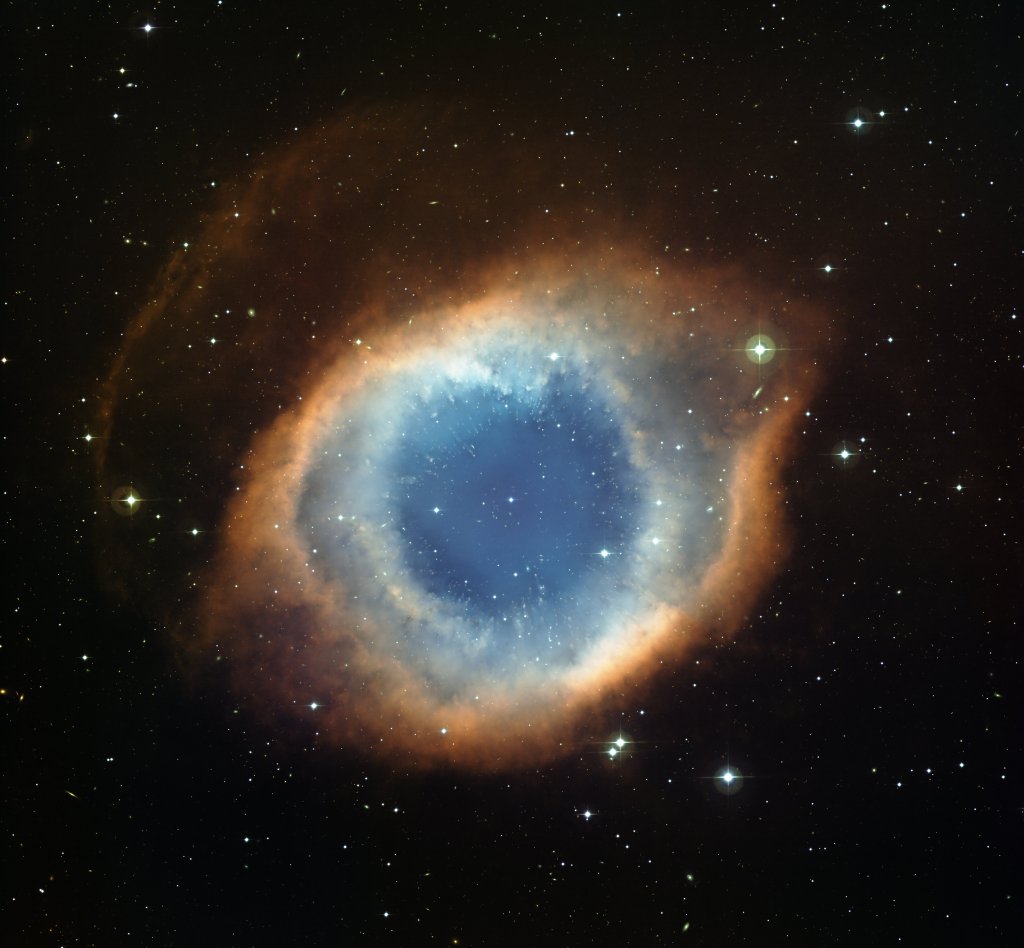





A deep new image of the magnificent Helix planetary nebula has been obtained using the Wide Field Imager at ESO's La Silla Observatory. The image shows a rich background of distant galaxies, usually not seen in other images of this object.
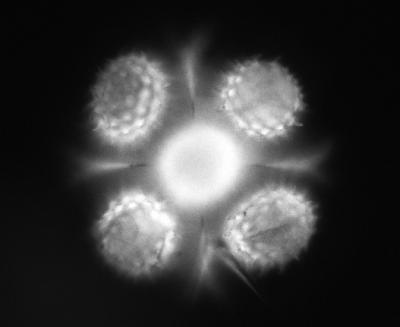
A team of Vanderbilt scientists have invented what is basically the world's smallest periscope and are using it to look at cells and other micro-organisms from several sides at once.

The researchers have officially dubbed these devices "mirrored pyramidal wells" and they consist of pyramidal-shaped cavities molded into silicon whose interior surfaces are coated with a reflective layer of gold or platinum. They are microscopic in dimension – about the width of a human hair – and can be made in a range of sizes to view different-sized objects. When a cell is placed in such a well and viewed with a regular optical microscope, the researcher can see several sides simultaneously.
We learn a lot from genes but it turns out we can learn even more - like where you lived or even who you spent time with.   It just requires knowing where and how to look.

Researchers from Stanford and Tel-Aviv University are using a technique called "reverse ecology" to examine metabolic networks and pull out proxies for reconstructing bacterial environments millions of years in the past. The work, published in the February issue of the Journal of Computational Biology, offers clues to the complex evolutionary interplay between organisms such as parasites and hosts.
Interstellar space dust from a dead star identified by a research team led by The University of Nottingham could unlock some of the mysteries of the early universe.

Dr Loretta Dunne and her team have found new evidence of huge dust production in the Cassiopeia A supernova remnant, the remains of a star that exploded about 300 years ago. The paper is set to be published in the Monthly Notices of the Royal Astronomical Society.
White people are having a tough 2009.   And it's going to get worse if new research in the Journal of Personality and Social Psychology is accurate.    A series of six studies conducted by University of Washington and Michigan State University psychologists says that whites react more negatively to racial minority individuals who strongly identify with their racial group than to racial minority individuals who weakly identify with their group.

The research, they say, may provide evidence for the claim from some blacks that they personally experience more prejudice than they see  others receiving.
A pregnant fossil fish at the Natural History Museum in London has shed light on the possible origin of sex, according to a study published today in the journal Nature by an international team including Museum scientists.

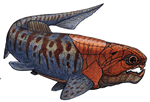
The fossil is an adult placoderm, an extinct group of armored fish, and it contains a 5cm-long embryo.  It is dated to the Upper Devonian period 350 million years ago and was found in the Gogo formation of western Australia.  The fish species is Incisoscutum ritchiei and this specimen is one of the earliest examples of a pregnant vertebrate and shows that internal fertilisation, or sex, started far sooner than previously thought.
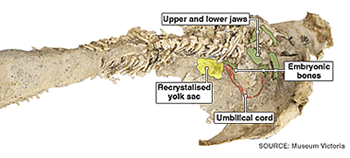
A 380-million-year-old fossil fish that shows an unborn embryo and umbilical cord has been discovered, write scientists from the Natural History Museum in Nature.  The extremely rare specimen shows incredible detail. The umbilical cord is attached to an area of small bones, corresponding to the embryo. This means the fish would have given birth to live young, known as viviparity and is the oldest record of this kind known.

'The find is important because it provides concrete evidence for vivparity,' says Zerina Johanson, fossil fish curator at the Natural History Museum.


Fossil specimen found in Australia showing the umbilical cord and embryo parts. © Museum Victoria
If you're in the prejudice business the worst thing that can happen is to have a woman and an African-American fighting it out to be President.   A white guy has a tough time out there these days and that's a good thing for society because it means that America continues to be the least racist country in the world.

But if you're in the prejudice business the death of institutional racism and the demise of cultural racism means you'll need to look deeper;  namely to find people being prejudiced against themselves.    Then you can say it's the legacy of old prejudice and the cycle continues.
Okay, you're thinking a guy who started a site where scientists write feature articles directly to the audience must be insane to endorse big media science journalism, right?   

Not at all.  Science journalism is a different beast than what we do here but it still has more commonality than it lacks and that's why I was intrigued by a recent back and forth between Professor Larry Moran of the University of Toronto and Chris Mooney of Seed Media's Scienceblogs.com.

Moran is never one to pull punches - that's why I have him on my blogroll - but that doesn't mean I always agree with him, I just like his style.
Show Me The Science Month Day 21


Why do certain species of fruit flies prefer some fruits over others? Two biologists have looked at the genetic basis behind the evolution of fruit preference, in a paper in this month's issue of Genetics (an incredible issue which happens to contain another amazing, pioneering, paradigm-shifting, ground-breaking paper).

Many insects specialize in feeding on just one or a few types of plants. This fact isn't that surprising, since plants have all sorts of defenses for warding off insects, including the production of toxic chemical compounds, and insects that feed on plants have typically evolved ways to get around the defenses of one type of plant, but not another. This phenomenon is dramatically played out in the hundreds of species of fruit flies around the world, many of which specialize in just one or a few types of fruit. Researchers at Michigan State and UNC Chapel Hill have looked at the genetic changes that enabled one species of fruit fly to specialize in the fruit of the Morinda plant, also known as cheese fruit, a fruit that is toxic to other flies.


Morinda citrifolia, photograph by Eric Guinther

