Plants are obviously essential to our survival and that of most other animals on earth but it is easy to overlook how they have become discretely embedded into our everyday lives; plants provide us with food, medicines, and raw materials used by our industries.
Despite their importance, very few of us could name more than a tiny fraction of the plants that surround us and while most of us could easily between a buttercup and a dandelion (provided both are in flower), only a hand full of experts could identify all 1600 native plants in the UK - and nobody is able to name all of the 250,000 or so plant species recorded world-wide.
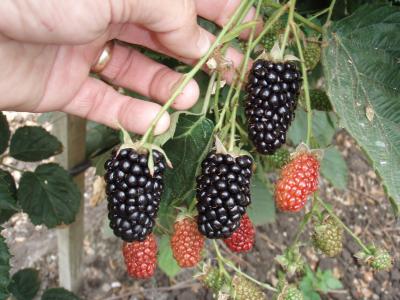
Introducing 'Natchez', the twelfth release in a series of erect-growing, high-quality, productive, floricane-fruiting blackberry (Rubus L. subgenus Rubus Watson) cultivars developed by the University of Arkansas.
According to John R. Clark and James N. Moore of the Department of Horticulture at the University of Arkansas, the new blackberry is a result of a cross of Ark. 2005 and Ark. 1857 made in 1998. The original plant was selected in 2001 from a seedling field at the University of Arkansas Fruit Research Station in Clarksville, and tested as selection Ark. 2241.
'Natchez' produces large fruit, near 9 grams on average in research trials. Fruit of 'Natchez' are elongated, somewhat blocky, and very attractive with an exceptional glossy, black finish.
How many arms does a spiral galaxy have? Can you spot a galaxy with a central “peanut” bulge? How about a galactic merger? You won't need a towel to write an astronomical 'Hitchhiker’s Guide to the Galaxy', just a computer. Answers to these and other strange questions will be provided by worldwide web users in an online citizen science project called Galaxy Zoo 2, which launches today.
Participating in certain mental activities, like reading magazines or crafting in middle age or later in life, may delay or prevent memory loss, according to a study released today.
The study involved 197 people between the ages of 70 and 89 with mild cognitive impairment, or diagnosed memory loss, and 1,124 people that age with no memory problems. Both groups answered questions about their daily activities within the past year and in middle age, when they were between 50 to 65 years old.
Preschool children who are securely attached to their mothers form closer friendships in the early grade-school years for a number of reasons, according to a new University of Illinois study published in Child Development.
Scientists have known about the link between attachment and friendship quality, but they haven't understood the reasons it exists.
The study included 1,071 children from the National Institute of Child Health and Human Development Study of Early Child Care and Youth Development. Researchers assessed mother-child attachment at age three. They also assessed how openly mothers and children acknowledged and communicated about their emotions when the child was four and a half.
While science tries to understand the stuff dreams are made of, humans, from cultures all over the world, continue to believe that dreams contain important hidden truths, according to newly published research.
In six different studies, researchers surveyed nearly 1,100 people about their dreams. "Psychologists' interpretations of the meaning of dreams vary widely," said Carey Morewedge, an assistant professor at Carnegie Mellon University and the study's lead author. "But our research shows that people believe their dreams provide meaningful insight into themselves and their world."
Six studies published in the past year by a Cornell researcher add to growing evidence that an apple a day -- as well as daily helpings of other fruits and vegetables -- can help keep the breast-cancer doctor away.
In one of his recent papers, published in the Journal of Agricultural and Food Chemistry (57:1), Rui Hai Liu, Cornell associate professor of food science and a member of Cornell's Institute for Comparative and Environmental Toxicology, reports that fresh apple extracts significantly inhibited the size of mammary tumors in rats -- and the more extracts they were given, the greater the inhibition.
Contrary to the TV sitcom where the wife experiencing strong labor pains screams at her husband to stay away from her, women rarely give birth alone. Today, there are typically doctors, nurses and husbands in hospital delivery rooms, and sometimes even other relatives and friends. Midwives often are called on to help with births at home.
Assisted birth has likely been around for millennia, possibly dating as far back as 5 million years ago when our ancestors first began walking upright, according to University of Delaware paleoanthropologist Karen Rosenberg. She says that social assistance during childbirth is just one aspect of our evolutionary heritage that makes us distinctive as humans.
U.S. intelligence officials have spent more than seven years searching for Osama bin Laden but UCLA geographers say that, if he is still alive, they have a good idea of where he was at the end of 2001 — and perhaps where he has been in the years since.
Show Me The Science Month Day 15

What happens when a big chunk of your genome is accidentally copied? Bad things could obviously happen when when sudden and dramatic changes are made to your genome (which is why we wear sunblock on the beach and lead shields when getting X-rayed). Recent studies have found that accidental duplications in the genome (which can change the copy number of sets of genes) are involved in a growing list of diseases, including autism, psoriasis, and susceptibility to AIDS. And yet we also know that big DNA duplications aren't always harmful, because we can find ancient duplications in our genomes that harbor genes filling useful roles in our physiology.
How frequently do these large duplications arise, and what role have they played in human evolution? A group led by Evan Eichler, at the University of Washington, aided by the DNA sequencing powerhouse of the Genome Sequencing Center at Washington University (in St. Louis - not the same place as the University of Washington!), has studied these questions
by looking for big, duplicated chunks in our closest relatives - the great apes. Their results show that big DNA duplications have probably played an important role in the evolution of our species.