





Show Me The Science Month Day 6

Yesterday we discussed the discovery of a gene that keeps mouse subspecies from producing fertile hybrid offspring. In other words, a gene that is putting a reproductive barrier between incipient mouse species.

Scientists have discovered speciation genes in other organisms as well. A report by Nitin Phadnis and H. Allen Orr at the University of Rochester describes a speciation gene that puts a reproductive barrier between fruit fly subspecies.
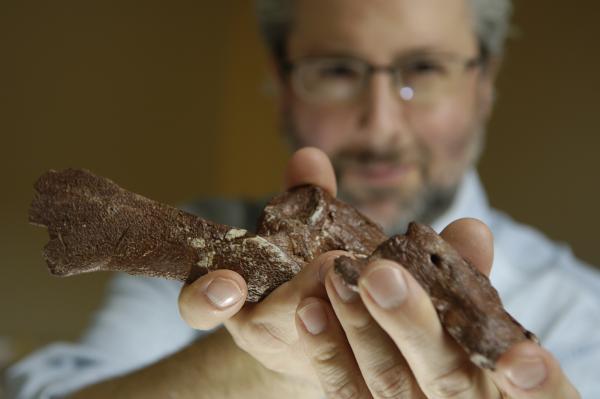
In 2004 a University of Chicago researcher discovered something every evolutionary biologist knew had to exist - a missing link between land animals and fishes.
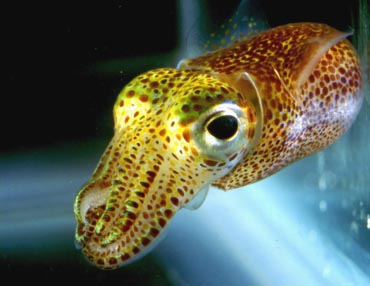
All life  depends on peaceful coexistence with a swarm of microbial life inside us that performs vital services from helping to convert food to energy to protection from disease.  With the help of a squid that uses a luminescent bacterium to create a predator-fooling light organ and a fish that uses a different strain of the same species of bacteria like a flashlight to illuminate the dark nooks of the reefs where it lives, scientists have found that gaining a single gene is enough for the microbe to switch host animals.
Monash Institute of Medical Research (MIMR) scientists have created Australia's first induced pluripotent stem (iPS) cell lines.   They have derived the cells from skin cells, and reprogrammed them to behave as embryonic stem cells; a breakthrough that will allow Australian scientists unlimited access to study a range of diseases.

Until now, Australian scientists have had to import human iPS cells from America or Japan.

Program leader, Dr Paul Verma, said the significance of developing iPS cells 'in-house' cannot be underestimated. "We now have the capability to investigate any human disease we wish, rather than relying on iPS cells from specific diseases that have been generated elsewhere."
A new find in Arctic Canada strongly suggests that animals migrated from Asia to North America not around Alaska, as once thought, but directly across a freshwater sea floating atop the warm, salty Arctic Ocean.  

In 2006, John Tarduno, professor of geophysics at the University of Rochester and leader of the Arctic expedition, led an expedition to the Arctic to study paleomagnetism—the Earth's magnetic field in the distant past. Knowing from previous expeditions to the area that the rocks were rich with fossils, Tarduno kept an eye out for them and was rewarded when one of his undergraduate students uncovered the amazingly well preserved shell of a turtle.
Show Me The Science Month Day 5

Speciation Genetics is, in a sense, an oxymoron. Genetics is the study of heritable characteristics, but the researchers who study speciation genetics are looking for genes that cause inheritance to fail. They are looking for the genetic incompatibilities that keep species apart.

Speciation is about how a population of similar, interbreeding organisms becomes two or more populations so different from each other that they no longer form a common gene pool. Species' differences can be extremely subtle. In fact, an evolutionary process of speciation means that there must be a point at which the physical differences between two species is hard to discern, as well as a point when two populations aren't quite different species, but well on their way to becoming separate. At some point, when one gene pool splits into two, genetic incompatibilities arise that make cross-breeding between two populations a doomed enterprise.

What kinds of genetic incompatibilities first arise in the process of speciation? What types of genes are involved? A paper in the January 16th issue of Science reports on the discovery of a 'speciation gene' keeping two mouse sub-species from producing viable offspring.
If you're a woman and need an excuse not to clean the carpet, it's your lucky day.   The bad news is, whatever you may already have done may have an impact on having kids.   Researchers at the UCLA School of Public Health have found the first evidence that perfluorinated chemicals, or PFCs — chemicals that are widely used in everyday items such as food packaging, pesticides, clothing, upholstery, carpets and personal care products — may be associated with infertility in women. 
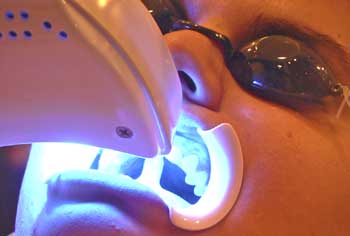
Want to know if you have an honest dentist?   Tell him you want to try UV tooth bleaching.   A study in Photochemical&Photobiological Sciences writes the lack of any enhanced bleaching effect is bad enough but it also damages skin and eyes up to four times as much as sunbathing.

And as with sunbathing, fair-skinned or light-sensitive people are at even greater risk, said lead author Ellen Bruzell of the Nordic Institute of Dental Materials.  

Bruzell also found that bleaching damaged teeth. She saw more exposed grooves on the enamel surface of bleached teeth than on unbleached teeth. These grooves make the teeth more vulnerable to mechanical stress.


Want skin damage?
Creationism, the rejection of the scientific basis of  evolutionary theory, is experiencing a resurgence among Europeans. The Department of Biology and Didactics of Biology at the TU Dortmund has organized an international conference addressing the issue, titled “Attitude and Knowledge concerning Evolution and Science in Europe (AKESE)”, funded by the German Federal Ministry of Research and Education.

On February 20th, researchers from different scientific backgrounds and seven European countries will meet at the Max Planck Institute for Molecular Physiology in Dortmund to discuss the scientific significance of evolutionary theory, its lack of social acceptance and the negative attitude towards science that rejection of evolution entails.
It would seem that in a bad economy, tax cuts make the most sense.    Letting people keep their money instead of letting the government spend money to collect taxes, spend money to institute government programs and then pay government employees to write checks is believed to lead to a great deal of waste.

