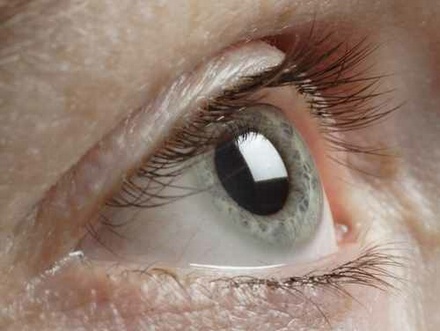





Scientists have known for more than 200 years that vision begins with a series of chemical reactions when light strikes the retina, but the specific chemical processes have largely been a mystery. A team of researchers from the United States and Switzerland say they have shed new light on this process by "capturing" this chemical communication for future study and say it may lead to the development of new treatments for some forms of blindness and vision disorders. 
Researchers at the University of British Columbia have discovered a mimic of one of "nature's antibiotics" that can be used to coat medical devices to prevent infection and rejection.   The study, released today in the journal Chemistry and Biology, found that a synthetic form, short tethered cationic antimicrobial peptides (cationic peptide), can protect surfaces, like those of medical devices, killing bacteria and fungi that come into contact with them. Peptides are small proteins.
A study of college freshmen in the United States and in China found that Chinese students know more science facts than their American counterparts but both groups are nearly identical when it comes to their ability to do scientific reasoning - unfortunately neither group  was very good at it.

The lesson is that educators must go beyond teaching science facts if we hope to produce voters, policy makers and scientists who can make reasoned choices.
Show Me The Science Month, Day 2

How do two populations change genetically when they are subjected to different evolutionary pressures? To answer this question, many intrepid evolutionary biologists have trudged out into the field to painstakingly study wild populations, but in many cases, we can learn more by studying evolution in the lab. In a paper published the February issue of Nature Genetics, a group of Portuguese and US researchers report a study of 28 years of evolution in a set of lab fruit fly populations. Their results are an example of how studying evolution in the lab, even for a short time, can provide insight in to how natural selection shapes the genetic contours of a population.
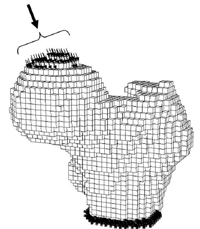
Better keep that resolution to hit the gym - you don't want to end up like an astronaut.  A recent study by Joyce Keyak of UCIrvine suggests that the bones of astronauts  lose up to 30% of their hipbone strength, comparable losses caused by osteoporosis in the elderly.
Morale has plummeted at the National Science Foundation, it seems, due to governmental oversight and interference from above.    The Senate Finance Committee didn't like a report they got from the NSF and are going to do something about it.

What, that sum'bitch Bush came back to haunt scientists and personally rewrite reports and ask why employees aren't doing their jobs instead of doing talk show appearances about how much he stinks?

The Scientific business of Thomson Reuters today announced the results of a study showing that the United States' share of scientific research has shrunk while Asia-Pacific's share of output has risen but the U.S. remains the leader globally in the relative impact of its research.

In its January/February issue of Science Watch, Thomson Reuters analyzes 12 year's worth of data from its National Science Indicators database to determine the U.S.'s global scientific influence based on the nation's research output and impact.

Investigators from Ludwig-Maximilians-Universität München and a Bolzano colleague have written another chapter in a murder case over 5,000 years old. New investigations  reconstructed the chronology of the injuries that Oetzi, the glacier man preserved as a frozen mummy, received in his last days.
In 2007 chocolate was all the rage, with Mars, Inc.-funded scientists even having their own panel at the AAAS meeting.  In 2008, blueberries were the rage.    

In 2009, says Dr. Luis Cisneros, Texas A&M AgriLife Research food scientist, "Stone fruits are super fruits, with plums as emerging stars."
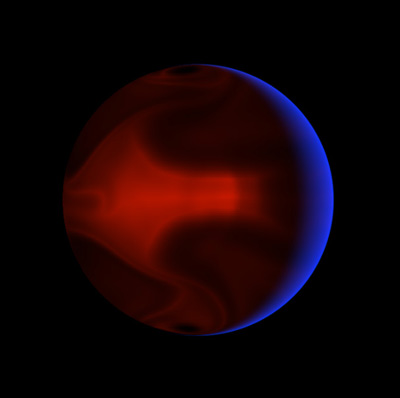
Astronomers have observed the intense heating of a distant planet as it swung close to its parent star, providing important clues to the atmospheric properties of the planet.  With that data,  astronomers at the University of California, Santa Cruz were able to generate 'realistic' images of the planet by feeding the data into computer simulations of the planet's atmosphere.    The researchers used NASA's Spitzer Space Telescope to obtain infrared measurements of the heat emanating from the planet as it whipped behind and close to its star. In just six hours, the planet's temperature rose from 800 to 1,500 Kelvin (980 to 2,240 degrees Fahrenheit).

