Two new efforts have taken a famous supernova remnant from the static to the dynamic. A new movie of data from NASA's Chandra X-ray Observatory shows changes in time never seen before in this type of object. A separate team will also release a dramatic three-dimensional visualization of the same remnant.
Nearly ten years ago, Chandra's "First Light" image of Cassiopeia A (Cas A) revealed previously unseen structures and detail. Now, after eight years of observation, scientists have been able to construct a movie that tracks the remnant's expansion and changes over time.
If your mother smoked, you're more likely to be an aggressive kid, according to a new Canada-Netherlands study published in the journal Development and Psychopathology.
And mothers who smoke, give birth under 21 and are poor should have caused North American to be overrun by the societal equivalent of Middle East dictators by now - so take what you want from that. While previous studies have shown that smoking during gestation causes low birth weight, this research claims mothers who light up during pregnancy predispose their offspring to an additional risk: violent behavior.
For a long time, we have been told that exercise is key to weight loss. If you don't have time to exercise, or can't, your excuse is built in.
Not so, says a recent international study. It comes down to knowing how many calories your body needs and eating that or less. Exercise can simply increase the calories you may ingest without gaining weight. Oddly, we knew this in 1908 but it seems to have been lost somewhere.
A team of researchers at Princeton University and The Cancer Institute of New Jersey has identified a long-sought gene that is fatefully switched on in 30 to 40 percent of all breast cancer patients, spreading the disease, resisting traditional chemotherapies and eventually leading to death.
The gene, called "Metadherin" or MTDH, is located in a small region of human chromosome 8 and appears to be crucial to cancer's spread or metastasis because it helps tumor cells stick tightly to blood vessels in distant organs. The gene also makes tumors more resistant to the powerful chemotherapeutic agents normally used to wipe out the deadly cells.
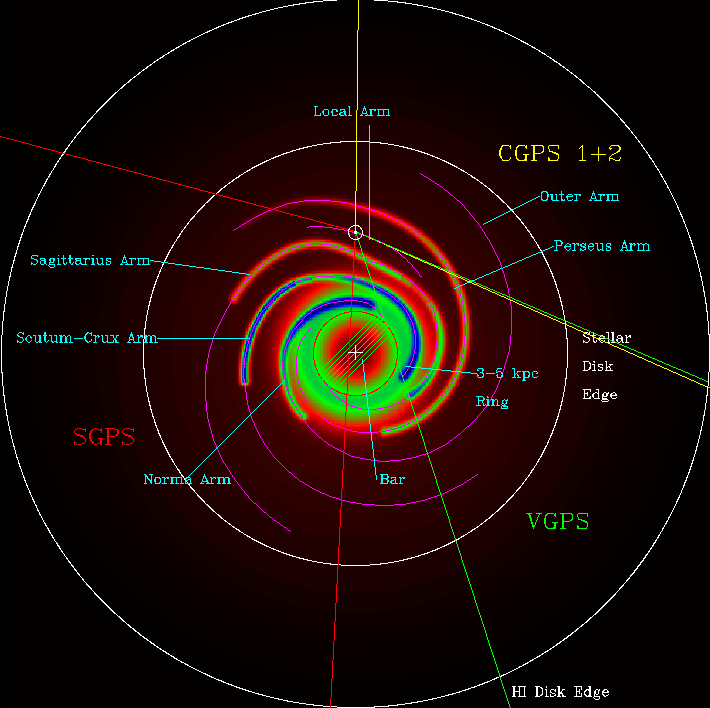
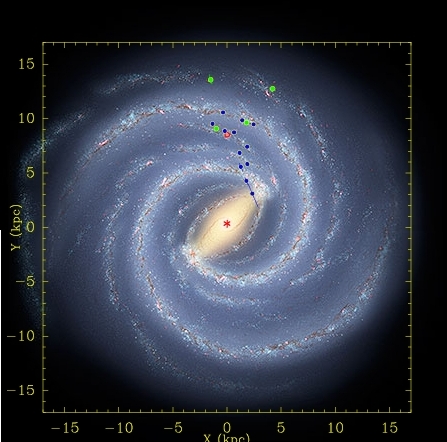
We may not be using it for navigation any time soon, but a new map of our own Milky Way galaxy provides other answers about the structure of our galaxy, and resolves conflicting information gathered from previous surveys.
Many previous mappings of the Milky Way have focused on either the inner galaxy or the outer galaxy, and as a result, different surveys have found different numbers of spiral arms - two in the inner galaxy and four in the outer. Now, Iowa State University has completed the first map of the entire system of galactic spiral arms, which shows two arms at the center branching into four on the outside.
Salon has an interview with
Stuart Kauffman, a biologist who has written multiple fascinating books about complex systems. Kauffman has a new book,
Reinventing the Sacred, in which he argues that we need to toss out scientific reductionism and take a new, holistic approach to science and rename it God. But how bad is the problem really?
Laplace famously claimed that if we knew the initial position and momentum of all the particles in the universe, we could confidently predict the future of the universe - that is, the universe is completely deterministic. Quantum mechanics seems to indicate that it is not - there is a graininess to the universe at a fundamental level (unless there are so-called 'hidden variables' determining the quantum behavior of particles).
During the 1990’s there was a lot of discussion (yelling?) over the question of whether or not Dinosaurs were endothermic, that is, warm blooded. In the regular media there is still a pretty solid leaning toward the idea that they were.
I’m inclined to say they weren’t. Here are two reasons why:
A new way to reduce carbon dioxide emissions and tackle climate change had been unveiled by a group of economists. Or an old way, depending on how long you have been around. Under their proposals, companies would buy what are in effect permits to pollute, but the price of those permits would be controlled because the government would retain enough, at a fixed price, to stop the cost increasing above that level.
Yes, it is price controls all over again. Welcome to 1972.
Let's face it, with all that talk about
life on other planets and
dark matter, we lose sight of the big picture. To start 2009 off right, the Milky Way, our galaxy, wants you to know she is not out of coolness yet. To wit, new measurements of the Milky Way say our home Galaxy is rotating about 100,000 miles per hour faster than previously thought.
Physicists at Indiana University have developed a promising new way to identify a possible abnormality in a fundamental building block of Einstein's theory of relativity known as "Lorentz invariance." If confirmed, the abnormality would disprove the basic tenet that the laws of physics remain the same for any two objects traveling at a constant speed or rotated relative to one another.
IU distinguished physics professor Alan Kostelecky and graduate student Jay Tasson take on the long-held notion of the exact symmetry promulgated in Einstein's 1905 theory and show in a paper to be published in the Jan. 9 issue of Physical Review Letters that there may be unexpected violations of Lorentz invariance that can be detected in specialized experiments.