Astronomers have uncovered strong evidence that brown dwarfs form like stars. Using the Smithsonian's Submillimeter Array (SMA), they detected molecules of carbon monoxide shooting outward from the object known as ISO-Oph 102. Such molecular outflows typically are seen coming from young stars or
protostars. However, this object has an estimated mass of 60 Jupiters, too small to be a star. Astronomers have classified it as a brown dwarf.
A Duke University study suggests that evolution can behave as differently as dogs and cats. While the dogs depend on an energy-efficient style of four-footed running over long distances to catch their prey, cats seem to have evolved a profoundly inefficient gait, tailor-made to creep up on a mouse or bird in slow motion.
"It is usually assumed that efficiency is what matters in evolution," said Daniel Schmitt, a Duke associate professor of evolutionary anthropology. "We've found that's too simple a way of looking at evolution, because there are some animals that need to operate at high energy cost and low efficiency."
Namely cats.
A study led by researchers at The University of Nottingham has identified a gene that protects the body from lung cancer.
The research, published in the journal Proceedings of the National Academy of Sciences, USA and funded by a £72,000 grant from the British Lung Foundation, has found that the tumor suppressor gene, LIMD1, is responsible for protecting the body from developing lung cancer — paving the way for possible new treatments and early screening techniques.
Lead researcher Dr Tyson Sharp and his University of Nottingham team, together with US collaborator Dr Greg Longmore, set out to examine if loss of the LIMD1 gene correlated with lung cancer development.
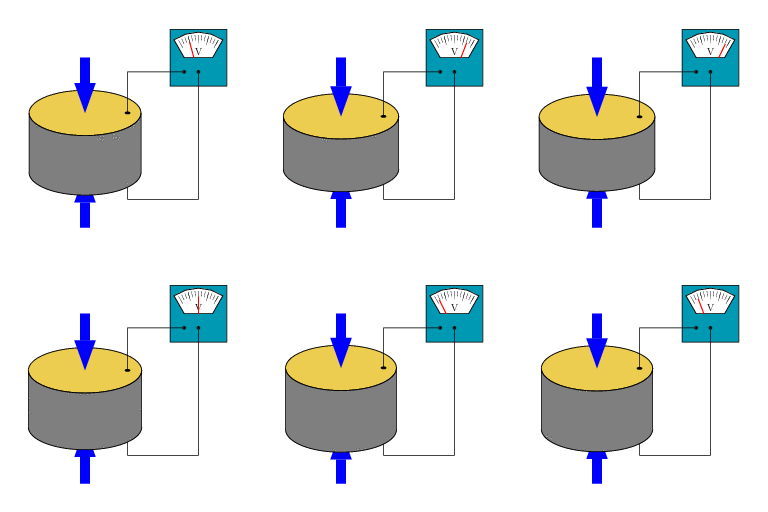
Wouldn't it be great if your cell phone or mp3 player could charge itself? What if your house could generate electricity from the noise of the cars on the road? Or if the waste heat generated by your air conditioner could help put a dent in that expensive summer electric bill? As the demand for cheaper and more renewable energy sources increases, piezoelectrics - a class of material that produces an electric potential when mechanically deformed - may hold the key to unlocking the energy flowing all around us.
Why can humans talk while chimps can't? The answer is more than just vocal cord anatomy; our brains have a lot to do with our ability to learn and use language. One 'language gene' is FOXP2. Mutations in FOXP2
lead to a rare but dramatic language disorder. Characterized by an inability to use grammar. We all know people who are grammatically challenged (stemming from illiteracy, for example), but this disorder is not the same thing - the affected people have a strong genetic barrier that prevents them using grammar, no matter how hard they work at it.
This disorder is a dramatic example of a language development disorder, but millions of children have much more mild language disorders. Many of these kids outgrow their language problems but not all. A group of researchers working in the UK and the US
asked whether some of these relatively mild language disorders are somehow connected to the FOXP2 gene, which so far has only been found to be involved in dramatic speech disorders. Sure enough, they found that variants in a gene regulated by FOXP2 are strongly correlated with mild language disorders.
Researchers have discovered that DNA damage decreases a cell's ability to regulate which genes are turned on and off in particular settings. This mechanism, which applies both to fungus and to us, might represent a universal culprit for aging.
"This is the first potentially fundamental, root cause of aging that we've found," says Harvard Medical School professor of pathology David Sinclair. "There may very well be others, but our finding that aging in a simple yeast cell is directly relevant to aging in mammals comes as a surprise."
Their findings appear in the November 28 issue of the journal Cell.
Converting forests or fields to biofuel crops can increase or decrease greenhouse gas emissions, depending on where – and which – biofuel crops are used according to researchers at University of Illinois.
Scientists analyzed data from dozens of studies to determine how planting new biofuel crops can influence the carbon content of the soil. Their findings appear this month in the journal Global Change Biology Bioenergy.
Most plastics are based on petroleum. A bio-plastic that consists of one hundred percent renewable raw materials helps to conserve this resource. Researchers have now optimized the plastic in such a way that it is even suitable for products such as Nativity figurines.
Toys have to put up with a lot of rough treatment: They are sucked by small children, bitten with milk teeth, dragged along behind bobby cars, and every now and then they have to survive a rainy night outdoors. Whatever happens, it is vital that the material does not release any softeners or heavy metals that could endanger children.
Researchers at Purdue University have developed a technique that uses a laser and holograms to precisely position numerous tiny particles within seconds, representing a potential new tool to analyze biological samples or create devices using nanoassembly.
The technique, called rapid electrokinetic patterning, is a potential alternative to existing technologies because the patterns can be more quickly and easily changed, said mechanical engineering doctoral student Stuart J. Williams.
The phrase "empty nest" can conjure up images of sad and lonely parents sitting at home, twiddling their thumbs, waiting for their children to call or visit. However, a new study, reported in Psychological Science, a journal of the Association for Psychological Science, suggests that an empty nest may have beneficial effects on the parents' marriage.
University of California, Berkeley psychologists Sara M. Gorchoff, Oliver P. John and Ravenna Helson tracked the marital satisfaction of a group of women over 18 years, from the time they were in their 40s to when they were in their early 60s.