

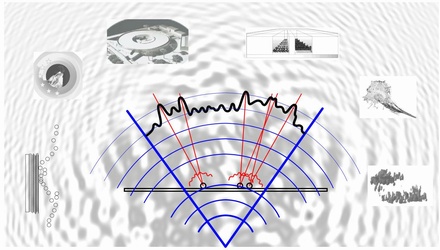





The precise timing of the origin of life on Earth and the changes in life during the past 4.5 billion years has been a subject of great controversy for the past century.

The principal indicator of the amount of organic carbon produced by biological activity traditionally used is the ratio of the less abundant isotope of carbon, 13C, to the more abundant isotope, 12C. As plants preferentially incorporate 12C, during periods of high production of organic material the 13C/12C ratio of carbonate material becomes elevated.

Using this principle, the history of organic material has been interpreted by geologists using the 13C/12C ratio of carbonates and organics, wherever these materials can be sampled and dated.

GRB 080319B was so intense that, despite happening halfway across the Universe, it could have been seen briefly with the unaided eye. In a Nature paper, Judith Racusin of Penn State University, and a team of 92 co-authors report observations across the electromagnetic spectrum that began 30 minutes before the explosion and followed it for months afterwards.

"We conclude that the burst's extraordinary brightness arose from a jet that shot material almost directly towards Earth at almost the speed of light - the difference is only 1 part in 20 000," says Guido Chincarini, a member of the team.

Gamma-ray bursts are the Universe's most luminous explosions. Most occur when massive stars run out of fuel. As a star collapses, it creates a black hole or neutron star that, through processes not fully understood, drives powerful gas jets outward. As the jets shoot into space, they strike gas previously shed by the star and heat it, thereby generating bright afterglows.

New nanotechnology paints for walls, ceilings, and surfaces could be used to kill hospital superbugs when fluorescent lights are switched on, said scientists today at the Society for General Microbiology's Autumn meeting being held this week at Trinity College, Dublin.

The new paints contain tiny particles of titanium dioxide, which is the dazzling white compound often used as a brightener in commercial paints. It will also be familiar to tennis fans as the powder used for the white lines to mark out the courts at Wimbledon.

Retail medical clinics located in pharmacies and other stores primarily attract both insured and uninsured patients who are seeking help for a small group of easy-to-treat illnesses or preventive care but do not otherwise have a regular health care provider, according to a new RAND Corporation study.

Retail medical clinics are typically located in drug stores and other large retail chain stores, such as Target and Wal-Mart, rather than in medical facilities. There are now almost 1,000 retail clinics in the United States and it is estimated there may be 6,000 by 2011.

The RAND Health study is the first to examine the types of patients who use the retail clinics and the health care services delivered by the clinics, which are growing in number and popularity. The findings are published in the September/October of the journal Health Affairs.

More than 1,500 audiocassette tapes taken in 2001 from Osama bin Laden's former residential compound in Qandahar, Afghanistan, are yielding new insights into the radical Islamic militant leader's intellectual development in the years leading up to the 9/11 terrorist attacks.

Flagg Miller, an assistant professor of religious studies at the University of California, Davis, and the first academic researcher to study the tapes, will present his preliminary observations in a lecture at the Center of Modern Oriental Studies in Berlin on Sept. 18. The first research paper stemming from Miller's study of the tapes will appear in the October issue of the journal Language & Communication.

Women employed in casual and contract jobs are up to ten times more likely to experience unwanted sexual advances than those in permanent full time positions, a University of Melbourne study has found.

The research by Associate Professor Anthony LaMontagne of the McCaughey Centre, VicHealth Centre for the Promotion of Mental Health and Community Wellbeing will be presented at the From Margins to Mainstream Conference: 5th World Conference on the Promotion of Mental Health and the Prevention of Mental and Behavioral Disorders.

Associate Professor LaMontagne's study examined the likelihood of sexual harassment in different types of employment.

Better self-control is linked to higher intelligence. But until now psychologists have been unsure exactly why. Now, researchers at Yale University are the first to report a clue that's helping to understanding why there is a tendency for more intelligent individuals to resist smaller, sooner rewards, while the preference for immediate rewards is associated with lower intelligence (IQ). The study, reported in the Sept. 9th issue of the journal 'Psychological Science,' is the first to investigate--and identify--the neural mechanisms that account for this relationship. The idea is relevant to areas such as personal financial planning and mental health, including massive credit card debt, substance abuse, attention deficit/hyperactivity disorder, and excessive gambling or online gaming. The work suggests that understanding such a relationship could even lead to interventions for enhancing self-control. If a mentally challenging task like a Sudoku improves your IQ, could it help you quit smoking?

Imagine that instead of setting out to invent a better lightbulb, Thomas Edison had announced his intention to invent a light-emitting diode that you could use to illuminate your kitchen. This isn't completely far-fetched: the first examples of light-emitting diodes (LEDs) began to appear as early as 1907. But it wasn't until the 1960's and 70's that useful, visible-spectrum LEDs began to appear, and LEDs haven't been used to light kitchens until very recently. Thomas Edison, had he set out to make a useful, household LED, would have been doomed to failure beacause it would be years before basic science made the necessary technologies possible.

When Richard Nixon declared the conquest of cancer "a national crusade" in 1971, cancer researchers were inevitably set up to be viewed as failures. Although at the time the recent molecular biology revolution led people to think that disease conquest was just around the corner, now we can look back and see that the War on Cancer had no hope of achieving its goals in the 1970's. Scientists are being punished for that hubris now, in the form of misguided news pieces such as Newsweek's current exposé: "We Fought Cancer...And Cancer Won".

Microbes that break down oil and petroleum are more diverse than we thought, suggesting hydrocarbons were used as an energy source early in Earth's history, according to a presentation at the Society for General Microbiology's Autumn meeting.

These microbes can change the composition of oil and natural gas and can even control the release of some greenhouse gases. Understanding the role of microbes in consuming hydrocarbons may therefore help us access their role in the natural control of climate change.

Do you ever think you might have a serious problem because you have to check your e-mail about a hundred times a day? Do you get angry or agitated when you can't check your e-mail or send text messages? Excessive e-mailing and text messaging is just one subtype of potential pathological addiction. And some people suffer from excessive gaming. But even if you check e-mail a hundred times a day and play online games 35 hours a week, don't worry: you're probably not pathological yet. "Carl" is an example of a guy who plays online games 35 hours a week. He's a 51 year old Transportation Planner from California with a friendly, down-to-earth demeanor. After work, he spends about five hours a night fighting monsters, completing quests, and talking to Orcs and Trolls in a game called 'World of Warcraft.' WoW, as it’s commonly known, is a 'massively multiplayer online role-playing game' (MMORPG) with over 10 million subscribers, set in the fantasy Warcraft universe. Carl’s record for sitting in front of the computer playing WoW is three and a half days with no sleep, few bathroom breaks, and a perfect 'level 70' avatar by the end of the campaign.


