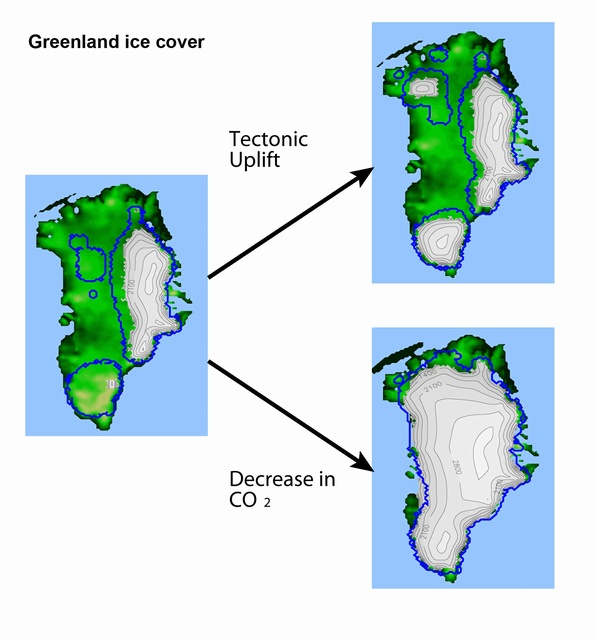









There is a great deal of concern about the effects of global warming on the Greenland ice sheet but scientists at the University of Bristol and the University of Leeds have taken the discussion to a deeper level - namely in stating that only changes in atmospheric carbon dioxide are able to explain the transition from the mostly ice-free Greenland of three million years ago to the ice-covered Greenland of today.

CO2 drops caused Greenland to become ice-covered so CO2 gains could undo that, they say.

There are several competing theories, ranging from changes in ocean circulation, the increasing height of the Rocky Mountains, changes in the Earth's orbit, and natural changes in atmospheric greenhouse gas concentrations. Using state-of-the-art computer climate and ice-sheet models, Dr. Dan Lunt from the University of Bristol and colleagues decided to test which, if any, of these theories was the most credible.

Not all fat is created equal, it seems. A Temple University study finds fat in obese patients is "sick" when compared to fat in lean patients.

Why 'sick? When our bodies don't work properly, we say we're sick. The study in the September issue of Diabetes finds that the same could be said for fat tissue found in obese patients. The cells in their fat tissue aren't working properly and as a result, are sicker than cells found in lean patients' fat tissue.

Lead author Guenther Boden, M.D. theorizes that "sick fat" could more fully explain the link between obesity and higher risk of diabetes, heart disease and stroke.

The latest research into dual-purpose contraceptives and non-hormonal contraception will be presented at the annual scientific conference of the Society for Reproductive Biology (SRB) conference in Melbourne.

University of Newcastle Laureate professor John Aitken, a world-leader in reproductive biology, will discuss the need to develop novel, safe, effective, dual-purpose contraceptive agents that combine the prevention of pregnancy with protection against sexually transmitted diseases (STDs). His research has explored the development of a contraceptive agent that immobilises – but does not kill – sperm. The agent also possesses microbicidal activity simultaneously reducing the risk of infection with sexually transmitted diseases, such as Chlamydia.

'Framing the debate' had its 15 minutes of fame, somewhere early in 2006, and since then has been revealed as little more than another word for 'spin' and, in a new study published in the journal Communication, Culture & Critique, Barbara Barnett of Kansas University lays out how framing was used in the Duke lacrosse players rape allegation.

Despite investments, community goodwill and some good ideas, a vexing question remains in the age of school reform: Why has so much hope and effort led to disappointment?

Beginning in the late 1980s, the Chicago Public Schools, like many urban schools systems, launched a series of initiatives to reorganize schools, improve teaching and encourage parental participation. The changes in Chicago not always have met the expectations of proponents, wrote Charles Payne in his new book, "So Much Reform, So Little Change: The Persistence of Failure in Urban Schools".

The results of national school reform efforts also have led to some disappointment. A lack of trust among teachers and principals and parents frequently creates dysfunction in schools, noted Payne.

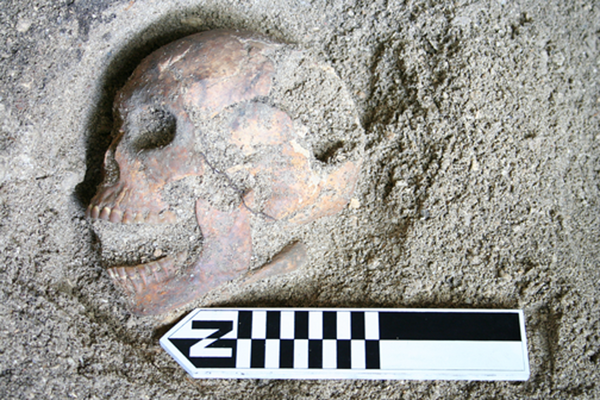
Misinterpreted fragments of leg bones, teeth and brow ridges found in Palau appear to be an archaeologist's undoing, according to researchers at three institutions. They say that the so-called dwarfs of these Micronesian islands actually were modern, normal-sized hunters and gatherers.

Scientists from the University of Oregon, North Carolina State University and the Australian National University refute the conclusion of Lee R. Berger and colleagues that Hobbit-like little people once lived there.(1)

"One of his biggest mistakes was rushing to publish," said University of Oregon anthropologist Greg C. Nelson of Berger. "He did not take the time to understand the area in which he was working -- its entire history, not just the skeletal stuff," he said. "Any time you work anywhere, you have to understand this history. You just can't walk in and cowboy it, pull some stuff out and draw conclusions in the absence of understanding the bigger picture."

You may not know "Daredevil" if you are not a comic book guy - the Ben Affleck movie certainly didn't endear him to most of the public. Daredevil lost his sight in an accident but, shortly after that, found his remaining senses had been enhanced.

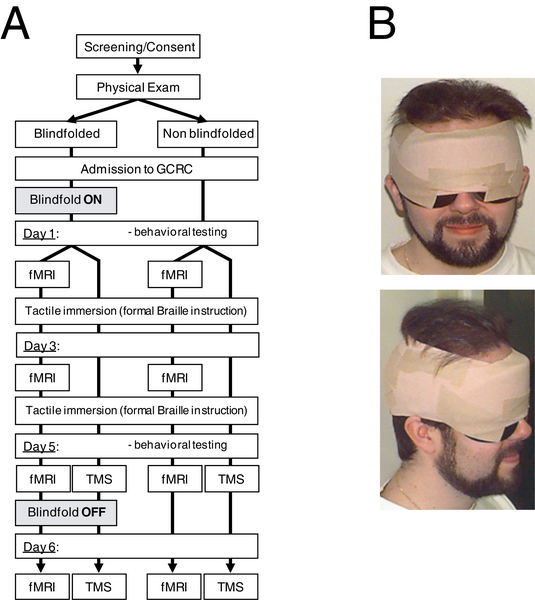
It was common sense, the radiation-boosting aspects notwithstanding, and previous research has confirmed that when vision is lost, a person's senses of touch and hearing become enhanced. But exactly how this happens has been unclear.

Now a long-term study from the Berenson-Allen Center for Noninvasive Brain Stimulation at Beth Israel Deaconess Medical Center (BIDMC) demonstrates that sudden and complete loss of vision leads to profound – but rapidly reversible -- changes in the visual cortex. These findings not only provide new insights into how the brain compensates for the loss of sight, but also suggest that the brain is more adaptable than originally thought.

Scientific happenings, big and small, on this day in history…

But first, today’s quiz:
What event, which took place on this day in 1883, produced the most violent explosion known in human history? You probably know the answer; it’s just a matter of thinking about it for a moment. But just to be sure, you can check the answer at the end of the article.

And on to other historic happenings…

I usually limit my book reviews to Goodreads or Shelfari but this one deserves much more attention. In Happy Accidents: Serendipity in Modern Medical Breakthroughs; When Scientists Find What They're NOT Looking for, Morton Meyers reviews examples of the unpredictability of scientific progress. This could just be a collection of interesting anecdotes - and some of the stories are truly fascinating. My favorite is probably the discovery of platinum compounds for the treatment of cancer.
Rogue prefers his steak medium-well. But when it comes to sniffing out a rare plant, this dog performs work that’s very well done, indeed.

The 4-year-old Belgian sheepdog is part of a Nature Conservancy collaborative project to test the efficacy of using dogs to sniff out the threatened Kincaid’s lupine . The plant is host to the endangered Fender’s blue butterfly, found only in Oregon’s Willamette Valley.


