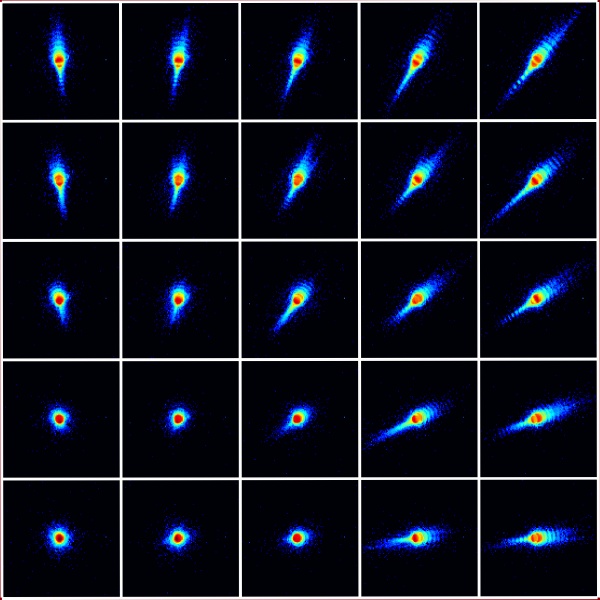






A super-resolution X-ray microscope developed by a team of researchers from the Paul Scherrer Institut (PSI) and EPFL in Switzerland combines the high penetration power of x-rays with high spatial resolution, making it possible for the first time to shed light on the detailed interior composition of semiconductor devices and cellular structures.

The new instrument uses a Megapixel Pilatus detector (whose big brother will be detecting collisions from CERN's Large Hadron Collider), which has excited the synchrotron community for its ability to count millions of single x-ray photons over a large area. This key feature makes it possible to record detailed diffraction patterns while the sample is raster-scanned through the focal spot of the beam. In contrast, conventional x-ray (or electron) scanning microscopes measure only the total transmitted intensity.

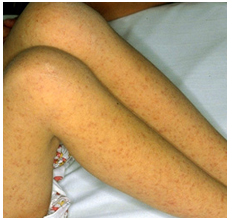
Hypochondriacs beware. The Rocky Mountain spotted fever and lyme disease caused by ticks is nothing to take lightly—especially in the dry season when ticks are most prominent, even more so due to global warming.

Rocky Mountain spotted fever, which was first identified in the Rocky Mountains, is caused by the bacteria Rickettsia rickettsii, when an infected tick comes in contact with humans. The ticks affected by the bacteria include the American dog tick, the lone-star tick, and the wood tick, all of which like to live in wooded areas and tall, grassy fields.

Similarly, Lyme disease is named after the place it was discovered in Lyme, Connecticut in 1975. It is caused by a cork-screw like bacterium called Borrelia burgdorferi. The black-legged ticks are usually the ones that spread the disease. Like its progressive corkscrew shaped bacterium, ticks are affected by feeding off small animals with the disease. These animals usually include mice, chipmunks, and other wild rodents. When the infected tick attaches to a person or animal and stays attached long enough (usually more than 36 hours) to take a “blood meal” it has further passed on the infection.

Below is the final statement emerging from the Altenberg workshop, agreed upon by all 16 participants. Individual commentaries about the workshop will be posted on the KLI web site, and MIT Press will publish the full proceedings by the end of 2009.

A group of 16 evolutionary biologists and philosophers of science convened at the Konrad Lorenz Institute for Evolution and Cognition Research in Altenberg (Austria) on July 11-13 to discuss the current status of evolutionary theory, and in particular a series of exciting empirical and conceptual advances that have marked the field in recent times.

The new information includes findings from the continuing molecular biology revolution, as well as a large body of empirical knowledge on genetic variation in natural populations, phenotypic plasticity, phylogenetics, species-level stasis and punctuational evolution, and developmental biology, among others.
I first came across the word synchrotron in connection with the Crab Nebula, as well explained here at Hyperphysics. However, the phenomenon is these days very much down-to-earth: last weekend I returned from our last ever session at the Daresbury Synchrotron, which is soon to be shut down (final public use Saturday 1st August 2008). It first came on-line for experiments in 1981: prior to that, intense X-ray and hard UV synchrotron radiation was obtained as a by-product through “parasitic” operation on particle storage rings. Among others, Reading’s own Keith Codling had shown that much more useful science was being obtained from the synchrotron radiation than from the particle experiments. As a result of their concerted effort, the first Second-Generation light source was built at Daresbury.

Reaching a finish line is an obstacle that does not begin or end with procrastination. A college dissertation, however, can be built on the foundations of such a behavior. Studies have proven that a small amount of pressure can actually stimulate comprehension and motivation, something that can be achieved through procrastination.

In a 2002 study by Jeffrey J. Walczyk, Kathryn E. Kelly, Scott D. Meche and Hillary Braud at Louisiana Tech University College called “Time Limitations Enhance Reading Comprehension,” students read passages under no time constraints, mild pressure, or under high-demand time limits. Results showed that the best reading comprehension was observed under mild time pressure. The idea can be further addressed by taking a closer look at procrastination.

With the idea encapsulated in the Parkinson’s Law stating that “Work Expands so as to fill the time available for its completion,” procrastination may be a realistic endeavor. Robert A. Harris, author of "Writing with Clarity and Style: A Guide to Rhetorical Devices for Contemporary Writers," associates the law with two factors. He addresses both in an article called “Human Factor Phenomena in Problem Solving.”

"Survival of the fittest" is the catch phrase of evolution by natural selection. While natural selection favors the most fit organisms around, evolutionary biologists have long wondered whether this leads to the best possible organisms in the long run.

A team of researchers at The University of Texas at Austin, led by Drs. Matthew Cowperthwaite and Lauren Ancel Meyers, has developed a new theory, which suggests that life may not always be optimal.

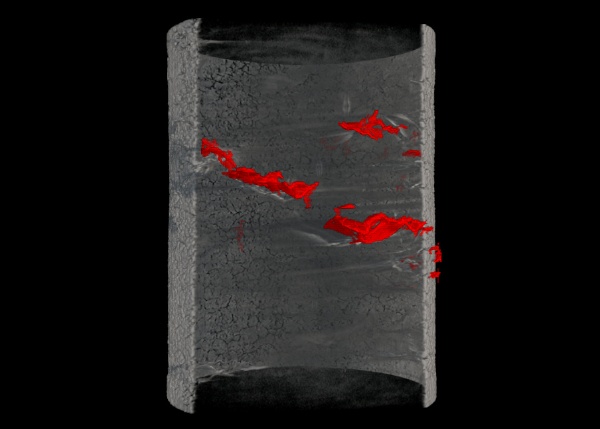
A team of researchers from the University of Manchester, the National Institute of Applied Sciences (INSA) in Lyon and the ESRF has revealed how a growing crack interacts with the 3D crystal structure of stainless steel.

By using a new grain mapping technique it was possible to determine the internal 3D structure of the material without destroying the sample. Afterwards, a crack was initiated in the stainless steel, and the scientists were able to study how the crack grew between the grains. This is the first time that such an experiment has used the 3D grain mapping technique, and the first results are published in Science this week.

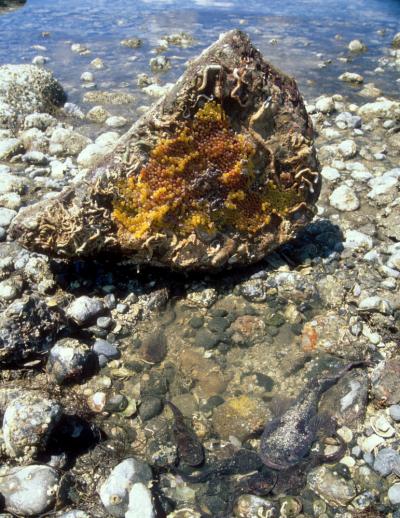
New research on the midshipman fish, a close relative of the toadfish, indicates that that the ability to make and respond to sound is an ancient part of the vertebrate success story.

After building a nest for his potential partner, he calls to nearby females by contracting his swim bladder, the air-filled sac fish use to maintain buoyancy. The sound he makes is not a song or a whistle, but a hum; more reminiscent of a long-winded foghorn than a ballad. Female midshipman find it very alluring, and they only approach a male's nest if he makes this call.

Researchers at Goldsmiths, University of London have conducted a study that highlights how errors can occur in the eyewitness identification process of the criminal justice system. The study shows that stress and fear reduce the likelihood of successful identification, bringing into question a victim’s ability to identify the perpetrator of a crime.

Visitors to the London Dungeon were asked to describe and identify an actor encountered in the ‘Labyrinth of the Lost’ who stepped out to block their path. Whilst they were in the labyrinth, some participants wore a heart rate monitor to measure the level of their anxiety. The researchers found that participants who had experienced a higher state of anxiety were less likely to report correct descriptions of the actor and were less likely to correctly identify him/her in a line-up than participants who had experienced less anxiety.

Some bacterial cells can swim, morph into new forms and even become dangerously virulent - all without initial involvement of DNA. Yale University researchers writing in Science describe how bacteria accomplish this amazing feat - and in doing so provide a glimpse of what the earliest forms of life on Earth may have looked like.

To initiate many important functions, bacteria sometimes depend entirely upon ancient forms of RNA, once viewed simply as the chemical intermediary between DNA's instruction manual and the creation of proteins, said Ronald Breaker, the Henry Ford II Professor of Molecular, Cellular and Developmental Biology at Yale and senior author of the study.


