China is the largest polluter in the world and leads in greenhouse gas emissions but is exempt from the Kyoto Protocol. Many Western countries argue that all polluters should face restrictions if any do, but the US, for example, is the largest importer of goods from China.

Should importers of goods also be responsible for greenhouse gas emissions of goods?

The Kyoto Protocol had numerous flaws, based primarily on an inadequate understanding of which gases caused global warming and to what extent. Focusing solely on counting carbon emissions within national borders was also inadequate in deciding who is responsible for emissions reduction, as suggested by today’s G8+8 stalemate.

A research team has for the first time discovered evidence of water that came from deep within the Moon, a revelation that strongly suggests water has been a part of the Moon since its early existence – and perhaps ever since it was created by a cataclysmic collision between the early Earth and a Mars-sized object about 4.5 billion years ago.

The team, led by Alberto Saal, assistant professor of geological sciences at Brown, believes that the water was contained in magmas erupted from fire fountains onto the surface of the Moon more than 3 billion years ago. About 95 percent of the water vapor from the magma was lost to space during this eruptive "degassing," the team estimates. But traces of water vapor may have drifted toward the cold poles of the Moon, where they may remain as ice in permanently shadowed craters.

For the first time, scientists have succeeded in developing human embryonic stem cells (hESCs) from a single cell, or blastomere, of a 4-cell stage embryo, the 24th annual conference of the European Society of Human Reproduction and Embryology heard today.

Dr. Hilde Van de Velde, from the Vrije Universiteit Brussel (VUB), Brussels, Belgium, said that their research meant that it might be possible in the future to produce hESC lines at an earlier stage without destroying the embryo.

If we told you that men in the morning had a better response to vaccinations for hepatitis A and influenza, you might think there was some biology bias at work, but that's what a study led by Anna Catriona Phillips of the University of Birmingham found. They assessed the response to a hepatitis A vaccine in young healthy adults and also examined responses to the annual influenza vaccination in older community-based adults.

In the first study, participants consisted of 75 University of Birmingham students who were vaccinated with the hepatitis A vaccine during a morning session (10 am to 12 pm) or early evening session (4 pm to 6 pm). In the second study, 90 older adults attended their medical practice for the annual influenza vaccination and received the vaccination in the morning between 8 am and 11 am or in the afternoon between 1 pm and 4 pm.

Most people who find a seashell during their summer holiday on the coast will probably not be aware that they have found a unique record of the climate. For paleontologists, those hard calcium shells provide a profound insight into the history of our earth and especially into the climate of the past.

Shells are a unique climate archive. The shells have clearly delineated growth patterns that show changing nutritional conditions, temperature fluctuations and environmental pollution. Shells are found all over the world, in the polar regions and at the equator, on land and in the ocean, in deeper waters and on ocean shelves, in tidal zones and in rivers, streams and lakes. "Shells are simply everywhere and, depending on their location, they provide us with important information about climatic developments.

They serve as records of volcanic eruptions in Iceland or the occurrence of a hurricane in Florida; they can, for example, even tell us whether the early Indian tribes on the western coast of Canada collected mollusks during full moon, crescent moon or new moon periods," states Schöne. Even though many types of shell are durable and survive for thousands of years, the mollusks themselves are extremely sensitive: In the presence of environmental pollution, they respond by lowering their rate of shell growth, which is why they can also be used for longer-term monitoring of water quality.


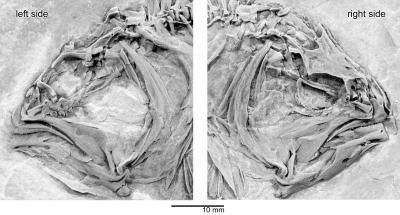
Hidden away in museums for more that 100 years, some recently rediscovered flatfish fossils have filled a puzzling gap in the story of evolution and answered a question that initially stumped even Charles Darwin.

All adult flatfishes--including the gastronomically familiar flounder, plaice, sole, turbot, and halibut--have asymmetrical skulls, with both eyes located on one side of the head. Because these fish lay on their sides at the ocean bottom, this arrangement enhances their vision, with both eyes constantly in play, peering up into the water.

 Skull of heteronectes chaneti, showing incomplete orbital migration intermediate between generalized fishes and living flatfishes.

After taking a fresh look at an old fossil, John Flynn, Frick Curator of Paleontology at the American Museum of Natural History, and colleagues determined that the brains of the ancestors of modern Neotropical primates were as small as those of their early fossil simian counterparts in the Old World. This means one of the hallmarks of primate biology, increased brain size, arose independently in isolated groups—the platyrrhines of the Americas and the catarrhines of Africa and Eurasia.

"Primatologists have long suspected that increased encephalization may have arisen at different points in the primate evolutionary tree, but this is the first clear demonstration of independent brain size increase in New and Old World anthropoids," says Flynn of the paper that appeared in the Museum's publication Novitates this June. Encephalization is the increase in brain size relative to body size. Animals with large encephalization quotients (E.Q.'s) are those with bigger brains relative to their body size in comparison to the average for an entire group. Most primates and dolphins have high E.Q.'s relative to other mammals, although some primates (especially apes and humans) have higher E.Q.'s than others.

While it's true that the attractiveness of orthodontic braces is related to less metal, according to a recent survey, the least attractive ones remain the most effective. It's that old form versus function issue.

Study findings published in a recent issue of the American Journal of Orthodontics and Dentofacial Orthopedics found that the public's attitude about the attractiveness of various styles of braces indicates that the types of dental appliances with no visible metal were considered the most attractive. Braces that combine clear ceramic brackets with thin metal or clear wires were a less desirable option, and braces with metal brackets and metal wires were rated as the least aesthetic combination.

Money is important for survival and for entertainment, and it is often used as a reward, but recent studies have shown that money is also a factor in personal performance, interpersonal relations and helping behavior, as well.

In a recent set of experiments, psychologists Kathleen D. Vohs of the University of Minnesota, Nicole L. Mead of Florida State University and Miranda R. Goode of the University of British Columbia found that participants’ personal performance improved, and interpersonal relationships and sensitivity towards others declined, when they were reminded of money.

To set up one of the experiments, the researchers used four different types of reminders about money.

Terrace-like elevations of just a few nanometres can form during production of organic thin films made from electrically conductive material. This phenomenon was previously only known from inorganic materials and is crucially important for future production of a new generation of semi-conductor components based on organic thin films.

Inorganic semi-conductors have a simple construction and have made high-performance computers possible. In contrast, organic semi-conductors are complex but enable production of innovative electronic circuits, as vividly demonstrated by the first prototypes for roll-up screens. Yet these benefits of organic semi-conductors can only be fully harnessed when the response of their organic molecular layer - whose thinness is crucial in functional terms - is better understood.

The national research network (NRN) "Interface controlled and functionalised organic thin films" of the Austrian Science Fund FWF is contributing to precisely this understanding.