







We grow closer and closer to an understanding of the mechanisms underlying addictions, and with that knowledge we also learn about other illnesses. It is not new to think of eating disorders as addictions, but the connection has often been one of analogy, not brain function.

In a piece in Scientific American magazine, an interesting exploration of the underlying mechanisms that may be at play with anorexia nervosa:

Addicted to Starvation: The Neurological Roots of Anorexia

"What is more, cultural cues cannot easily explain why the afflicted, who are shockingly skinny, misperceive themselves as fat.

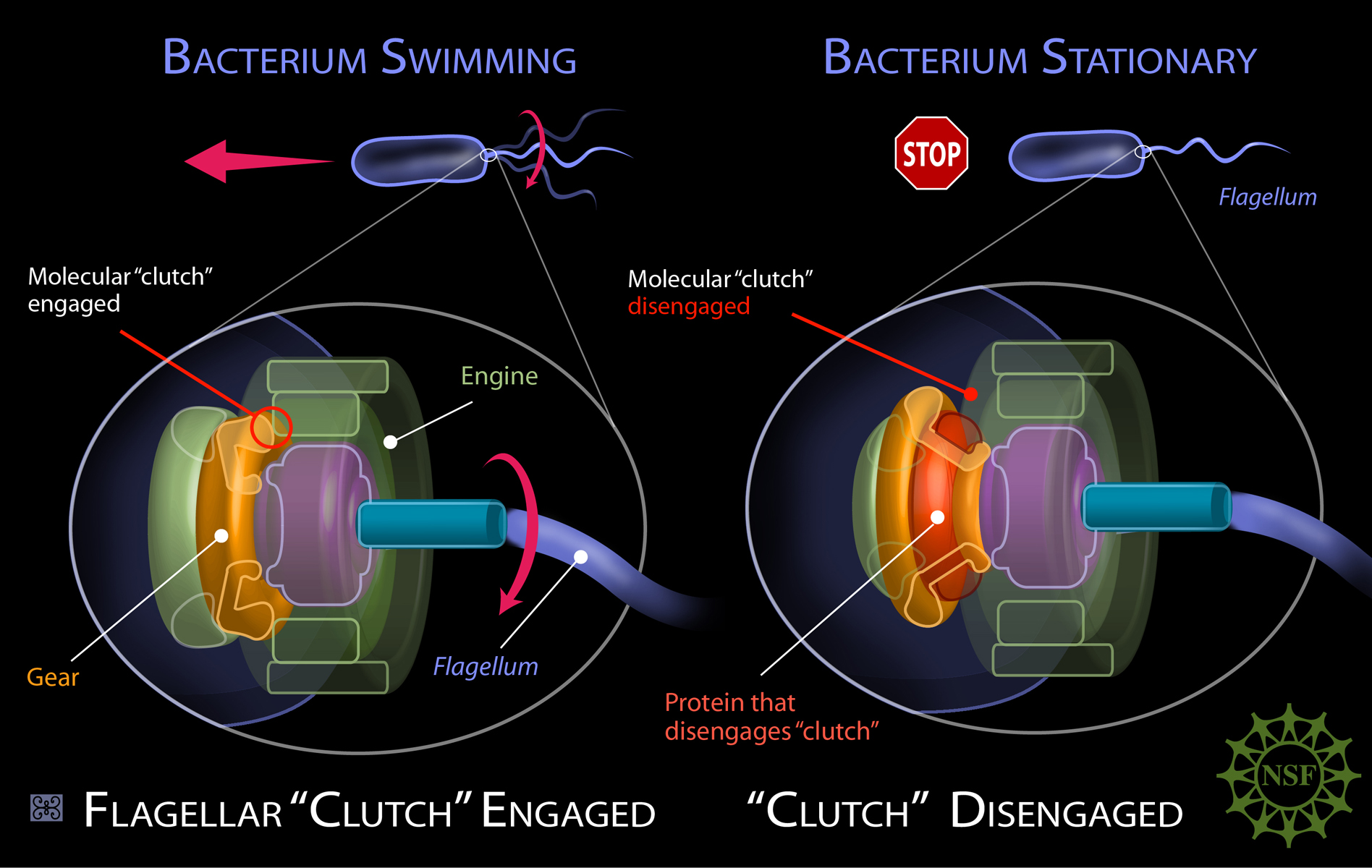
It has been long been known that bacteria swim by rotating their tail-like structure called the flagellum. The rotating motion of the flagellum is powered by a molecular engine located at the base of the flagellum. Just as engaging the clutch of a car connects its gear to its engine and delivers power to its wheels, engaging the molecular clutch of a bacterium connects its gear to its engine and delivers power to its flagellum.

Now, a paper appearing in Science describes, for the first time, how the flagellum's rotations are stopped so that bacteria stop moving.

Here's how the stopping mechanism works: while a bacterium is swimming, it releases a protein (shown in red in the stationary bacterium in the figure) that flows between its gear and engine. The presence of this protein detaches the bacterium's gear from its engine and thereby stops the delivery of power to its flagellum. This process is analogous to disengaging the clutch of a car, which detaches its gear from its engine and thereby stops the delivery of power to its wheels.

Once the delivery of power to bacterium's flagellum stops, the flagellum stops rotating, and the bacterium's swimming ends.

In the current issue of Science, researchers from the European Molecular Biology Laboratory's European Bioinformatics Institute [EMBL-EBI] uncover systematic errors in existing methods that compare genetic sequences of different species to learn about their evolutionary relationships.

They present a new computational tool that avoids these errors and provides accurate insights into the evolution of DNA and protein sequences. The results challenge our understanding of how evolution happens and suggest that sequence turnover is much more common than assumed.

The four letter code that constitutes the DNA of all living things changes over time; for example individual or several letters can be copied incorrectly [substitution], lost [deletion] or gained [insertion]. Such changes can lead to functional and structural changes in genes and proteins and ultimately to the formation of new species. Reconstructing the history of these mutation events reveals the course of evolution.

Yesterday I was facilitating a philosophy discussion at the New York Society for Ethical Culture when I found myself all of a sudden defending philosophy from the accusation that it’s all made up stuff. Two of the participants raised the objection from different perspectives, both representing persistent misconceptions concerning how philosophers go about doing their business.

The first criticism is that philosophy can never settle anything because, unlike science, it does not rely on experimental evidence. Granted, philosophers don’t do experiments (other than the very inexpensive thought variety), but then again philosophy isn’t science, so it seems odd to accuse philosophers of not doing what scientists do. (Then again, check out the experimental philosophy web site!)

Philosophers have other ways of settling disputes and advancing their discipline, and these ways make use of the rules of rational discourse and logic. For instance, just like no self-respecting scientist would be caught dead conducting an experiment with a statistically flawed design (say, the lack of a control), so no professional philosopher wants to be found engaging in a logical fallacy. And logical fallacies are even more clearly defined and understood than most experimental protocols.

Health-care system constraints combined with a lack of a uniform referral process are leaving Ontario physicians brokering which patients are in greatest need of hip and knee replacement, a study led by a St. Michael's Hospital researcher funded by the Canadian Institutes of Health Research has revealed.

The study, conducted by a team of researchers from across the University of Toronto and published in Medical Decision Making, examined the impact of patient characteristics, including age, weight/obesity, comorbidity and perioperative risk, and gender and caretaker roles in the decision-making process of 18 family physicians, 15 rheumatologists and 17 orthopedic surgeons from across Ontario.

The variability in this process means not everyone who needs this surgery will actually get surgery.

With food prices going up, farmers are getting wealthy (or wealthier, in the case of the big conglomerates), right? Not outside the US, according to a study in Economic Development and Cultural Change by Marcel Fafchamps(1) and Ruth Vargas Hill(2).

In their new study for look to the long-time coffee producing nation of Uganda to attempt to answer the riddle of why higher prices don't 'trickle down' in other countries, even if they are modern liberalized economies.

Coffee is the world's largest agricultural commodity, and is also one of the world's most volatile. Large global coffee price fluctuations mean coffee has seen many periods of rapidly increasing prices. But new research shows that when global coffee prices rise, farmers do not see the same rise in the price they receive.

When six day care centers imposed a fine on parents who picked their children up late, tardiness doubled and it stayed high even when the fine was removed.

How can it be that a financial penalty made the problem worse? Parents, it seems, stopped seeing lateness as an imposition on teachers, and instead saw it as something that could be purchased with no moral failing.

A basic tenet of economics is that people always behave selfishly, or as the 18th century philosopher economist David Hume put it, "every man ought to be supposed to be a knave."

Information gleaned from a Greenland ice core by an international science team shows that two huge Northern Hemisphere temperature spikes prior to the close of the last ice age some 11,500 years ago were tied to fundamental shifts in atmospheric circulation.

The ice core showed the Northern Hemisphere briefly emerged from the last ice age some 14,700 years ago with a 22-degree-Fahrenheit spike in just 50 years, then plunged back into icy conditions before abruptly warming again about 11,700 years ago. Startlingly, the Greenland ice core evidence showed that a massive "reorganization" of atmospheric circulation in the Northern Hemisphere coincided with each temperature spurt, with each reorganization taking just one or two years, said the study authors.

The new findings are expected to help scientists improve existing computer models for predicting future climate change as increasing anthropogenic greenhouse gases in the atmosphere drive up Earth's temperatures globally.

Firing someone? Do it on Friday because they would have the weekend off anyway and they are less likely to show up after two days with a rifle. Some things don't change.

But the 'Friday Effect' for publicly traded companies has diminished with the advent of instant news so they have little to gain from saving bad news until Fridays on the assumption that traders are distracted by the approaching weekend, says economist Leon Zolotoy in his research, for which he will be awarded a PhD at Tilburg University in the Netherlands on 25 June.

Zolotoy researched how international stock markets react to new information. The Sarbanes-Oxley Act was introduced in July 2002, partly as a result of the corporate scandals involving Global Crossing, WorldCom, Enron and Tyco. The Act’s strict disclosure requirements were designed to restore investors’ and analysts’ confidence in the stock market.

Since September 11, U.S. politicians have repeatedly reminded us that the journalists in the Arab world are biased against America and the West. A new study in the July 2008 issue of International Journal of Press/Politics says that is not the case.

To provide a snapshot of journalists' attitudes and to create a benchmark for future studies, the researchers surveyed 601 mainstream professional Arab journalists with the goal of understanding how they view both their profession and the events they cover. (1)

While still subject to censorship, Arab journalists have growing aspirations for independence fed by their access to more than 300 free-to-air Arab satellite channels and the rise of blogging on the internet.


