







Conserving biodiversity must be considered when developing plans to reduce greenhouse gas emissions from deforestation, researchers warn in a paper today.

The 2007 statistics from the Food and Agriculture Organization of the United Nations indicate that from 1990 to 2005 the world lost 3% of its total forest area, some 13 million hectares per year. The greatest losses were in Latin American and the Caribbean ( 7 % over 15 years or about 16 million hectares per year) Africa (9% over 15 years or 4.4 million hectares per year). Land use change (mostly deforestation) accounts for 18-25% of global annual greenhouse gas emissions.

The United Nations Framework Convention on Climate Change is currently discussing ways of Reducing Emissions from Deforestation and Degradation (REDD) in developing countries. REDD has great potential to deliver benefits for biodiversity and people, as well as for the climate, however it is likely that these benefits will be concentrated in forests with high carbon stocks and that land use change may shift to low-carbon forests and other ecosystems important for biodiversity.

In a report in the current issue of the journal Cell, Dr. Hugo Bellen and colleagues at Baylor College of Medicine along with Dr. Michael Miller from the University of Alabama at Birmingham show how a single mutation in the human form of the VAMP-Associated Protein B (VAPB) contributes to the nerve and muscle breakdown in flies and worms, similar to ALS in humans. They found important clues about what goes wrong in the nerves and muscles of people with amyotrophic lateral sclerosis, better known as ALS or Lou Gehrig's disease.

The story actually begins around 500 years ago, when a Portuguese immigrant to Brazil brought along an uninvited guest – a mutation in the gene for VAPB. That mutation leads to a rare form of inherited ALS that has so far been identified in about 200 people. ALS is a devastating disease that begins in middle age and affects nerves and muscles, destroying the individual's ability to move, talk, swallow and breathe, eventually killing the person who has it. There are an estimated 30,000 people with ALS in the United States alone. It affects people of all ethnicities worldwide.

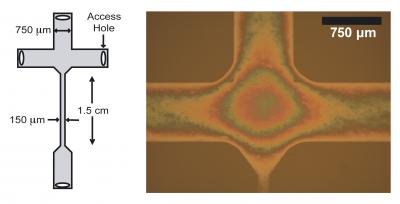
While the results may not rival the artistry of glassblowers in Europe and Latin America, researchers at the National Institute of Standards and Technology (NIST) and Cornell University have found beauty in a new fabrication technique called "nanoglassblowing" that creates nanoscale (billionth of a meter) fluidic devices used to isolate and study single molecules in solution—including individual DNA strands.

Traditionally, glass micro- and nanofluidic devices are fabricated by etching tiny channels into a glass wafer with the same lithographic procedures used to manufacture circuit patterns on semiconductor computer chips. The planar (flat-edged) rectangular canals are topped with a glass cover that is annealed (heated until it bonds permanently) into place. About a year ago, the researchers observed that in some cases, the heat of the annealing furnace caused air trapped in the channel to expand the glass cover into a curved shape, much like glassblowers use heated air to add roundness to their work.

Scientists are deploying an advanced research aircraft to study a region of the atmosphere that influences climate change by affecting the amount of solar heat that reaches Earth's surface.

Findings from the project, based at the National Center for Atmospheric Research (NCAR), will be used by researchers worldwide to improve computer models of global climate in preparation for the next report by the Intergovernmental Panel on Climate Change (IPCC).

The project, running from April to June, is known as START 08 (Stratosphere-Troposphere Analyses of Regional Transport). It focuses on a remote boundary zone of the atmosphere called the tropopause, which sits at the bottom of the stratosphere. Scientists are increasingly interested in the tropopause, because of both its importance in the global climate system and because the buildup of greenhouse gases has altered this atmospheric region in ways that are not yet fully understood.

A story in the Minneapolis Star-Tribune caught my attention today, not only because it was an interesting article but because it may indicate a shift in our country’s approach to health care. As we all know, the number of people with diseases and conditions that are preventable is growing in America (and globally).

 One way to deal with this is on an individual level, treating the symptoms or curing the disease after the fact. In this model, the focus is on individual treatment, or downstream of the event. Another way to deal with this problem is at the community level, working to prevent the disease or condition from ever occurring. In this model, the focus is on prevention, or upstream of the event. (I’ve greatly oversimplified the issues – there are accidents, genetic predispositions, etc that we can’t prevent – but you get the general idea.)

Health care costs are skyrocketing, competing with gas, food and mortgages. Perhaps at an individual, day-to-day level, we can’t control gas, food or the housing crisis. But we can do something about our health. If we take steps to prevent something from occurring, we can dramatically increase the health of our nation (and ourselves) while reducing the money spent on treating health issues.

Critics may say the US is losing its competitive edge but nonetheless she remains dominant in science and technology worldwide by a large margin, according to a RAND Corporation study issued today.

The United States accounts for 40 percent of the total world's spending on scientific research and development, employs 70 percent of the world's Nobel Prize winners and is home to three-quarters of the world's top 40 universities.

An inflow of foreign students in the sciences -- as well as scientists and engineers from overseas -- has helped the United States build and maintain its worldwide lead, even as many other nations increase their spending on research and development. Continuing this flow of foreign-born talent is critical to helping the United States maintain its lead, according to the study.

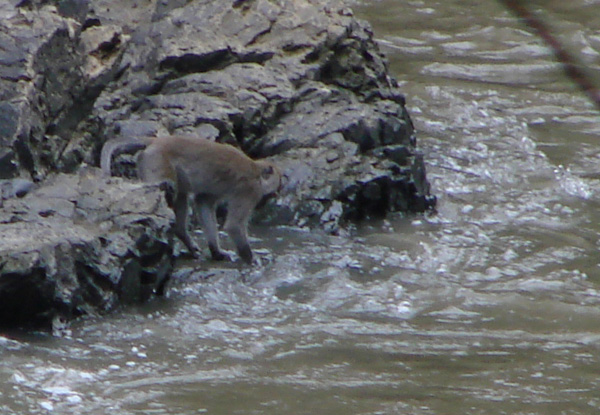
Long-tailed macaques eat mostly fruit — but when resources are scarce, they’ve been known to get creative with their cuisine. When living near humans, they raid gardens and learn to beg for food. Sometimes they even steal food from inside houses.

Now, for the first time, scientists have observed long-tailed macaques fishing with their bare hands.

Nature Conservancy scientist Erik Meijaard and other researchers are the first to scientifically document this rare conduct. In a recent article published in the International Journal of Primatology, Meijaard and his coauthors say that, while conducting field studies in Indonesia, they have repeatedly observed long-tailed macaques catching fish from fast-flowing rivers.

New fossil evidence from the rock desert and cold, treeless steppes of Tibet's desolate Himalayan-Tibetan Plateau that now comprise Earth's highest land mass suggests a literally groundbreaking possibility:

Major tectonic changes on the Tibetan Plateau may have caused it to attain its towering present-day elevations -- rendering it inhospitable to the plants and animals that once thrived there -- as recently as 2-3 million years ago, not millions of years earlier than that, as geologists have generally believed. The new evidence calls into question the validity of methods commonly used by scientists to reconstruct the past elevations of the region.

Benfotiamine, a popular vitamin supplement is being advertised with claims that are demonstrably untrue, as revealed by research published in the open access journal BMC Pharmacology.

Benfotiamine is a synthetic derivative of thiamine (vitamin B1). It is marketed heavily as a dietary supplement using a selection of unsubstantiated, 'not-quite-medical' claims that tend to characterize this field. A large part of this campaign has been built around the belief that benfotiamine is lipid-soluble and, therefore, more physiologically active.

Scientific research led by Dr Lucien Bettendorff of the Center for Cellular and Molecular Neurobiology at the University of Liège, Belgium, has entirely disproved these claims.

The proteins upon which life depends share an attribute with paper airplanes: Unless folded properly, they just won't fly.

But researchers have been puzzled by how the long, linear proteins cranked out by the ribosome factories in a cell are folded into the shapes they must assume to perform their function. They only have known that for many of the most complex and essential proteins, the folding takes place out of sight, hidden in the inner cavity of a type of molecule called a chaperonin.

Now Stanford researchers have begun prying open the lid, literally, on the inner workings of chaperonin molecules by deducing the mechanism by which the lid operates on a barrel-shaped chaperonin called TRiC.


