








In the contentious political debate over embryo stem (ES) cell research, both proponents and opponents begin with the premise that "embryos are destroyed for their cells," as President Bush claims and non-partisan journalists repeat frequently in stem cell news stories.

It's only when partisans get beyond this premise that opinions diverge. Proponents of ES cell research argue that embryo destruction is justified based on the promise of extraordinary medical advances. In contrast, the President and his supporters describe ES cell derivation as "the taking of innocent human life," which is "always immoral." And yet, in strictly biological terms, the conventional wisdom is wrong. No life is being "taken" or destroyed when embryos are transformed into ES cells.

To understand the relationship between embryos and ES cells, it is critical to understand the process of development that is initiated by fertilization. The single-cell embryo undergoes multiple rounds of division giving rise to about 100 cells after five to six days. At this stage, the cells along the surface undergo biochemical changes that eliminate their potential to differentiate into anything other than the placenta. And in the center of the embryo, only about two dozen cells retain the ability to develop into every tissue and organ that makes up the human body proper.

Do scalar fields exist across the whole universe? Unlike gravitational or magnetic fields, which have both strength and direction, scalar fields have strength alone, varying from point to point.

They definitely exist within some closed systems, such as the temperature distribution within the earth’s atmosphere, but it is not yet known whether they exist on the scale of the universe.

It's a vital question because the existence of scalar fields could help explain how the universe developed after the Big Bang and became as we observe it today. For example scalar fields could explain the existence of dark matter and energy, which can only be observed indirectly from their gravitational effects on the part of the universe we can see.

Researchers from the Peninsula Medical School in Cornwall, UK, have modified a photodynamic therapy (PDT) treatment that combines a topically applied cream with visible light to destroy cancer cells while leaving surrounding tissue unharmed.

The cream is applied directly to skin cancers and pre-cancers, which then naturally produces a photosensitive drug. A special red light is then shone on the tumour a few hours later, to activate this light sensitive compound. This results in cellular damage and the destruction of the tumour.

This technique results in reduced scarring and little or no damage to the surrounding healthy cells.

As Indiana Jones races against time to find an ancient crystal skull in his new movie adventure, he should perhaps take a moment to check its authenticity.

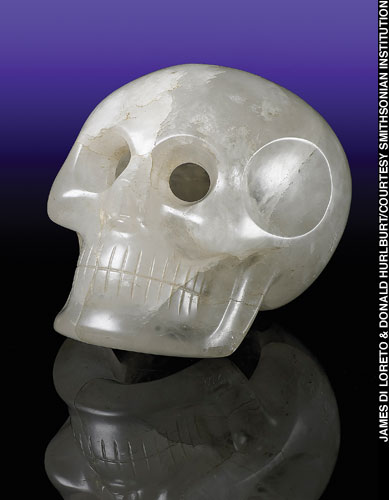
New research suggests that two well-known crystal skulls, in the British Museum and the Smithsonian Institution, Washington DC, did not, after all, come from ancient Mexico. Academics now believe the British skull was made in 19th century Europe and the American one even more recently.

The British Museum bought its skull, a life-size carving from a single block of rock crystal from Tiffany and Company, New York in 1897. Its origins were unknown but there were suggestions it was of ancient Mexican origin. Human skulls worn as ornaments and displayed on racks were known to have featured in Aztec art. The skull attracted a lot of public attention and speculation it was once thought to have healing powers. Crystal skulls have since featured in many books, articles and films, most recently in the new Steven Spielberg movie Indiana Jones and the Kingdom of the Crystal Skull.

Some people interested in mathematics have curiosity about how mathematics is used in finance, and perhaps even have an eye toward a career in quantitative finance. Others are already pursuing a career in finance and the capital markets, and have an interest in learning more of the underlying mathematics. All around the world Financial Mathematics and Financial Engineering programs are appearing, filling a growing educational need, and the umbrella organization for these programs is the International Association of Financial Engineers (http://www.iafe.org/home.php). The proliferation of financial mathematics was the subject of a Wall Street Journal article ("Wall Street Warms To Finance Degree With Focus on Math", 14 November 2006), by Ronald Alsop. It was also the cover story of the 23 January 2007 issue of Business Week. The subject matter was a main focus of a one-quarter program entitled "Quantitative Modeling in Finance and Econometrics" held in Spring 2004 at the Institute for Mathematics and Its Applications, see http://www.ima.umn.edu/complex/#spring .

Robocup 2008 will be a lot more interesting with the addition of more realistic soccer-playing robots. So realistic some can even walk like people.

Researcher Daan Hobbelen of TU Delft has developed Flame - a new, highly-advanced walking robot. This type of research, for which Hobbelen will receive his PhD on Friday 30 May, provides insight into how people walk.

If you try to teach a robot to walk, you will discover how complex an activity it is. Walking robots have been around since the seventies but some, like factory robots, are limited in flexibility. TU Delft is a pioneer in the other method used for constructing walking robots, based on the way humans walk.

The human body is home to a diverse range of microorganisms, estimated to outnumber human cells in a healthy adult by ten fold. The importance of characterizing human microbiota for understanding health and disease is highlighted by the recent launch of the Human Microbiome Project by the National Institutes of Health. This report describes the investigation of healthy human skin for microbiota diversity and establishes the basis for determining a core microbiome.

The Human Microbiome Project aims to characterize the microbial communities of several regions of the body, including skin, where determining the core microbiome is essential to understanding and developing new treatments for skin conditions and diseases such as acne and atopic dermatitis (eczema).

In this study, researchers led by Dr. Julie Segre of the National Human Genome Research Institute have generated a diversity profile of human skin microbiota by sequencing 16S rRNA, a component of the prokaryotic ribosome, isolated from a specific region of skin. “We focused this study on the inner elbow to inform future clinical studies of the extremely common inflammatory skin disorder atopic dermatitis, which affects this area of the skin and is associated with Staphylococcus infections,” explains Segre.

In investigating the intricacies of the body’s biological rhythms, scientists at Beth Israel Deaconess Medical Center (BIDMC) have discovered the existence of a “food-related clock” which can supercede the “light-based” master clock that serves as the body’s primary timekeeper.

The findings, which appear in the May 23 issue of Science, help explain how animals adapt their circadian rhythms in order to avoid starvation, and suggest that by adjusting eating schedules, humans too can better cope with changes in time zones and nighttime schedules that leave them feeling groggy and jet-lagged.

“For a small mammal, finding food on a daily basis is a critical mission,” explains the study’s senior author Clifford Saper, MD, PhD, Chairman of the Department of Neurology at BIDMC and James Jackson Putnam Professor of Neurology at Harvard Medical School. “Even a few days of starvation is a common threat in natural environments and may result in the animal’s death.”

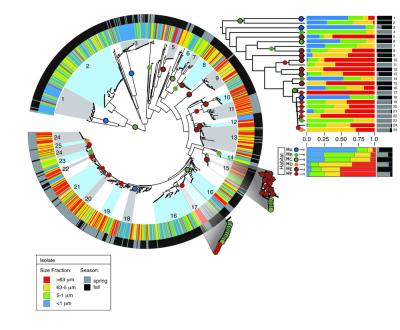
It isn't just people. Marine bacteria also organize into professions or lifestyle groups that partition many resources rather than competing for them. Microbes with one lifestyle, such as free-floating cells, flourish in proximity with closely related microbes that may spend life attached to zooplankton or algae.

This new information about microbial groups and the methodology behind it could change the way scientists approach the classification of microbes by making it possible to determine on a large scale, relatively speaking, the genetic basis for ecological niches. Microbes drive almost all chemical reactions in the ocean; it’s important to identify the specific professions held by different groups.

“This is the first method to accurately differentiate the ecological niche or profession among large groups of microbes in the ocean,” said Professor Martin Polz, a microbiologist in MIT’s Department of Civil and Environmental Engineering. He and colleague Professor Eric Alm, a computational biologist, published a paper describing their research in the May 23 issue of Science.

Alzheimer’s disease (AD), the most frequent cause of dementia, is a form of amyloidosis. It has been known for a century that dementia, brain atrophy and amyloidosis can be caused by chronic bacterial infections, namely by Treponema pallidum in the atrophic form of general paresis in syphilis. Bacteria and viruses are powerful stimulators of inflammation. It was suggested by Alois Alzheimer and his colleagues a century ago that microorganisms may be contributors in the generation of senile plaques in AD.

A number of chronic diseases are in fact caused by one or more infectious agents - stomach ulcers are caused by Helicobacter pylori while chronic lung disease in newborns and chronic asthma in adults are both caused by Mycoplasmas and Chlamydia pneumonia and some other pathogens have been associated with atherosclerosis.

The realization that pathogens can produce slowly progressive chronic diseases has opened new lines of research into Alzheimer’s disease.


