









If you read the medical news lately you may have seen a headline title Skeleton May Show Ancient Brain Surgery. This article was about an 1800 year old skeleton found in Veria, Greece. The skeleton was of a woman of about 25 years of age that suffered severe head trauma and underwent cranial surgery, unfortunately evidence shows that she did not survive.

There is an interesting history of skull surgery, known as trepanation, which comes from the Greek word trypanon, meaning auger or borer. Cranial trepanation has caught the interest of surgeons and archeologist since the 1860's, when it was first realized that ancient humans had scraped or cut holes in the skulls of living persons in France and Peru.

Trepanation is serious enough surgical procedure in this day and age, could this procedure have taken place as a routine operation as long ago as 2000 BC? We do have a historical record of thousands of skulls with evidence of this surgery. Sometimes historical records suggest a reality that we find hard to accept.

The news keeps coming in, and examples of how real science works (as opposed to make believe creationism or so-called intelligent design) are beginning to get so numerous that it is hard to imagine people capable of reading newspaper articles are still capable of denying evolution. Last month, for instance, a spectacular discovery was published in Nature magazine, a finding that has resolved a long-standing question about the evolution of bats. Darwin listed the problem as one of the great mysteries of evolution he was not able to address in “The Origin of Species”: how did bats originate from terrestrial ancestors? The modern version of the conundrum hinged, until last month, on whether flight or echolocation (the amazing ability of bats to generate a sonar-like pulse to orient themselves and locate preys) came first. For decades biologists have been arguing in favor of either the flight-first or the echolocation-first hypothesis.

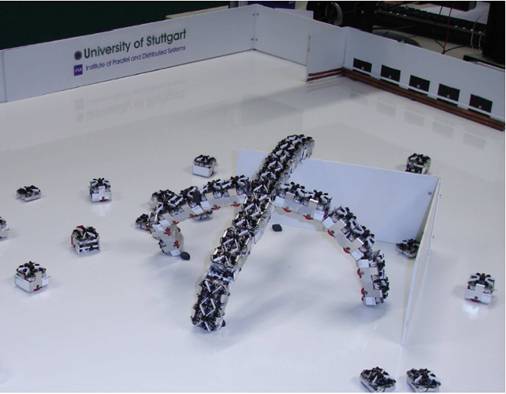
The aim of the ‘Symbiotic Evolutionary Robot Organisms’ project, or ‘Symbrion’, is to understand the principles that govern how robots can form themselves into a single artificial organism. The technique enables them to interact collectively with the physical world, and might ultimately be applied to real-world tasks such as rescuing earthquake victims.

‘Multi-robot organisms’ are made up of large swarms of individual robots, each slightly larger than a sugar cube, which work together to form a single artificial life-form. The organisms are able to share information and energy with one another, and to manage their own hardware and software.

North American buildings release more than 2,200 megatons of CO2 into the atmosphere - 35 percent of the continent’s total - according to a new report issued by the trinational Commission for Environmental Cooperation (CEC). The report says rapid market uptake of energy-saving technologies could result in over 1,700 fewer megatons of CO2 emissions by 2030 - a cut nearly equal to the CO2 emitted by the entire US transportation sector in 2000.

Promoting the green design, construction, renovation and operation of advanced energy-saving buildings could cut North American greenhouse gas emissions more deeply and cheaply than any other available measure, the report advises.

Scientists are fond of placing great value on what they call skepticism: Not taking things on faith. Science versus religion, is the point. In practice this means wondering about the evidence behind this or that statement, rather than believing it because an authority figure said it. A better term for this attitude would be: Value data.

Due to a recent whirlwind bout of touring, I was excited to do nothing but plunk on my couch with the dog and watch many, many hours of pro sports. Ski videos would be nice, but really what I was looking for was a good cricket match — completely incomprehensible and hopefully extending across multiple days. Contract bridge and international chess competed for close-second.

This has happened before but, if you have small children and/or a pregnant spouse, you know your ability to sink into a vegetative stupor is tempered by relationship politics. This, I think, is not an issue relevant to me alone.

Everyone knows computer chips have increased in speed and shrunk in size over the past few decades and their interconnects, the copper wires that transport signals around the chip and to other chips, have shrunk also. As interconnects get smaller, the copper’s resistance increases and its ability to conduct electricity degrades. This means fewer electrons are able to pass through the copper successfully, and any lingering electrons are expressed as heat. This heat can have negative effects on both a computer chip’s speed and performance.

The $260 billion semiconductor industry won't get too excited just yet but they have to take notice of a Rensselaer Polytechnic Institute study comparing the performance of copper nanowires and carbon nanotube bundles for interconnects. It is the first study to examine copper nanowire using quantum mechanics rather than empirical laws.

Amino acids are organic molecules that are the backbone of the proteins that build many of the structures and drive many of the chemical reactions inside living cells. The production of proteins is believed to constitute one of the first steps in the emergence of life. Amino acids are truly the 'building blocks' of life on Earth but the presence of these compounds in meteorites has led some researchers to look to space as a source.

Scientists at the Carnegie Institution have discovered concentrations of amino acids in two meteorites that are more than ten times higher than levels previously measured in other similar meteorites. This result suggests that the early solar system was far richer in the organic building blocks of life than scientists had thought, and that fallout from space may have spiked Earth’s primordial broth.

According to a new study in single-celled organisms, cheating could be genetic. And it could be the same in humans, giving new meaning to the term 'slime mold.'

An international team found that some amoebae have the ability to use cheating tactics to give them a better chance of survival. The research suggests that cheating may be widespread among social creatures - but so are survival instincts. Around other cheaters, or when cheating would place all in peril, the cheating did not occur.

Scientists at the National Institute of Environmental Health Sciences (NIEHS) recently conducted a study showing that long-term exposure to a component of artificial butter flavoring called diacetyl can be harmful to the nose and airways of mice. The study was conducted because diacetyl has been implicated in causing obliterative bronchiolitis (OB), a rare but debilitating lung disease, in humans.

OB has been detected in workers who inhaled significant concentrations of the flavoring in microwave popcorn packaging plants. When laboratory mice inhaled diacetyl vapors for three months, they developed lymphocytic bronchiolitis - a potential precursor of OB. None of the mice, however, were diagnosed with OB.

