





A paper by Professor Fabrizio Schifano at the University of Hertfordshire’s School of Pharmacy, which has been published in the Journal of Psychopharmacology, indicates that 1,022 people died between 1990 and 2004 in instances where the presence of cocaine/crack cocaine was detected.

In this descriptive and correlational study, Professor Schifano reviewed the number of mentions on death certificates during the specified period, last year use of cocaine; treatment demand, number of drug offenders; seizures, prices and average purity levels.

Expressive writing --writing about one’s deepest thoughts and feelings—may help change the way cancer patients think and feel about their disease.

In one of the first studies published in an oncology journal about the benefits of writing therapy, researchers say those who immediately reported changes in thoughts about their illness also reported a better physical quality of life three weeks later.

“Previous research suggests expressive writing may enhance physical and psychological well-being,” said Nancy P. Morgan, M.A., writing clinician and director of the Lombardi Comprehensive Cancer Center’s Arts and Humanities Program. “But most of those studies involved three to five writing sessions that were conducted in a controlled laboratory setting. Here, we found that just one writing session in a busy cancer clinic where the patients are frequently interrupted can still have a positive impact on patients.”

Scientists at the University of Michigan have shown that their new metabolic imaging instrument can accurately detect eye disease at a very early stage. Such a device would be vision-saving because many severe eye diseases do not exhibit early warning signals before they begin to diminish vision. The testing is noninvasive and takes less than 6 minutes to administer to a patient.

Victor M. Elner, M.D., Ph.D., and Howard R. Petty, Ph.D., report their findings in the February issue of Archives of Ophthalmology. The women had been recently diagnosed with pseudotumor cerebri (PTC), a condition that mimics a brain tumor and often causes increased pressure on the optic nerve that can lead to vision loss.

The study grew out of Petty and Elner’s observation that metabolic stress at the onset of disease causes certain proteins to become fluorescent. To measure the intensity of this flavoprotein autofluorescence (FA), they designed a unique imaging system equipped with state-of-the art cameras, filters, and electronic switching, together with customized imaging software and a computer interface.

Lockheed Martin's Aegis Ballistic Missile Defense (BMD) Weapon System successfully destroyed an errant United States satellite, preventing it from an uncontrolled and unpredictable reentry and potential crash to Earth.

In the mission, the SPY-1B radar on the cruiser USS Lake Erie detected the satellite during its orbit and, through the capable equipment and computer programs comprising the Aegis Weapon System, computed a targeting solution to guide an SM-3 missile to intercept the satellite. Once the SM-3 was launched from the ship's MK 41 Vertical Launch System (VLS), Aegis guided the missile to the terminal phase of the intercept.

Lockheed Martin engineers recently worked with U.S.

A University of British Columbia astronomer with an international team has discovered the largest structures of dark matter ever seen. Measuring 270 million light-years across, these dark matter structures criss-cross the night sky, each spanning an area that is eight times larger than the full moon.

“The results are a major leap forward since the presence of a cosmic dark matter web that extends over such large distances has never been observed before,” says Ludovic Van Waerbeke, an assistant professor in the Dept. of Physics and Astronomy.

To glimpse the unseen structures, the team of French and Canadian scientists “X-rayed” the dark matter, an invisible web that makes up more than 80 per cent of the mass of the universe.

Kevin Gardner sees green roads right around the corner.

“A lot of the infrastructure in this country needs to be re-built,” says Gardner, University of New Hampshire associate professor of civil engineering and director of the Environmental Research Group. “We have a real opportunity to re-build the infrastructure the right way with sustainable materials and socially sensitive designs that protect air, water, land, and human resources.”

Funded by the Federal Highway Administration and pooled state highway funds, as well as Environmental Protection Agency (EPA) grants for specific research projects, Gardner established the new Recycled Materials Resource Management Center (RMRC) at UNH on June 1, 2007. The RRMC is a collaboration between UNH environmental and social impact researchers and University Wisconsin-Madison geotechnical, or soil behavior, faculty. Working closely with a board of advisors composed of representatives from the EPA, the Federal Highway Administration and the American Association of State Highway and Transportation Officials, as well as numerous other stakeholders, one of the Center’s activities is to establish a green roads program that develops criteria for what makes a roadway green.

A team of academic, industry and independent researchers has demonstrated a new class of computer attacks that compromise the contents of “secure” memory systems, particularly in laptops.

The attacks overcome a broad set of security measures called “disk encryption,” which are meant to secure information stored in a computer’s permanent memory. The researchers cracked several widely used technologies, including Microsoft’s BitLocker, Apple’s FileVault and Linux’s dm-crypt.

The team reports that these attacks are likely to be effective at cracking many other disk encryption systems because these technologies have architectural features in common.

There are lots of journals out there, more than I could name in any one article, but as you get into science communication, the number of peer-reviewed publications drops considerably.

That seems odd, since communicating with the public, and therefore with the voters on policy, is so crucial to keeping science funding in place.

A group of volunteers had that same thought, so they secured some funding from the European Space Agency's Hubble Space Telescope group and set out to fill that gap. CAP Journal was born. CAP Journal stands for Communicating Astronomy with the Public. It's a new magazine, in print and online, and the timing is excellent.

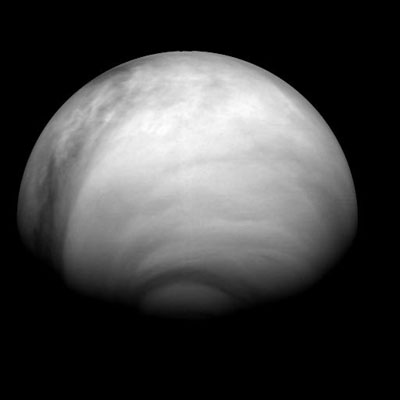
Venus, it turns out, is a planet of extraordinarily changeable and extremely large-scale weather. Bright hazes appear in a matter of days, reaching from the south pole to the low southern latitudes and disappearing just as quickly. This kind of ‘global weather’, unlike anything on Earth, has given scientists a new mystery to solve.

The cloud-covered world of Venus is all but a featureless, unchangeable globe at visible wavelengths of light. Switch to the ultraviolet and it reveals a truly dynamic nature. Transient dark and bright markings stripe the planet, indicating regions where solar ultraviolet radiation is absorbed or reflected, respectively.

In July 2007, the Venus Monitoring Camera (VMC) captured a series of images showing the development of a bright southern haze.

The first direct evidence of how and when tectonic plates move, that collision with one sliding below the other into the rocky mantle, could potentially improve their ability to assess earthquake risks.

A team of researchers writing in Nature found that, contrary to common scientific predictions, dense plates tend to be held in the upper mantle, while younger and lighter plates sink more readily into the lower mantle.

The mantle is a zone underneath the Earth's crust encompassing its super hot molten core. It is divided into an upper and lower area, and is made up of a 2,900 km circumference of churning, viscous rock. It is constantly fed with new material from parts of tectonic plates which slide down from the surface into it.

