





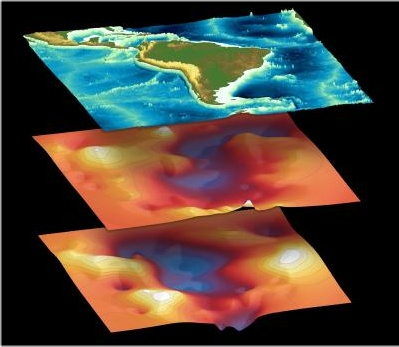

The Joint Genome Institute (DOE JGI) has released an upgraded version of the IMG/M metagenome data management and analysis system, providing tools for analyzing the functional capability of microbial communities based on their metagenome DNA sequence in the context of reference isolate genomes.

The new version includes five additional metagenome datasets generated from microbial community samples that were the subject of recently published studies, including the metagenomic and functional analysis of termite hindgut microbiota (Nature 450, 560-565, 22 November 2007) and the single cell genetic analysis of TM7, a rare and uncultivated microbe from the human mouth (PNAS, July 17, 2007, vol. 104, no. 29, 11889-11894).

Anyone who has conducted field research knows that the very process of collecting data alters the system that you are studying. As you walk across a field, forest or stream to collect data, your footfalls trample vegetation, they compact the soil, they scrape algae off the rocks. Survey work usually involves a single visit to a site - as long as you avoid sampling from the areas you have trampled, it’s usually pretty safe to assume that your presence is unlikely to have affected the data that you have collected. Permanent plots are a different matter - because these plots are repeatedly sampled, there is cumulative damage. In larger plots, permanent trails may be established within plots.

Since we can’t avoid these effects, the real question is whether the effects are significant. Ecological systems are inherently heterogeneous. Does the effect of disturbance fall within the range of natural variability within the sample? That’s what really matters when it comes to data collection. In a forthcoming paper in the journal Biotropica, Liza Comita and Gregory Goldsmith “sought to quantify the significance and spatial extent of research trail impacts on the structure and dynamics of the seedling layer in the 50-ha permanent forest dynamics plot on Barro Colorado Island (BCI), Panama”.

There was a time when you had to be rich to be fat. Now you have to be rich to stay thin, says a new study.

Researchers led by Jennifer L. Black at New York University critically reviewed ninety studies published between 1997 through 2007 on neighborhood determinants of obesity through the PubMed and PsychInfo databases.

They found that neighborhoods with decreased economic and social resources have higher rates of obesity. They also found that residents in low-income urban areas are more likely to report greater neighborhood barriers to physical activity, such as limited opportunities for daily walking or physical activity and reduced access to stores that sell healthy foods, especially large supermarkets.

Turning native ecosystems into “farms” for biofuel crops causes major carbon emissions that worsen the global warming that biofuels are meant to mitigate, according to a new study by the University of Minnesota and the Nature Conservancy.

The carbon lost by converting rainforests, peatlands, savannas, or grasslands outweighs the carbon savings from biofuels. Such conversions for corn or sugarcane (ethanol), or palms or soybeans (biodiesel) release 17 to 420 times more carbon than the annual savings from replacing fossil fuels, the researchers said. The carbon, which is stored in the original plants and soil, is released as carbon dioxide, a process that may take decades.

This “carbon debt” must be paid before the biofuels produced on the land can begin to lower greenhouse gas levels and ameliorate global warming.

A study by psychologists at Stanford, Pennsylvania State University and the University of California-Berkeley says that many Americans subconsciously associate blacks with apes.

In addition, the findings show that society is more likely to condone violence against black criminal suspects as a result of its broader inability to accept African Americans as fully human, according to the researchers.

Co-author Jennifer Eberhardt, a Stanford associate professor of psychology, said she was shocked by the results, particularly since they involved subjects born after Jim Crow and the civil rights movement. "This was actually some of the most depressing work I have done," she said. "This shook me up. You have suspicions when you do the work—intuitions—you have a hunch. But it was hard to prepare for how strong [the black-ape association] was—how we were able to pick it up every time."

Anoop Sindhu and colleagues report on a gene that may have played a key role in the evolution of grasses. The gene, Hm1, provides resistance against Cochliobolus carbonum race 1 (CCR1), a fungus that is capable of attacking and killing corn at any stage of its development (images of CCR1 infection). While CCR1 is only known to affect corn, the gene Hm1 and its relatives are present throughout the grass family, but are absent from other lineages.

Although scientists have speculated over the negative effects of environmental toxins for years, new data suggest that certain environmental toxins may disrupt the normal growth and hormonal development of girls.

Some of these toxins, such as the mycoestrogen zearalenone (ZEA) produced by the Fusarium fungus species, can be found naturally in the environment, have properties similar to the female reproductive hormone estrogen, and are also structurally similar to anabolic growth agents used in animal breeding.

A new study scheduled for publication in The Journal of Pediatrics suggests that certain mycoestrogens may be directly linked to the early onset of sexual development in young girls.

Using the genetic equivalent of an ancient thermometer, a team of scientists has determined that the Earth endured a massive cooling period between 500 million and 3.5 billion years ago.

Reporting today (Feb. 7) in the journal Nature, researchers from the University of Florida, the Foundation for Applied Molecular Evolution and the biotechnology company DNA2.0 describe how they reconstructed proteins from ancient bacteria to measure the Earth’s temperature over the ages.

Scientists at the University of Liverpool have found that natural variability in the earth’s atmosphere could be masking the overall effect of global warming in the North Atlantic Ocean.

Scientists have said that surface temperatures around the globe have risen over the last 30 years in accord with global warming. New data, however, shows that heat stored in the North Atlantic Ocean has a more complex pattern than initially expected, suggesting that natural changes in the atmosphere also play a role.

A coalition of researchers at the University of Liverpool and Duke University analyzed 50 years of North Atlantic temperature records and used computer models to assess how the warming and cooling pattern was controlled. They found that the tropics and mid-latitudes have warmed, while the sub-polar regions have cooled.

Hybrid electric vehicles, using both conventional gasoline and stored electricity, are at best a stop-gap and, at worst, slow development of more sustainable fuel-cell powered electric vehicles, say researchers in France.

Jean-Jacques Chanaron Research Director within the French National Centre for Scientific Research (CNRS) and Chief Scientific Advisor at the Grenoble School of Management and Julius Teske at Grenoble, question strongly whether the current acceptance of hybrid vehicle technology particularly in the USA is in any way environmentally sustainable.

The researchers have analyzed the spread of this technology including the non-financial drivers for its adoption. They point out that most manufacturers are rapidly integrating hybrid electric vehicles into their technology portfolio, despite the absence of significant profitability.

